


Why can satin camisole tops look almost identical on the hanger yet feel completely different during dinner? The shine gives very little away about the material underneath. A beautiful neckline matters, but the fiber label is the better starting point for choosing a top that will feel comfortable and earn its place in a wardrobe.
For work, a softly skimming camisole under tailoring is a reliable combination. For an evening out, a fluid camisole with a skirt can feel dressed without becoming elaborate. The right purchase brings together fabric, fit, and the outfit it needs to complete, rather than relying on sheen alone.
Table of Contents
- Satin Fabrics Compared for Camisole Tops
- What Satin Fiber Means for Price and Value
- Fit and Quality Checks Before You Try On
- Work-to-Weekend Layering Formulas
- Caring for Satin Camisole Tops
- Find Your Satin Camisole in Tulsa or Jenks
Satin Fabrics Compared for Camisole Tops
Satin describes a weave, and the fiber on the care label decides comfort, care, and price. A camisole labeled satin might contain silk, polyester, rayon, or a blend, and each of those materials behaves differently against the skin. Two tops with identical shine can demand completely different washing routines.
Satin's lustrous face comes from its construction, and the fabric can be woven in different weights and fibers, as Encyclopaedia Britannica's satin overview explains. A substantial weave suits a visible evening top, while a lighter one sits comfortably beneath a jacket. Weight and sheen describe the weave; the fiber label states the material.
Satin fiber comparison for camisole tops
Moisture regain measures how much water a dry fiber can absorb relative to its mass, which is a different question from how quickly a finished garment dries. The Satin Universe polyester satin guide supplies the typical regain values used in this comparison.
| Fiber | Moisture regain | Feel and breathability | Best for |
|---|---|---|---|
| Silk satin | About 11% | Absorbs and releases water vapor; comfortable for prolonged skin contact | Warm events and close-to-skin wear |
| Polyester satin | About 0.4% | Low fiber-level absorption; can feel clammy in humidity | Frequent office-to-evening wear |
| Rayon satin | Depends on the blend | Soft drape; generally more breathable than polyester | Fluid tops for dinner and daytime |
Regain figures explain part of comfort. The rest comes from the garment itself.
A close fit, a substantial lining, or a jacket that stays on will make any fiber feel warmer. The practical test is to compare two finished camisoles intended for the same occasion and judge how each one wears. Silk performs well at a long dinner or an indoor celebration where the top rests against bare skin for hours. Polyester suits a busy work week when wrinkle resistance and manageable upkeep matter. Rayon moves beautifully through dinner and daytime, and its care label may still ask for hand washing or dry cleaning behind that soft feel.
Choose for the actual day
Comfort deserves attention even in clothing that never sees a sofa. The discussion of choosing loungewear with California Cowboy treats how a garment feels as a deciding factor, and the same lens works for a camisole bought for dinners and desk hours.
A camisole headed for a cool office and a short dinner does a different job than one worn through an outdoor reception. A washable option is the smarter buy for a shopper who won't arrange specialist cleaning after every wear.
A quick shopping check keeps the decision grounded:
- Read the composition: Named fibers and their proportions tell you far more than the word satin alone.
- Note the care requirement: A top only earns its hanger space if its cleaning routine fits your week.
- Match the week ahead: Room temperature, hours on the body, and whether a jacket stays on all decide which fiber feels best.
Practical rule: Choose the material for the hours it will spend on your body, because that is where the purchase proves itself.
What Satin Fiber Means for Price and Value
Fiber content, construction, fit, and usable wear build a stronger case for value than the word satin on a tag. Satin describes a weave rather than a fiber, so two tops with identical sheen can sit far apart on price for legitimate reasons.
Silk satin generally costs more and asks for more careful maintenance, while polyester satin is typically more accessible and easier to keep in rotation. The Apparel Search satin camisole guide describes those fiber-specific trade-offs, including the limits of assuming that a luxurious appearance means silk or lower environmental impact.
Rayon and blended satins sit between those poles in feel and upkeep. Their prices track construction quality more closely than the fiber name alone, so a well-finished blend with clean seams and a stable neckline can justify costing more than a plainly made silk top. The comparison should account for what the shopper is getting.
Judge the purchase by its intended use
| Shopping situation | What deserves the budget | What doesn't justify paying more |
|---|---|---|
| A camisole worn visibly for dinners | A neckline that stays positioned, attractive drape, clean finishing | Shine without clear fiber information |
| A base beneath work jackets | Comfortable armholes, dependable straps, manageable care | Decorative details hidden beneath the jacket |
| An occasional special-event top | A cut that works with the planned outfit | A prestigious description attached to an awkward fit |
| A regularly washed wardrobe staple | Care instructions that suit the household routine | Delicate construction that won't suit frequent handling |
The useful questions are simple ones. How often will the top touch bare skin? How often will it need cleaning? Will most of it remain hidden beneath another garment?
A shopper buying for frequent use should fold cleaning effort into the decision. A less expensive camisole that needs constant adjustment or never leaves the wardrobe earns nothing back. A higher price earns its keep when the construction matches it: straps that hold, a neckline that lies flat, finishing that survives the care the fiber demands.
Cedar & Lily Clothier's guide to quality women's clothing brands provides another starting point for evaluating clothing beyond its label. For a specific purchase, the boutique's team can help weigh composition and care alongside fit.
A lower price doesn't prove poor quality, and a higher price doesn't excuse a neckline that won't stay put.
Fit and Quality Checks Before You Try On
Satin's reflective face makes uneven tension easy to notice. A camisole can technically close around the body yet still pull across the bust, twist at the side seam, or catch at the waist.
The National Park Service's explanation of weaving patterns describes how satin's construction creates a smooth, reflective surface. In the fitting room, that surface makes a relaxed skim more useful than a tight fit. The goal is movement without excess fabric collapsing around the neckline.
Run the fitting-room checks in order
- Start with the bust. The fabric should pass smoothly over the fullest point without horizontal pull lines. Gaping near the armhole can signal a shape mismatch rather than a need for a smaller size. A tighter size may remove the gap while creating tension elsewhere.
- Test the straps and their attachments. Adjustable straps are helpful only when the sliders hold their position and the attachment points feel secure. The intended bra should stay concealed at the front, sides, and back. Narrow camisole straps won't reliably hide broad bra straps.
- Check the length against the intended waistline. Measuring from the shoulder to the preferred hem position helps with online comparisons. A shorter cut can sit neatly beneath tailoring, while a longer one needs enough room to tuck without creating a bulky fold. The hem shouldn't catch at the widest part of the hip.
- Watch how the cut behaves. Bias-cut satin follows curves and can cling where a shopper expected it to float. It needs sufficient ease, especially across the stomach and hips. A straighter cut may be simpler to fit for someone seeking a dependable layering piece.
- Assess the neckline with the outer layer. A V or square neckline can create useful separation beneath a collar. A scoop can sit neatly under knitwear. The best shape is the one that remains visible and balanced when the jacket or cardigan is worn.
- Inspect seams and finishing. Strap joins and armholes deserve particular attention because they experience handling and movement. Loose stitching, puckered seams, or an uneven hem shouldn't be dismissed as normal consequences of delicate fabric. Turn the garment inside out and check whether the finish looks consistent.
- Check light and coverage. Hold the fabric toward the fitting-room light, then assess it on the body with the intended undergarments. Pale shades may need a smooth, skin-toned bra. A jacket doesn't solve transparency if the outfit is likely to be worn open.
Finish with movement, not a mirror pose
The final test includes raising the arms, bending forward, and sitting down. A neckline that falls away when leaning forward or a hem that repeatedly rides up needs attention before purchase. A slipping strap may need adjustment, but persistent movement can indicate the wrong cut.
Cedar & Lily Clothier's guide to tailoring for women can help distinguish a manageable alteration from a garment that starts with the wrong proportions. Simple strap shortening may be reasonable; rebuilding an unsuitable bust shape is a different proposition.
- Keep the garment: It stays comfortable and aligned through ordinary movement.
- Try another size: Pulling appears across several areas rather than at a single construction point.
- Change the cut: Fixing one area consistently creates a problem somewhere else.
Work-to-Weekend Layering Formulas
The camisole is the base, and the outer layer sets the formality. A structured blazer gives a fluid top its shape; a cardigan makes the same silhouette feel gentler. Shine is the variable to manage. A matte ribbed-knit cardigan over a glossy silk camisole creates that contrast directly: the knit absorbs light while the satin reflects it, so each piece reads as its own decision.
Because satin is a weave and the fiber on the label drives how it wears, layering changes with fiber too. Silk satin breathes through a long day under a jacket, while polyester satin holds more warmth and suits a shorter evening out or a cooler weekend.
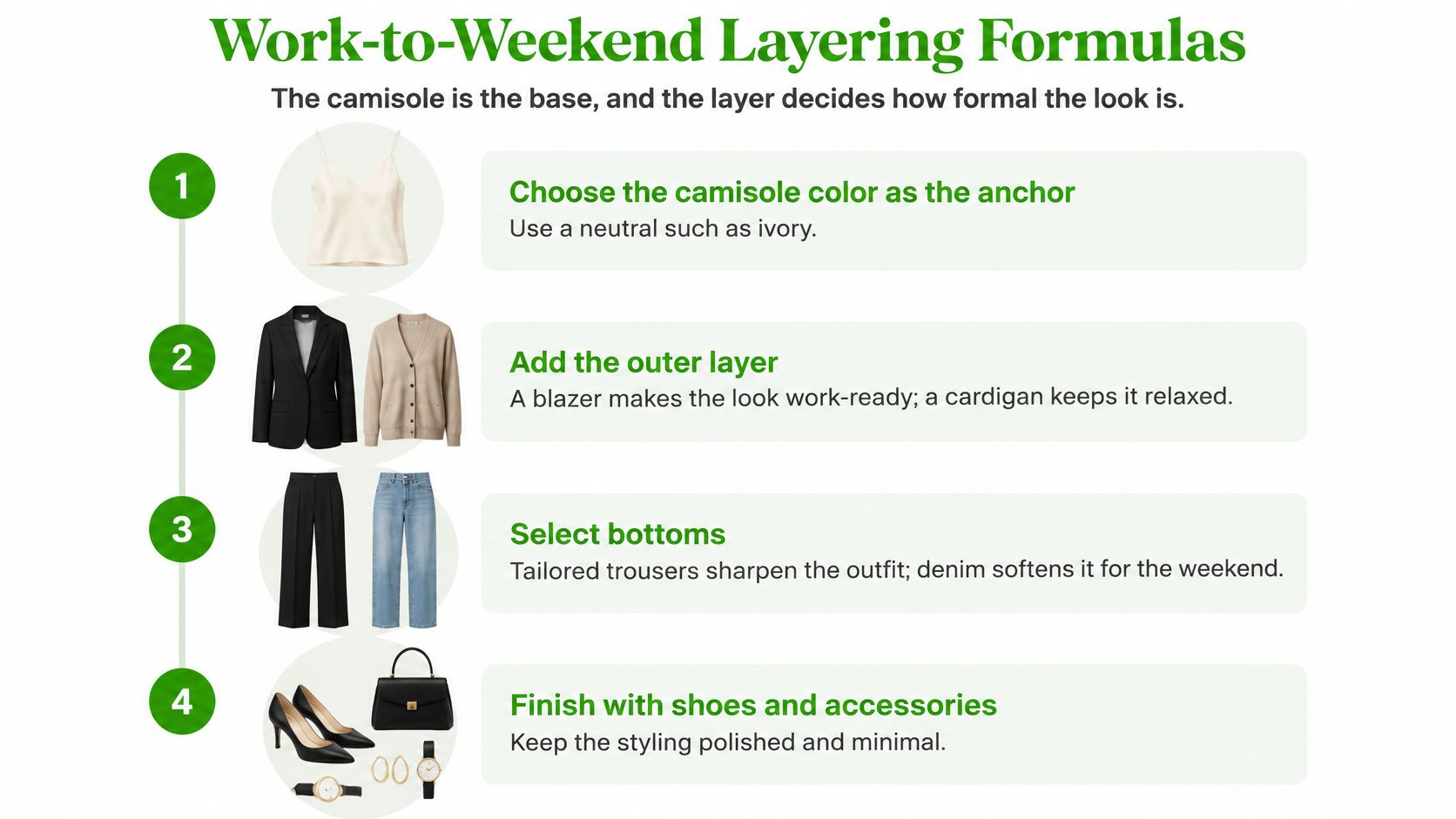
The visual below sets out the sequence for building an outfit without adding unnecessary pieces.
Layering formulas by occasion
| Occasion | Camisole | Layer | Bottom and shoes |
|---|---|---|---|
| Desk to dinner | Satin camisole in a neutral | Structured blazer | Wide-leg trousers and block heels |
| Client lunch | Satin camisole in ivory or taupe | Fine cardigan or cropped jacket | Straight trousers and loafers |
| Evening out | Silk satin in a deeper tone | Fitted jacket or none | Midi skirt and strappy heels |
| Weekend brunch | Satin in a soft print or pastel | Denim jacket or knit | Jeans and sandals |
These are outfit directions rather than rigid dress codes. A client-facing workplace may call for the jacket to remain on, while a relaxed lunch allows a cardigan and flatter shoes. For evening, the camisole's neckline and the skirt's waistband should look intentional together without requiring constant adjustment.
Build the outfit from the inside out
- Choose the camisole color as the anchor. Ivory or taupe works well when the rest of the outfit already contains texture or pattern. A deeper shade can create a quieter evening combination than adding more embellishment.
- Add an outer layer with a clear purpose. A structured blazer suits the desk; a fine cardigan suits lunch. A denim jacket lowers the formality for a weekend outing. Oversized cuts need particular care around sleeve length and shoulder width, and Maxijournal's guide to oversized blazer outfits for petite frames offers a useful proportion-focused reference.
- Select bottoms that balance the hem. Wide-leg trousers work best when the waist remains legible through a tuck or shorter camisole length. A midi skirt needs a clean meeting point at the waistband. Leaving a long, loose top over a full skirt can obscure the shape of both pieces.
- Finish with shoes and restrained accessories. Block heels sharpen a desk-to-dinner outfit without requiring a complete change. Loafers keep lunch dressing grounded, while sandals suit brunch. Near the fabric itself, low-profile pieces are the safer call: stud earrings and a short pendant sit close to the skin, while chunky chains and heavy hardware can catch on a satin weave.
For a concrete silk starting point, Cedar & Lily Clothier lists the Cami NYC Diona Camisole, described as made from silk fabric. Its role in an outfit should still be judged through the available product details and the shopper's preferred neckline and proportions.
For office-specific combinations, the boutique's business-casual outfit ideas for women offer additional context. Before adding another top, a shopper can test an existing camisole beneath the layer worn most often. That identifies a real wardrobe gap rather than another attractive duplicate.
Caring for Satin Camisole Tops
The garment's care label takes precedence over general fabric advice. Fiber composition provides the starting point, but dyes, trims, linings, and construction can require a more restrictive method. A dry-clean-only instruction shouldn't be replaced with a generic recommendation to hand wash.
Care method by satin fiber
The methods below apply only when the garment label permits them.
| Fiber on label | Wash | Dry | Iron or steam |
|---|---|---|---|
| Silk satin | Cold hand wash, or delicate cycle in a mesh bag if permitted | Air dry flat, out of direct sun | Low heat, inside out or with a pressing cloth |
| Polyester satin | Cold gentle cycle in a mesh bag | Hang dry; tumble low only if permitted | Low setting, or steam if permitted |
| Rayon satin | Cold hand wash after checking the label | Air dry flat; don't wring | Low heat with a pressing cloth |
| Blends | Follow the garment label and protect the most delicate fiber | Air dry flat unless otherwise directed | Use the lowest permitted setting |
Cool water and minimal agitation are sensible defaults for washable satin. A mesh bag reduces contact with other garments, but it doesn't make an unsuitable machine cycle safe. After rinsing, gentle pressure between clean towels removes excess water without twisting the fabric.
For additional fiber-specific detail, SEYANTE's care tips for different satin fibers provide a useful companion to the garment label. Cedar & Lily Clothier's guide to caring for silk clothing addresses the additional attention silk pieces can require.
Prevent damage between washes
Satin's long floating yarns create its smooth surface but also leave threads exposed to catching, as Sensoire's satin construction guide explains. Rings, sharp bag hardware, rough furniture, and broken fingernails deserve care around the fabric.
Inspection under strong light helps reveal pulled threads around the neckline, underarms, side seams, and hem. A pulled thread shouldn't be cut. If it can be moved without tension, a blunt needle can gently guide it toward the wrong side; a prominent snag is better left to a garment-care professional.
- Store without abrasion: Padded hangers suit garments that won't stretch under their own weight. Delicate bias-cut pieces may be better folded with tissue.
- Separate sharp fasteners: Keep exposed zips and hook-and-loop closures away from the fabric.
- Reduce unnecessary laundering: Polyester can shed microfibers during washing. A microfiber-catching laundry bag serves a different purpose from an ordinary protective mesh bag.
Care reminder: For washable pieces, the dependable routine is label check, cold gentle washing, and flat drying. Heat and wringing aren't shortcuts.
Find Your Satin Camisole in Tulsa or Jenks
The fiber determines much of a camisole's comfort and care, while the fit determines how cleanly the finished outfit sits. A worthwhile purchase works with the shopper's real schedule and existing layers, not just an imagined occasion.
Cedar & Lily Clothier is a women's clothing boutique with two Oklahoma storefronts, at Utica Square in Tulsa and in Jenks, plus an online store. Its curated selection includes designer labels such as LoveShackFancy, Alice & Olivia, Spanx, FRAME, Paige, and rag & bone, among others.
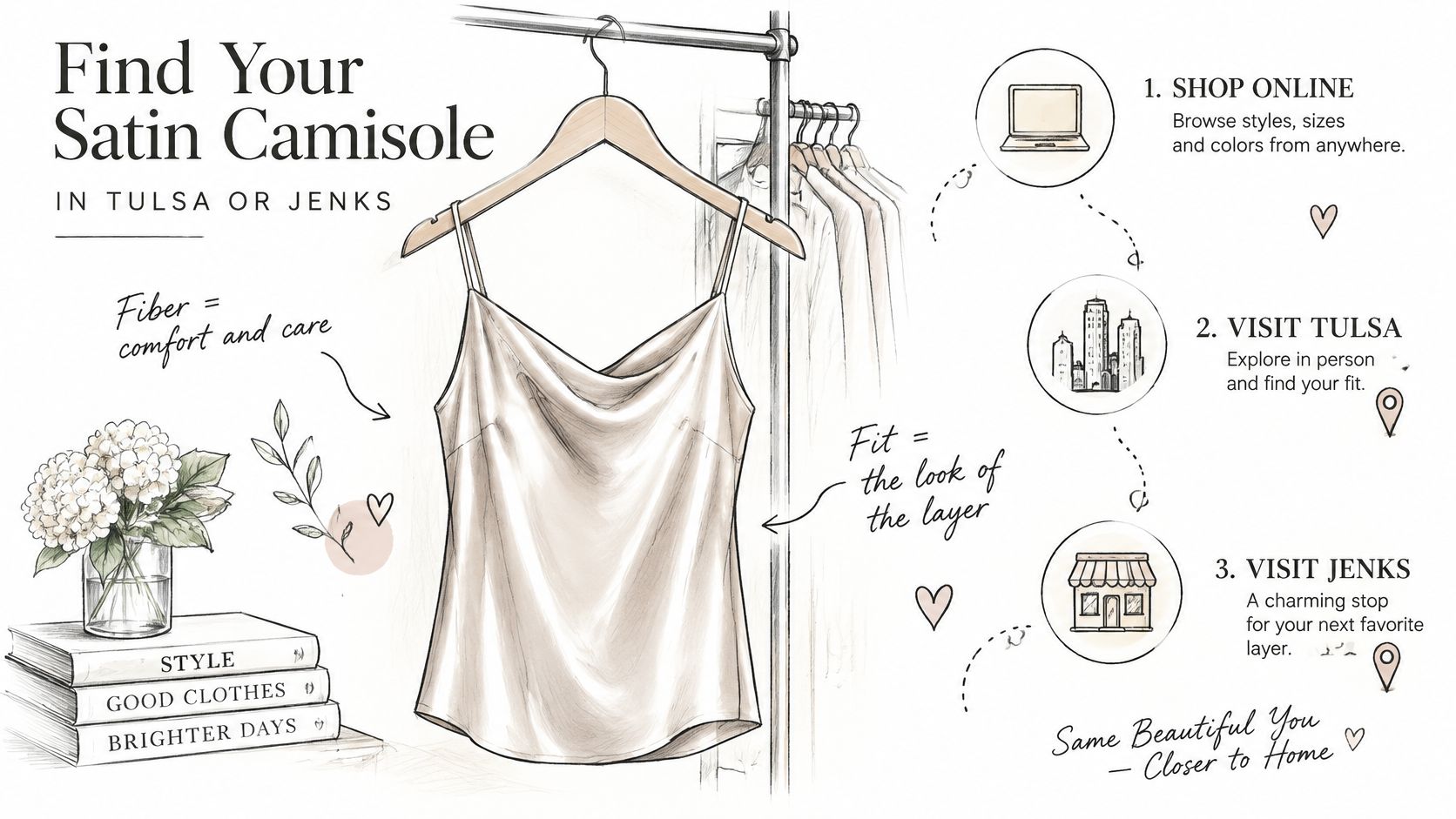
The shopping illustration below brings the practical choices together.
Choose the shopping route that resolves the uncertainty
For a shopper who already knows the preferred shape and size, online browsing can begin with composition and measurements. Product descriptions should answer the material question before an item reaches the cart. If a description doesn't resolve a concern about fabric or care, reaching out to Cedar & Lily Clothier is more useful than guessing from a photograph.
An in-person visit is particularly valuable when the uncertainty involves drape, coverage, or neckline placement. At Utica Square or the Jenks storefront, shoppers can see the fabric in daylight and get styling help from the team. The boutique's Utica Square shopping guide offers local context for planning a Tulsa visit.
Bringing the intended blazer or cardigan makes the appointment more productive. The team can assess whether the neckline remains visible, whether the jacket closes comfortably, and whether the camisole hem works with the outfit. Those details are harder to settle from separate product photographs.
- For a work wardrobe: Bring the jacket worn most frequently and the usual work bra.
- For an occasion: Bring the skirt or trousers already chosen, plus any undergarments that affect fit.
- For an everyday refresh: Identify the missing role, such as a lighter neckline under knitwear, before choosing another color.
Buy with a clear purpose
Cedar & Lily Clothier is an authorized retailer of the designer brands it carries. All merchandise is authentic and purchased directly through the brands and their authorized representatives. That gives shoppers a clear account of where the merchandise comes from, without substituting brand recognition for a personal fit check.
Online orders of $250 or more qualify for free shipping. The threshold is useful when planning a purchase, but it shouldn't encourage adding an unnecessary piece just to reach it.
Give the stylist three specifics at the start: the occasion, the jacket the camisole will sit under, and how much upkeep the fabric can realistically get. A shopper who hand washes willingly has different options than one who needs machine-friendly polyester. That narrows the decision quickly: which camisole completes the outfit comfortably, and which should stay on the hanger?
Cedar & Lily Clothier offers curated camisoles and coordinating tops, blazers, jackets, and cardigans, with personal help choosing the right proportions. Visit Cedar & Lily Clothier to shop online, or bring a favorite layer to Utica Square in Tulsa or the Jenks storefront for help finding a satin camisole that fits the week ahead.