
The invitation has arrived, a satin maxi looks promising, and the venue photos show both a lawn ceremony and a ballroom reception. The question isn't just whether the dress looks elegant. It's whether the hem will survive the walk, the lining will feel comfortable through dinner, and the whole outfit will match the couple's expectations.
For a satin maxi dress wedding guest outfit, the strongest starting point is the invitation, followed by movement, temperature, and ground conditions. A beautiful dress that needs constant adjusting isn't the right purchase, however good it looks standing still.
Table of Contents
- Which Dress Codes a Satin Maxi Suits
- Choosing Color and Fabric Weight for the Season
- Shoes, Accessories and Hair That Match the Event
- How to Check Fit Before You Buy a Satin Maxi
- Fixing Cling, Drag and Visible Lines on the Day
- Try On Your Satin Maxi in Tulsa or Jenks
Which Dress Codes a Satin Maxi Suits
A maxi isn't automatically right for every wedding. A satin maxi suits black tie, black-tie optional, and most formal evening weddings, but a glossy, floor-sweeping version usually reads as overdressed at a casual ceremony or daytime garden celebration.
Length alone doesn't establish the dress code. A relaxed maxi and a structured evening gown can share a hemline while making very different impressions. The Knot's formal-attire guide distinguishes floor-length black-tie dressing from the greater flexibility of formal attire, including ankle-length dresses and dressy separates.
Dress code, length and finish for a satin maxi
| Invitation wording | Length that works | Satin finish to choose | Watch for |
|---|---|---|---|
| Black tie | Floor-length gown | Full-sheen satin with structured bodice | Train length and drag on hard floors |
| Black tie optional | Floor or ankle length | Full sheen or softer drape | Overdressed for a daytime event |
| Formal | Floor or ankle length; dressy separates also work | Satin in a structured silhouette | Hem length against the heel height worn |
| Cocktail | Midi or shorter | Satin in a shorter silhouette | A full-length maxi may look overdressed |
| Semiformal | Midi, or a maxi in restrained color | Matte or softer satin | Accessories decide the formality |
| Daytime or garden, no code stated | Ankle length in lightweight satin | Brushed or matte satin | Hem catching on grass and uneven ground |
These are shopping filters, not permission to override the invitation. The daytime option is a restrained fallback, not a reason to assume every garden wedding welcomes a maxi.
Screen the event before choosing the dress
- Read the complete invitation. Include the wedding website's cultural, religious, and venue instructions.
- Identify the formality. Black tie, formal, cocktail, and semiformal call for different levels of structure and polish.
- Match length and finish. Reserve sweeping hems and pronounced sheen for events that support eveningwear.
- Remove distracting choices. Bridal-looking details, excessive embellishment, and revealing cuts can conflict with the setting.
- Finish deliberately. Jewelry, shoes, and a bag should support the chosen formality rather than attempt to rescue an unsuitable dress.
Jovani's wedding-guest guidance supports matching the outfit to the stated code, venue expectations, and practical comfort. A floor-length satin dress can work beautifully in an evening ballroom yet need a shawl for the church ceremony beforehand.
For unclear wording, Cedar & Lily Clothier's event dress-code guide offers a useful starting point. When uncertainty remains, the host can clarify the intended level of dress.
Shopping rule: Maxi describes length. It doesn't guarantee formality or suitability.
Choosing Color and Fabric Weight for the Season
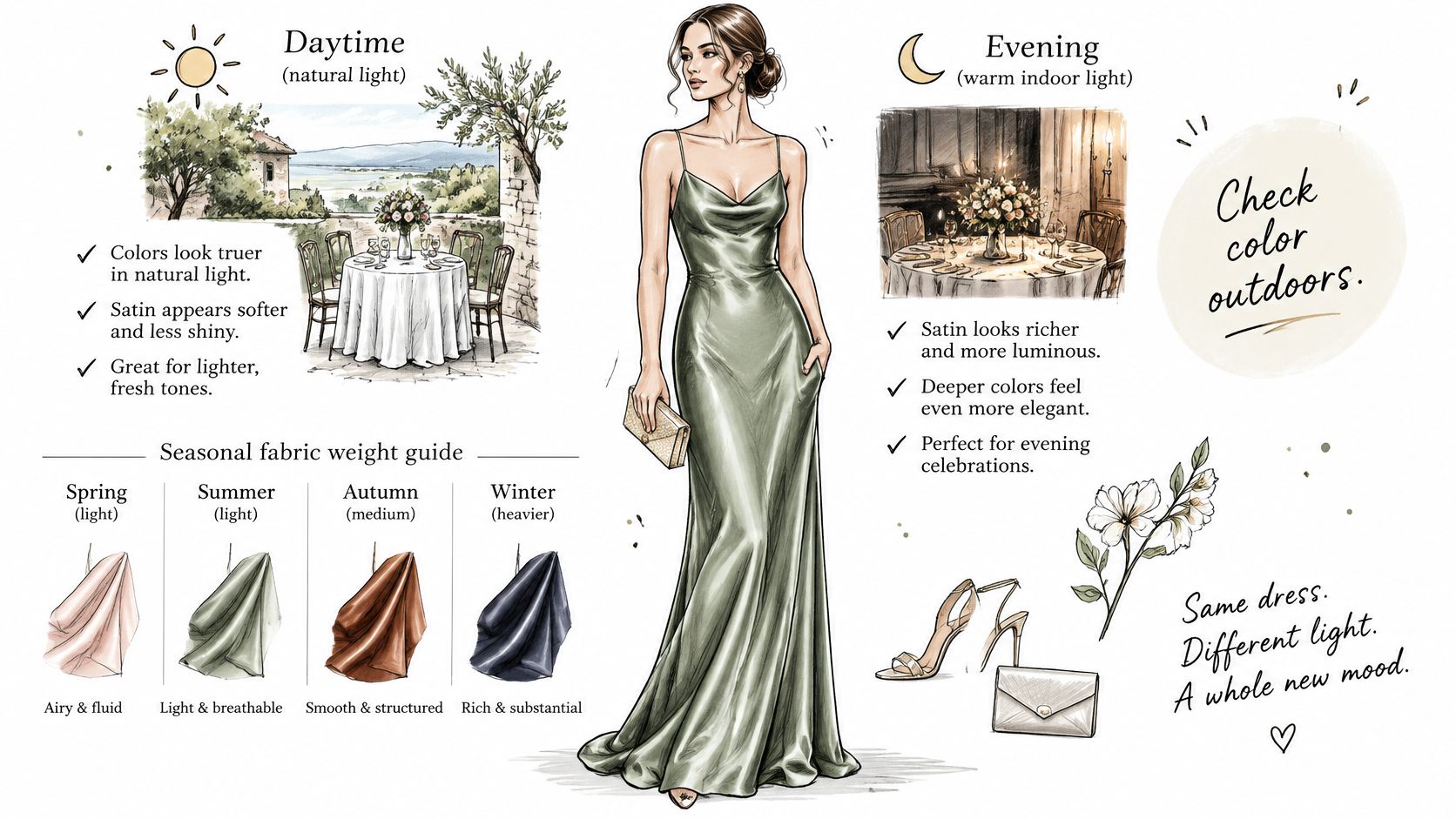
A pale satin that looks softly muted indoors can appear much brighter outside. Before committing, the shopper should view the fabric near a window and, where possible, in outdoor light, paying attention to both the color and how strongly it reflects light.
The distinction matters when a ceremony starts outdoors and finishes under warm reception lighting. The illustration shows why a shade shouldn't be judged under a single light source.
Fabric weight and color by wedding setting
| Setting | Fabric weight and layers | Colors that work |
|---|---|---|
| Late April to June, outdoor | Lightweight, breathable satin; a light wrap for evening | Pastels, mid-tones and jewel tones |
| July and August, Oklahoma heat often above 100°F | Lightest satin, minimal lining, flats or block heels | Light neutrals and soft mid-tones; avoid white |
| September to October, outdoor | Mid-weight satin; blazer or wrap after sunset | Deep jewel tones, navy and burgundy |
| Indoor evening, ballroom or hotel | Heavier, structured satin | Black, navy, deep jewel tones |
| Late fall or winter | Mid-to-heavy satin with long sleeves or a wrap | Deep navy, wine and forest green |
For the Oklahoma timing and heat conditions in this table, Oklahoma venue guidance identifies late April through June and September through October as favorable outdoor-wedding windows and notes that July and August in central and western Oklahoma can regularly exceed 100°F. The same guidance flags spring's severe-thunderstorm and tornado risk, making an indoor weather backup important for lawn ceremonies.
Choose construction before color
Lightweight outer fabric won't solve overheating if the dress has a heavy lining. The useful comparison is the complete garment: outer fabric, lining, sleeve coverage, and space for air to circulate. Minimal lining should still provide sufficient opacity and support.
For a summer garden setting, a soft mid-tone offers color without the bridal ambiguity of ivory or champagne. White and near-white shades should be excluded unless the couple explicitly sets that palette. Deep navy or wine suits a fall ceremony, while emerald or another jewel tone gives an evening ballroom outfit richness without extra embellishment.
Black isn't a universal yes or no. Venue, time, season, and the couple's preferences should settle the question; a host can clarify when needed.
Cedar & Lily Clothier's guide to finding flattering colors can help narrow the palette. The final test remains practical: would this color and fabric weight still look right at the actual venue, at the event's scheduled time?
Shoes, Accessories and Hair That Match the Event
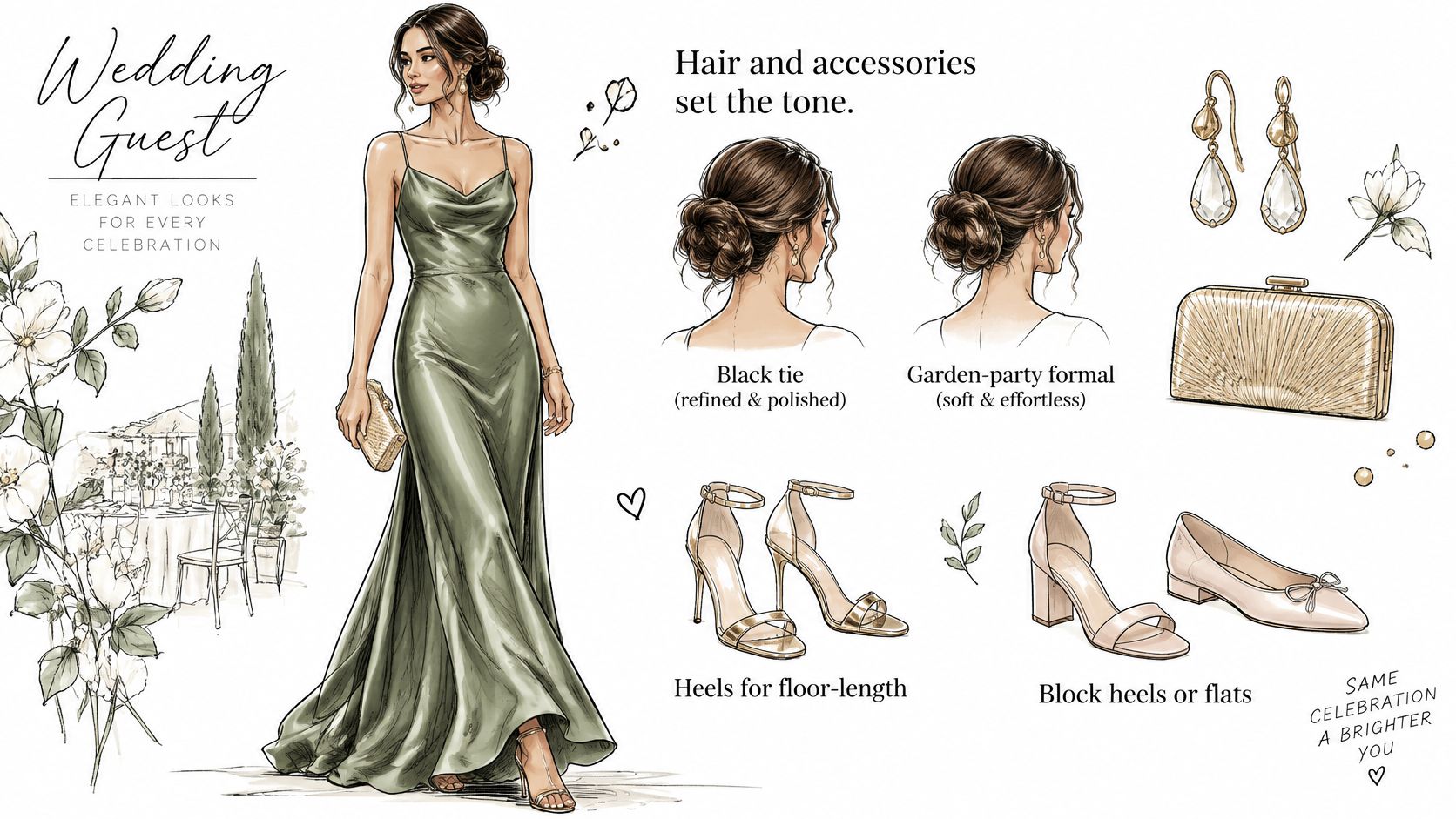
The same long silhouette can look appropriate for a ballroom or a garden party with different finishing pieces. Shoes come first because they affect walking and hem clearance; jewelry and hair follow once the outfit works on the ground.
These combinations illustrate proportion and balance rather than a requirement to buy a complete new set of accessories.
For an evening ballroom
A floor-length dress works with heels on a smooth, stable surface, provided the skirt clears the floor during a normal stride. A compact clutch and polished metal or gemstone jewelry add definition without covering the neckline.
The Devlyn Halter Maxi Dress offers a shoulder-framing halter neckline and flowing maxi length, making its silhouette relevant to evening-wedding shopping. Its supplied description doesn't establish a satin composition or exact floor clearance, so those details need confirmation before treating it as a satin gown.
With a halter neckline, earrings usually make more sense than a competing necklace. A sleek updo leaves the shoulders visible, while defined waves create a softer finish. For anyone considering a salon gloss ahead of the event, hair gloss insights from Boost Beauty Lounge provide background for that conversation.
For a lawn ceremony
The Derby Maxi Dress is described as floor-length, with flowing fabric and a relaxed fit, and is positioned for weddings and garden parties with heels or flats. Satin isn't confirmed in that description, so it belongs on a silhouette shortlist rather than being assumed to meet a satin-specific requirement.
For a lawn setting, the practical combination is a suitable maxi, dressy flats or broad block heels, a neutral clutch, and a light wrap. The dress must be fitted to that footwear; changing into flats later can leave an otherwise correct hem dragging.
- Religious ceremony: A shawl should stay in place without constant gripping.
- Daytime reception: Smaller jewelry keeps the outfit restrained.
- Photographs: A matte or satin-finish makeup base helps avoid excess shine; a defined lip or eye provides a single focal point.
Cedar & Lily Clothier's maxi-dress shoe guide offers further pairing guidance. Accessory weight should match the event's formality, not just the shine of the fabric.
How to Check Fit Before You Buy a Satin Maxi
Sizing by the tag fails because body proportions don't necessarily align with a single size category. Smooth satin makes that mismatch especially noticeable through pulling, displaced seams, and horizontal tension lines.
In a body-shape study published in Scientific Reports, only 9.15% of participants were consistent across bust, waist, and hip size categories, and 35.45% were not adequately accommodated by the existing sizing system. Those findings support measuring first rather than assuming a familiar label size will work.
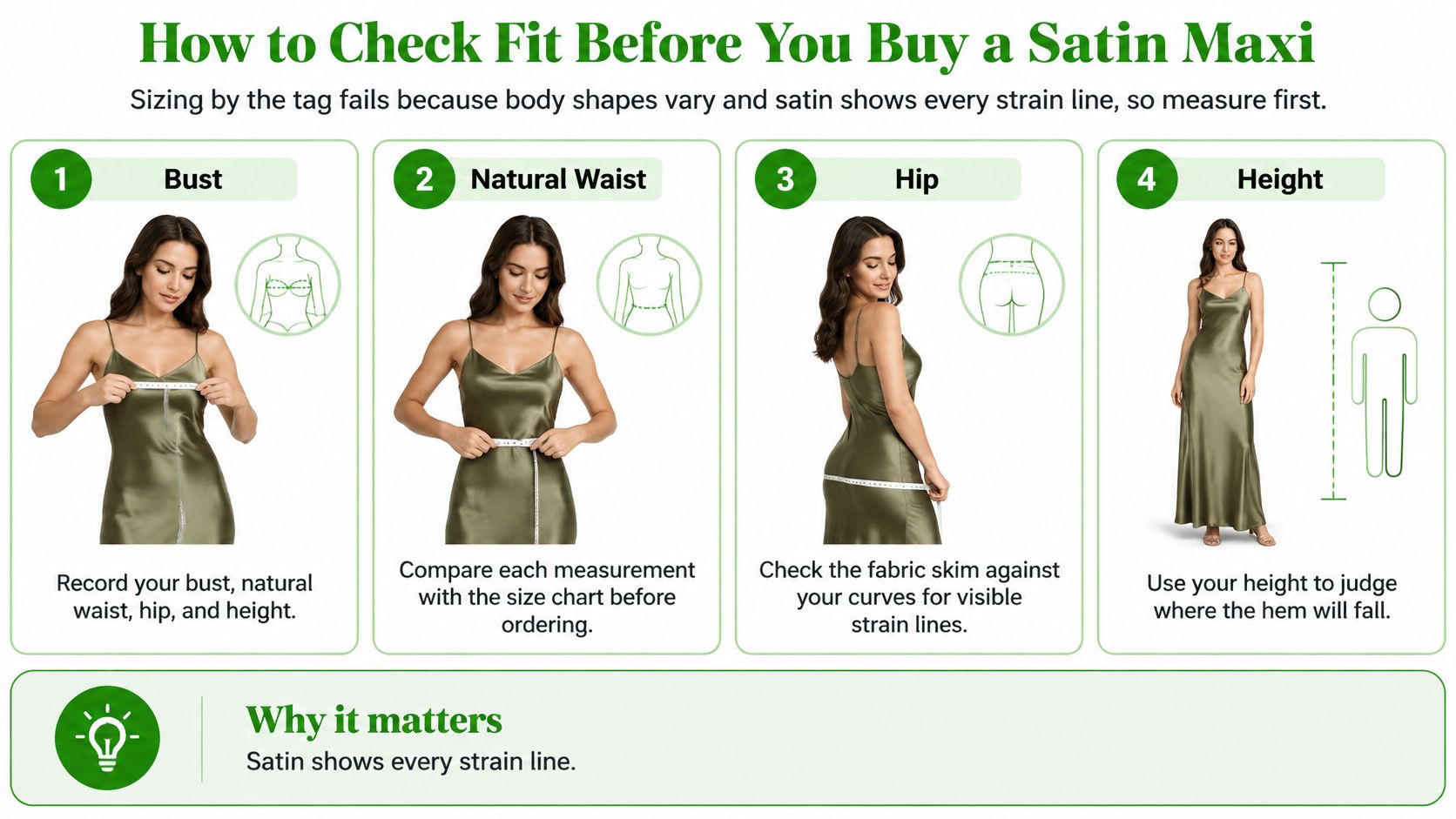
Measure, compare, then move
- Record bust, natural waist, hip, and height. A flexible tape should sit level without compressing the body; measurements taken over bulky clothing won't give a useful starting point.
- Identify the chart type. Compare measurements with the garment's finished-measurement chart where available, while keeping body-size charts separate because they describe different things.
- Find the largest mismatch. The most restrictive area may be the hip even when the bust matches the expected size.
- Choose room where it matters. A closely fitted dress shouldn't rely on pulling or overstretched seams to accommodate the body.
- Check the hem in the intended shoes. Height alone can't account for torso proportions, heel height, or the way the dress hangs.
A finished garment needs appropriate wearing ease, so equality between body and garment measurements isn't automatically a good fit. Bias-cut fabric also needs assessment on the body rather than a decision based solely on flat measurements.
Use a full movement test
Before removing tags, the wearer should sit, walk, raise both arms, climb stairs, and make a few dance movements. The bodice shouldn't require repeated pulling into place, and a slit should remain comfortable when seated.
Torso length deserves separate attention. A waist seam that sits too high or low can distort the entire silhouette even when the circumference measurements look suitable. Equally, a larger size won't necessarily correct an incorrectly positioned bust or an unsuitable neckline.
Cedar & Lily Clothier's women's tailoring guide can help distinguish an alteration opportunity from an unsuitable cut. At Utica Square in Tulsa or downtown Jenks, the team can help assess measurements, consult available sizing information, and judge the garment on the wearer.
A successful fit has clean side seams, no horizontal stress wrinkles across the bust or hips, and comfortable sitting and walking without adjustment.
Fixing Cling, Drag and Visible Lines on the Day
Cling around the legs, a hem that catches on grass, and visible lines under smooth fabric are problems to fix before reaching for more jewelry or a different bag. The fastest solution starts with identifying the cause: static, undergarments, shoe height, or actual fit.
The sheen on satin comes from long floats in the weave, so fiber content changes care and handling more than the look itself. Satin Universe's fabric-care reference notes that the same smooth surface can catch and snag more easily than a matte weave, which matters on wooden chairs, jewelry, and dried ground.
Satin maxi problems, causes and fixes
| Symptom | Likely cause | Fix |
|---|---|---|
| Clinging to hips or legs | Static from synthetic satin in dry air | Light lining or slip; suitable anti-static spray used sparingly after a hidden-area test |
| Hem drags on grass | Hem set for heels, or a long train | Stable block heels of suitable height; hold the hem for the walk; flats only if the hem clears |
| Visible bra or underwear lines | Smooth satin reveals edges | Smooth-cut, no-edge briefs or a thin slip in a nude that matches your skin tone; an appropriate backless or strapless bra |
| Wrinkles at bust or hip | Folded storage or restricted fit | Gently press storage creases if permitted; reassess the size or underlayer when wrinkles are tension lines |
| Too warm outdoors | Heavy lining or non-breathable construction | A lighter removable slip, less restrictive sleeves, shade, and earlier outdoor photos where practical |
Treat the cause without damaging the fabric
Silk satin generally needs gentle washing and shouldn't be wrung. Polyester satin tolerates more, though excessive heat can still damage it. The sewn-in label takes priority, including when it specifies professional cleaning rather than washing.
Where ironing is permitted, use low heat, work inside out, and place a pressing cloth between the iron and the garment. Heat and pressure will not release wrinkles caused by a tight fit, and repeated ironing only risks the fabric while the underlying tension stays.
For travel, hang the dress on arrival rather than leaving it folded in a bag. Steam only when the care instructions permit it.
Show-through is really two separate problems. A nude tone close to the skin keeps the color of undergarments from reading through, while smooth, edge-free construction stops raised seams from printing under the fabric. Heavy shapewear adds warmth, so a light slip is the better trade when support isn't the goal; Cedar & Lily Clothier's guide to dressing sheer fabrics covers related layering and coverage choices.
If a quick adjustment doesn't work, reassess the shoe or arrange a proper hem correction before abandoning the dress. An unstable heel or improvised pinned hem isn't a worthwhile trade-off.
Try On Your Satin Maxi in Tulsa or Jenks
The right dress is the one that matches the invitation and stays comfortable through the ceremony, dinner and dancing. Venue and dress code decide whether a satin maxi belongs at all; the try-on decides whether a specific one earns the spot.
There are two Oklahoma storefronts, at Utica Square in Tulsa and in downtown Jenks, alongside an online store. The racks carry curated designer and contemporary labels such as LoveShackFancy, Misa, Favorite Daughter and Lace the Label, rather than a house line, so one length filter can surface very different fabrics and constructions.
Browse with a clear shortlist
Dresses are offered in Mini, Midi, and Maxi lengths, which makes length a practical first filter. Brand names narrow the search, but each listing still deserves a fabric check, since a label's satin pieces usually sit next to crepe, knit and cotton styles.
For a confirmed satin option, the Anabella Dress is a 100% poly satin maxi with a thigh-high slit, sleeveless bodice, contrast printed button placket, and wide self-tie belt over an elasticated waist. The slit and elasticated waist are the details to test in motion, since they decide how the skirt behaves when you sit, climb a step or dance.
Make the fitting useful
- Explain comfort priorities. Bust support, coverage, heat sensitivity and freedom to dance narrow the options faster than color.
- Move through the event. Sit, reach and walk the floor so cling, slit behavior and strap slip show up in the dressing room instead of at the reception.
- Ask about local availability. An associate can confirm what each store has on the rack before you make the trip.
Cedar & Lily Clothier offers free shipping on orders of $250 or more for online purchases, and both storefronts let you judge sheen and drape in person rather than from a screen. The online assortment gives you a head start for browsing by length, then the visit covers what a product photo cannot: hem height, lining behavior and how the fabric moves against you.
Cedar & Lily Clothier carries occasion dresses and offers personal styling help for wedding guests balancing dress code, fit and comfort. Visit Cedar & Lily Clothier to shop online, or stop into Utica Square in Tulsa or downtown Jenks for a fitting that checks movement, coverage and length under real conditions.