


Have you ever put on an outfit and just felt… amazing? The compliments roll in, you feel a little spring in your step, and everything just clicks. Then the next day, you wear something else—maybe even a trendier or more expensive piece—and it just feels off.
The secret isn't about the price tag or what's currently trending. It’s all about color. Specifically, it’s about finding the colors that work in harmony with your unique combination of skin, hair, and eyes.
This is your personal guide to figuring that out, once and for all. We’re going to walk through the real-world methods of color analysis so you can finally crack the code. Imagine confidently grabbing a blazer or a special occasion dress, knowing it’s not just a beautiful piece, but that it makes you look absolutely radiant. This is the first, most crucial step in building a wardrobe that feels authentically you, a topic we dive into deeper in our guide on how to find your personal style.
The Power of a Personal Palette
Color analysis has been around for a while, but it's making a huge comeback. What started as a niche styling theory in the 1980s, categorizing people into Spring, Summer, Autumn, and Winter palettes, has become a modern must-know, thanks to social media and a renewed interest in personal style.
It's fascinating stuff. Modern analysts have found that about 70% of women have cool undertones, placing them in the Summer or Winter families. What does that mean for you when you're shopping for that perfect dress? One analysis showed that understanding your palette leads to up to 72% better trend-matching.
Think about slipping into a stunning Favorite Daughter midi dress in a rich, warm terracotta. If you're an Autumn, that color will make you glow. It's no surprise that sales data shows these kinds of personalized choices boost confidence and can even increase repeat purchases by as much as 40%. You can learn more about how to figure out what colors look good on you and see how this classic concept is being reinvented.
The goal is simple: wear colors that enhance your natural beauty, rather than compete with it. When you get it right, the effect is immediate—you look healthier, more vibrant, and effortlessly put-together.
This isn’t about restricting your wardrobe. It’s about being smarter and more intentional with your choices. When you know your best hues, you can build a closet where everything works together beautifully, making shopping easier and getting dressed a joy every single day.
So, What Colors Actually Look Good on You? Let's Find Your Undertone
First things first: let's figure out your skin's undertone. This is the absolute key to unlocking the colors that will make you shine. It’s not about how light or dark your skin is—that’s your surface tone, which can change with a tan. Your undertone is the permanent, subtle color just beneath the surface. Think of it as your skin’s built-in color filter.
Getting this right is a huge deal. Your undertone—which is generally 40% warm, 50% cool, and 10% neutral across the population—is responsible for about 80% of what makes a color flattering on you. It's a surprisingly simple concept that completely changes how you shop, and you can see more about how color analysis statistics impact fashion choices to understand why it works so well.
The Old-School Vein Test
This is one of the quickest and most reliable tricks in the book. Just find some good, natural light and take a peek at the veins on the inside of your wrist. The color you see is a major clue.
-
Greenish Veins: If your veins have a green tint, you likely have a warm undertone. It’s not that your veins are actually green! The natural yellow in your skin is just layering over the blue of your veins, creating that effect.
-
Bluish or Purple Veins: Seeing mostly blue or even purple? That points straight to a cool undertone. Your skin has subtle hints of pink, red, or blue.
-
A Bit of Both? If you're looking at your wrist and thinking, "I honestly can't tell," you might be seeing a mix of blue and green. This is a classic sign of a neutral undertone.
How Does Your Skin Handle the Sun?
Think back to your last beach day (and I hope you were wearing sunscreen!). How your skin reacts to the sun can tell you a lot about its underlying tone. This isn't about getting a sunburn, but more about your skin's natural go-to response.
People with warm undertones often find they tan pretty easily, usually turning a lovely golden-brown. On the other hand, if you have a cool undertone, you might feel like you go from pale to pink in a heartbeat, and tanning is a slow, difficult process, if it happens at all.
Pro Tip: Don't just rely on one of these tests. Try all three and look for a pattern. When the vein test, the sun test, and the jewelry test all point to the same conclusion, you’ve found your answer.
The Ultimate Tie-Breaker: The Jewelry Test
This is a favorite for a reason—it gives you instant visual proof. Go into your jewelry box and pull out something silver and something gold. It doesn't matter if they're real or costume; we're just looking at the color.
Now, hold each piece up to your face, preferably near a window with natural daylight. Pay attention to how each metal affects your complexion. Does one make you look a little more alive?
- If gold gives your skin a vibrant, healthy glow, you’re almost certainly in the warm family.
- If silver makes you look brighter and more awake, you probably have a cool undertone.
- And if you’re looking in the mirror thinking both look great? You’ve hit the jackpot with a neutral undertone, which means you can pull off either one effortlessly.
Finding Your Personal Season
Okay, so you’ve figured out your undertone. Now for the fun part: discovering your personal "season." This is a fantastic framework that links your overall coloring—skin, hair, and eyes—to a whole palette of shades that will make you shine. Think of it as taking the general "what colors look best on me?" question and getting a personalized, specific answer.
The four seasons—Winter, Spring, Summer, and Autumn—are split by undertone and intensity.
Two of the seasons, Winter and Summer, fall into the cool category. The other two, Spring and Autumn, are warm. So what’s the difference between the two cool seasons or the two warm ones? It all comes down to saturation. For example, someone with cool undertones who is a Winter will look absolutely striking in bold, crisp colors, while a cool-toned Summer glows in softer, more muted shades.
If you're still on the fence about your undertone, this little guide can help lock it in. It’s the essential first step before you can find your season.
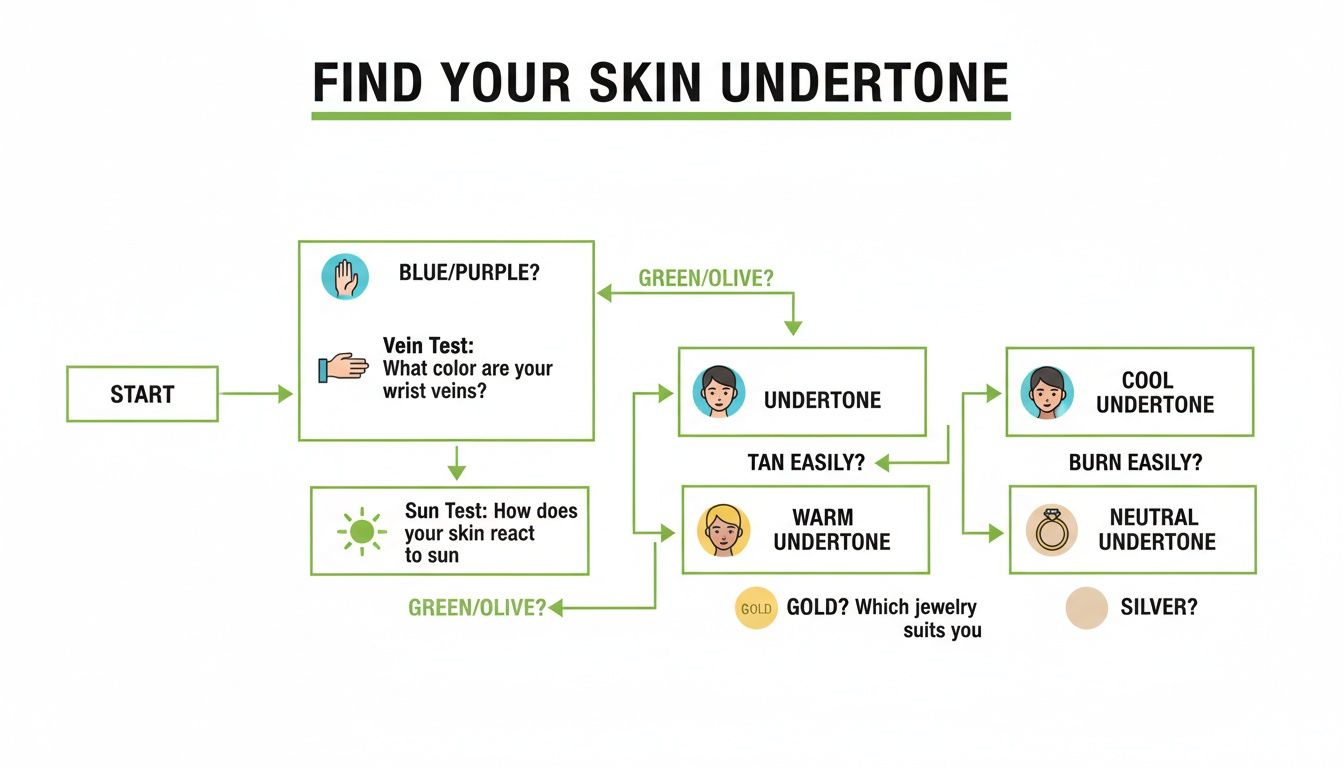
Just follow the chart through the vein, sun, and jewelry tests, and you'll have the foundation you need to build your perfect color palette.
The Four Seasons Explained
Let's dive into the characteristics that define each seasonal palette. While your skin's undertone is the main guide, your natural hair and eye color really help narrow it down. And don't worry if you feel like you don't fit perfectly into one box—it’s very common to have traits from a neighboring season. Just go with the description that feels the most like you.
-
Spring (Warm): You have that warm, golden glow. Your hair probably has natural golden or reddish highlights, anywhere from strawberry blonde to a warm medium brown. Your eyes are often clear shades of blue, green, hazel, or light brown. Springs look incredible in clear, bright, warm colors.
-
Summer (Cool): Your skin has a lovely cool, rosy undertone, and there isn't a lot of high contrast between your hair and skin. Your hair is often ashy—from light blonde to medium brown—without those warm, golden glints. Your eyes might be blue, gray-blue, cool green, or a soft slate color. Summers just come alive in soft, muted, and cool-toned pastels.
Your season isn't just a label; it's a curated library of colors guaranteed to make you look vibrant and healthy. It simplifies shopping and gives you a reliable starting point for building outfits that feel effortlessly right.
The Richer Palettes of Autumn and Winter
While Spring and Summer palettes tend to be on the lighter side, Autumn and Winter are all about depth, richness, and clarity.
-
Autumn (Warm): You have a warm, golden undertone and a rich, earthy overall look. Your hair is typically a warm shade from mid-brown to black or a beautiful medium to deep red. Often, there’s a low-contrast harmony between your skin, hair, and eyes, which can be any shade. Autumns thrive in deep, warm, earthy tones.
-
Winter (Cool): You most likely have a cool or even olive undertone with a noticeable, high contrast between your skin, hair, and eyes. Your hair is typically an ashy mid-brown to a deep, true black. Your eyes can be anything from deep brown to a piercingly clear blue or cool green. Winters are showstoppers in clear, deep, and cool jewel tones.
Once you know your primary season, you can start exploring its color palette. This knowledge is your secret weapon for everything from picking out a statement dress at Cedar & Lily to grabbing an everyday top that instantly brings out your best features.
Understanding Your Natural Contrast Level
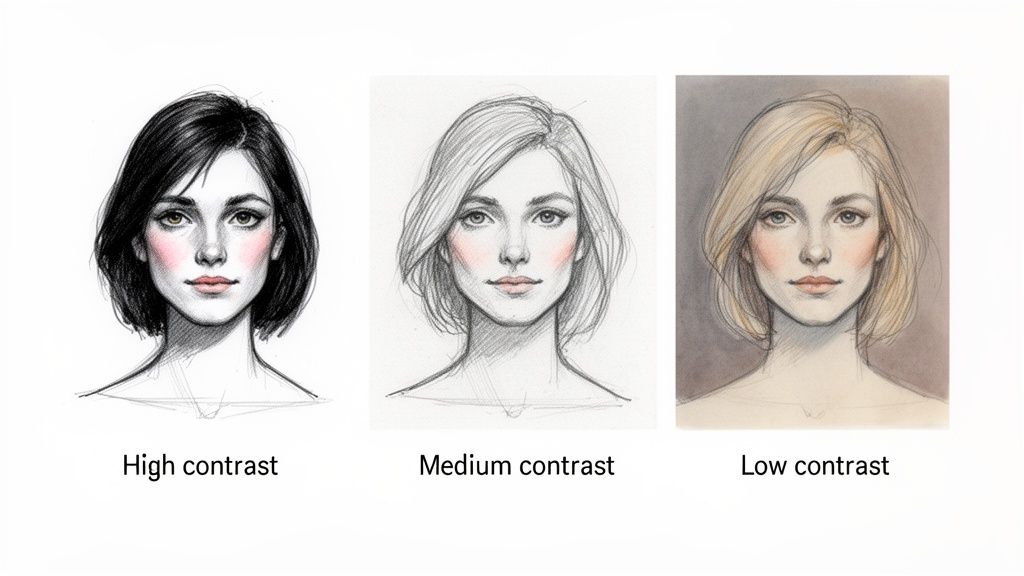
Alright, beyond your undertone and your season, there's one last piece of the puzzle that truly pulls your entire look together: your personal contrast level. It’s simply the degree of difference between your skin, hair, and eye color.
Getting this right is a total game-changer. It’s the secret to choosing prints and pairing colors in a way that feels effortlessly chic.
Think of it like this. Someone with very fair skin and jet-black hair has high contrast. On the flip side, a person with fair skin and light blonde hair has low contrast. Of course, there’s a whole beautiful range of medium contrast in between, where features blend more harmoniously without those stark differences.
How To Pinpoint Your Contrast Level
Ready for a simple trick? Just snap a quick picture of yourself in good, natural light. Now, pop open your phone's photo editor and convert it to grayscale or black and white. This little move strips away the distraction of color, letting you see the pure tonal values of your features.
Now, take a look at the black and white photo. What do you see?
- High Contrast: You'll notice dramatic differences between your features. Think almost-black hair against very light skin. The shades are at opposite ends of the gray scale.
- Low Contrast: Everything blends together softly. Your hair, skin, and eyes all appear as very similar shades of gray.
- Medium Contrast: You can see a definite difference between your features, but it isn't extreme. It’s a balanced, noticeable gradient.
Matching Your Contrast in Your Outfits
So, what do you do with this info? The goal is to echo your natural contrast level in the clothes you wear. When you do this, you create a balanced, cohesive look where you wear the clothes, not the other way around.
If you have high-contrast coloring, you were born to wear bold, graphic pairings. Black and white, navy and crisp white, or any combination with a strong light-and-dark dynamic will look absolutely incredible on you. These powerful combinations match your natural intensity. Imagine a sharply tailored blazer from L'AGENCE in a deep jewel tone over a bright white top—stunning.
On the other hand, if you have low contrast, you'll shine in monochromatic outfits or colors that are close in value. Soft, blended prints and tonal dressing—like pairing a cream top with camel trousers—create a sophisticated, harmonious effect that lets your natural beauty take center stage.
Key Takeaway: Matching the contrast level of your outfits to your personal coloring is one of the most powerful ways to look instantly put-together. It guarantees your clothing enhances your features instead of competing with them.
For those with medium contrast, you've got amazing versatility. You can confidently wear color combinations that have a noticeable difference in value, though you might want to steer clear of the most extreme pairings. Think charcoal gray with a soft blue, or a rich olive green with a classic ivory. You have the freedom to play with both softer and bolder looks to find what feels best.
Building a Wardrobe with Your Best Colors
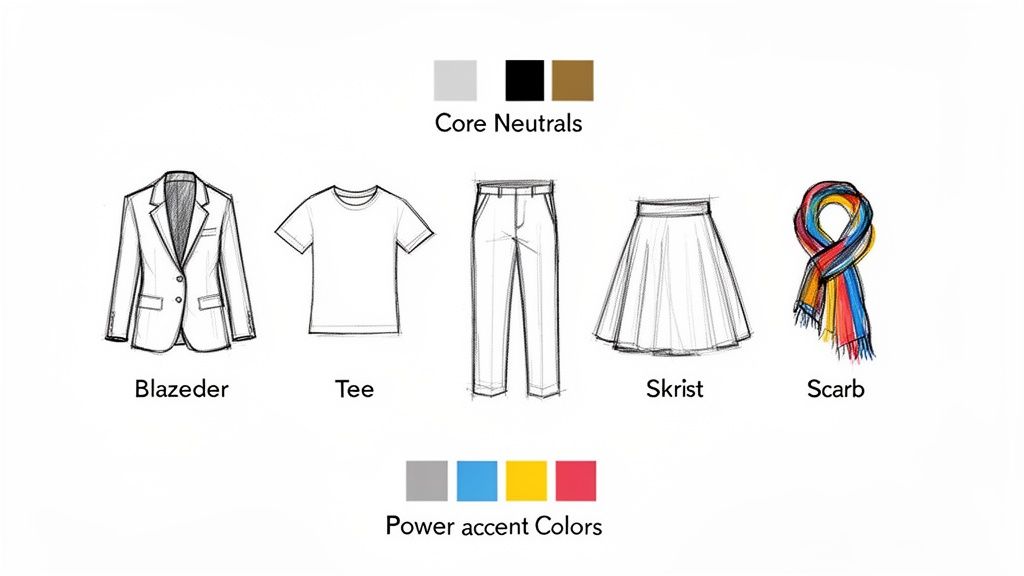
Okay, now for the best part. You've figured out your season and your contrast level, and it's time to put that knowledge to work in your closet. This isn't about a massive overhaul or getting rid of everything you own. It’s about being more intentional—shopping smarter and building a wardrobe that truly works for you.
The secret is to start with a solid base of your best neutrals. These are the workhorse shades that will become the backbone of your style—think trousers, blazers, and those essential tops you reach for again and again. Once you have that foundation, you can start weaving in your "power colors," those vibrant, eye-catching hues that make your outfits (and you!) come alive.
When you take this approach, you'll be amazed at how everything starts to coordinate so effortlessly. Getting dressed in the morning stops being a chore and becomes a creative, genuinely enjoyable part of your day.
Your Seasonal Shopping Blueprint
Every seasonal palette has its own signature set of neutrals and show-stopping accent colors. Knowing yours is like having a secret shopping weapon, whether you're hunting for a knockout dress for a gala or a simple, chic top for weekend brunch.
Here’s a quick guide to the colors you should be looking for:
- Spring Palette: Your foundation is built on warm, light neutrals like ivory, camel, and a soft warm gray. Bring in the energy with pops of coral, bright turquoise, and sunny yellow to play up your natural vibrancy.
- Summer Palette: Lean into soft, cool neutrals—think soft white, dove gray, and a lovely rose-beige. For your accents, go for muted pastels like lavender, blush pink, and powder blue for an effect that’s both serene and incredibly elegant.
- Autumn Palette: Your wardrobe starts with rich, warm neutrals like cream, chocolate brown, and deep olive green. Then, layer in those gorgeous, earthy statement colors: burnt orange, mustard yellow, and terracotta.
- Winter Palette: Go for crisp, high-contrast neutrals. Pure white, true black, and a classic navy are your go-tos. Then, bring the drama with bold, clear jewel tones. Emerald green, sapphire blue, and ruby red will look absolutely stunning on you.
A great way to think about it is that your neutrals are the canvas, and your power colors are the paint. A strong foundation of versatile neutrals lets your most flattering accent shades do the talking, giving you practically endless outfit combinations.
To make it even easier, we've put together a few ideas to get you started on your shopping list, no matter your season.
Curated Picks for Your Season
| Seasonal Palette | Best Neutrals | Statement Colors | Must-Have Style |
|---|---|---|---|
| Spring | Ivory, Camel, Light Gray | Coral, Turquoise, Sunny Yellow | A flowy, floral-print blouse that ties everything together. |
| Summer | Soft White, Dove Gray, Rose-Beige | Lavender, Blush Pink, Powder Blue | A classic trench coat in a soft stone or light blue color. |
| Autumn | Cream, Olive Green, Chocolate Brown | Burnt Orange, Mustard Yellow, Terracotta | A luxe cashmere sweater in a rich, earthy tone. |
| Winter | True Black, Pure White, Deep Navy | Emerald Green, Ruby Red, Sapphire Blue | A sharply tailored blazer in a bold jewel tone. |
Seeing it laid out like this really shows how each palette has a distinct personality, right? It’s all about finding the pieces that feel like you.
Building a Core Wardrobe
The ultimate goal is to curate a collection where every single piece makes you feel amazing. This is where having an intentional, focused wardrobe really pays off. When you choose items primarily from within your color palette, mixing and matching becomes second nature.
For instance, a "Winter" can confidently invest in a high-quality black blazer, knowing it will look incredible with a cobalt blue blouse or a fuchsia top. An "Autumn" can build countless outfits around an olive trench coat, knowing it complements everything from a simple cream sweater to a rust-colored dress.
This is the very essence of a functional, stress-free closet. If you want to dive deeper into this method, you should explore our guide on how to build a capsule wardrobe. It walks you through creating a minimalist collection that’s still packed with versatility.
And don't forget, your color palette goes beyond just your clothes! To really pull your entire look together, accessories are key. Learning how to pick glasses for your face shape can be just as important, ensuring every element works in harmony to create a confident, polished you.
Common Questions About Color Analysis
Diving into the world of color analysis is exciting, but it almost always brings up a few questions. As you start to see yourself through this new lens, it’s completely normal to hit a few spots where things feel a little fuzzy. Think of this as your personal FAQ for those moments of uncertainty.
What If I'm Stuck Between Two Seasons?
This is probably the most common question I hear, and for good reason! It’s incredibly rare for someone to fit perfectly into one seasonal box. You might be a Summer with slightly warmer highlights in your hair, or an Autumn with surprisingly cool-toned eyes.
If that sounds like you, don't sweat it. The best thing to do is figure out your dominant season and then feel free to borrow from its neighbor on the color wheel. For example, someone who is primarily a "Soft Summer" might find that some of the more muted, gentle shades from the "Soft Autumn" palette look just as stunning. The goal is to find what truly works for you, not to follow a rigid set of rules.
Does My Hair Color Change My Season?
This is another great question, especially for anyone who loves to experiment with their hair. If you dye your hair, does your entire color palette go out the window? The answer is a little bit of yes and a little bit of no.
Your core season is rooted in your skin's undertone, and that never changes. But, making a big change to your hair color—say, going from a soft, ashy brown to a vibrant copper red—will absolutely shift your overall contrast and warmth.
This often means you can start to pull in colors from a neighboring warm season with more success than before. The key is to simply re-evaluate how colors look against your face with your new hair. You might just discover that a few new shades suddenly click, even while your foundational palette stays the same.
Your seasonal palette is a powerful guide, not a strict set of rules. The ultimate goal is to wear what makes you feel confident and vibrant. Use your palette as a starting point and trust your eye to see what truly makes you glow.
But What If I Don't Like My Colors?
This happens! What if you discover you’re a classic Autumn, but you’ve spent your whole life loving cool, icy blues? The good news is you don’t have to purge your closet of every color you love.
There are a few simple ways to make it work:
- Find Your Version of the Color: Nearly every color has a warmer and cooler version. So instead of a pale, icy blue, an Autumn could look for a richer teal or a deep periwinkle that has more depth and warmth to it.
- Wear It Away From Your Face: If you truly love a color that’s not in your palette, just wear it on your bottom half! A skirt, a great pair of trousers, or even a handbag in that color won't clash with your complexion.
- Use Accessories as a Buffer: A scarf, a statement necklace, or a great pair of earrings in one of your best colors can create a flattering frame around your face, even if you’re wearing a less-than-ideal top.
At the end of the day, understanding your best colors is just one piece of the style puzzle. It works best when combined with dressing for your unique body shape. For more on that, take a look at our guide on how to dress for your body type.
At Cedar & Lily Clothier, we believe in the power of a well-curated wardrobe. Explore our collections to find beautiful pieces in every color palette, designed to make you look and feel your absolute best. https://cedarandlilyclothier.com