

A woman can stand in a boutique holding two jackets that look nearly identical on the rack, then notice that one costs substantially more. The difference isn't always visible at first glance. A luxury womens jacket earns its price through material, construction, and provenance, not through a fashionable label alone.
That makes the purchase less about chasing a seasonal shape and more about choosing a piece that works for the office, dinner, travel, and the occasions that matter. The right jacket should solve several wardrobe problems while continuing to look intentional after repeated wear.
Table of Contents
- What Makes a Womens Jacket Worth Calling Luxury
- Reading the Materials and Construction
- The Silhouettes Worth Owning
- Investment Piece or Trend Buy
- How to Style a Luxury Jacket for Work, Events, and Travel
- Caring for Premium Fabrics So They Last
- Choosing Your Next Jacket and Where to Find It
What Makes a Womens Jacket Worth Calling Luxury
The first distinction is the raw material. Full-grain leather has a natural surface and develops character, while bonded leather relies on leather fibers attached to a backing. Virgin wool generally offers a cleaner hand and more reliable structure than an acrylic-heavy blend. In insulated garments, the quality and sourcing of the fill matter as much as the shine of the outer shell.
The second distinction is construction. A well-made jacket has seams that sit correctly, hems that stay balanced, and a lining that allows the garment to move over a blouse or knit without pulling. Pattern matching, clean buttonholes, secure zippers, and a collar that rolls rather than collapses all reveal the maker's care.
The third is provenance. An established atelier brings cutting, fitting, and finishing knowledge that can't be added after a garment leaves the factory. A label with a clear history may also offer a more dependable path for alterations, repairs, or authentication.
Boutique rule: If a jacket looks impressive only while standing still on a hanger, it hasn't earned an investment price.
The three checks on the fitting room floor
A shopper can test the difference without knowing every technical term:
- Touch the fabric: Luxury materials usually have a distinct hand. Leather should feel supple or deliberately substantial, not plasticky. Wool should feel dense and resilient rather than limp.
- Move in the jacket: Raise the arms, sit down, and close the front. A good pattern accommodates movement without creating diagonal strain across the chest.
- Inspect the inside: The lining, seam finishing, pocket bags, and hardware should look considered. The interior shouldn't feel like an afterthought.
A useful companion to the buying process is this guide to quality womens clothing brands, particularly for shoppers building a wardrobe around fewer, more capable pieces.
The history supports that judgment. Women's jackets became recognized luxury fashion items during the 1920s, when glamorous outerwear was available in premium and more accessible fabrics and silhouettes, according to historical coverage of the women's outerwear market. The jacket had moved beyond utility and become a visible style statement.
Today, women's luxury outerwear remains a substantial part of the category. One estimate places women's luxury outerwear at USD 11.19 billion in 2025, or 60% of the total luxury outerwear market, while reporting that more than 55% of luxury outerwear purchases are made by female consumers. The same estimate projects the overall market from USD 18.65 billion in 2025 to USD 41.05 billion by 2035, with the women's segment forecast to grow at 8.5% annually. These figures come from Global Growth Insights' luxury outerwear estimate, and they reinforce the practical point: a women's jacket is a core luxury purchase, not a minor accessory.
Reading the Materials and Construction
A jacket tells its story through details that shoppers can feel. Leather is a good place to start, but the useful test isn't a single label. It's the relationship between weight, drape, and purpose.
Lighter lambskin is prized for softness and fine grain, while cowhide offers greater abrasion resistance. Goatskin sits between those qualities, with useful elasticity. One leather guide describes lambskin at about 1.0 to 1.2 ounces, cowhide at 1.4 to 1.8 ounces, and goatskin at 1.1 to 1.3 ounces, as detailed in this guide to leather jackets for women. Those specifications matter because the hand changes with the hide. Lambskin feels elegant and fluid, but it needs more careful handling. Cowhide is the stronger choice for frequent wear.
For an insulated jacket, shell and fill work together. A technical construction may use a 0.8-ounce, 10-denier ripstop nylon shell, a durable water repellent finish, and 65 grams of recycled polyester fill, as shown in the women's insulated jacket specifications. A light, low-denier shell improves packability, while synthetic insulation remains useful in damp weather because it retains more insulating ability when wet than down.
What the hand reveals
Wool should feel compact and spring back after a light press. Cashmere should feel smooth and supple, not merely fuzzy. A lining made from Bemberg cupro or silk-blend satin helps a jacket glide over knitwear and keeps the interior feeling cleaner during wear.
Construction deserves equal attention. Look for seams that lie flat, a lining that doesn't twist, and a chest that holds its shape without becoming rigid. Taped or canvas interfacings create a more structured effect than a jacket that relies only on sewn-through layers.
| Component | What to Look For | Why It Matters |
|---|---|---|
| Leather hide | A clear hide description and weight suited to the silhouette | Determines softness, structure, and abrasion resistance |
| Wool or cashmere | Dense hand, clean surface, and resilient recovery | Helps the jacket hold shape and feel substantial |
| Lining | Bemberg cupro, silk blend, or another smooth lining | Reduces friction over sweaters and blouses |
| Seams and hems | Even stitching, tidy edges, and balanced panels | Shows finishing quality and supports durability |
| Insulation | Recycled synthetic fill or responsibly sourced down with an appropriate shell | Balances warmth, weather use, and packability |
The practical inspection continues at the armhole. A high armhole can improve tailoring but shouldn't pinch. Sleeves should allow a blouse or fine sweater underneath without forcing the shoulder seam forward. For more guidance on proportion, alterations, and polish, tailoring for women offers a useful framework.
The Silhouettes Worth Owning
The most valuable silhouette is the one that solves a recurring dressing problem. A structured blazer handles work, presentations, dinner, and travel with a change of shoe. A single-breasted shape with a defined shoulder and a hem near the hip bone layers neatly over silk, fine knits, and lightweight wool.
The moto jacket does a different job. Supple leather and a waist-skimming length sharpen a dress or soften a polished trouser look. Hardware should feel weighted rather than hollow, and the front should close without straining across the bust. This is the jacket for making a simple outfit look finished without adding much else.
Five shapes with distinct jobs
The trench is the practical bridge between weather and polish. It covers a dress for a morning meeting, works over workwear, and handles transitional conditions more gracefully than a bulky insulated coat. A neutral shade earns more wear than a novelty print because it works with both dark tailoring and lighter event clothes.
The cocoon or oversized wrap coat is the evening and travel answer. Its clean line does the styling work, especially over a column dress or wide-leg trouser. The shape needs fluid fabric and enough room through the shoulder. Oversizing should look deliberate, not like a larger size chosen to accommodate a thick sweater.
The cropped puffer or quilted jacket brings warmth without swallowing the figure. Shoppers seeking the sleekest result should inspect the insulation architecture rather than focus only on the color. Down fill at 750 or higher and baffle construction are the benchmarks described in the plan for this category, although a specific garment's fill should always be verified before purchase.
A silhouette earns closet space when it works with the clothes already in rotation, not when it photographs well for one season.
A shopper can also think like a product team: identify the problem, define the use case, test the shape, and refine the final choice. Teams working through that kind of structured development may find product concept workflows for teams useful as a broader decision-making reference.
The strongest wardrobe usually contains one anchor blazer, one weather-ready layer, and one evening-friendly outer piece before it adds another trend-led shape. A cropped jacket can be worthwhile when its proportions suit the wearer and the existing wardrobe. It becomes a weak purchase when it works only with one dress or one narrow season.
Investment Piece or Trend Buy
You are choosing between two jackets for the same wardrobe gap. One works for office days, dinners, travel, and events. The other looks striking with one outfit and sits untouched afterward. Choose the first when its materials and construction support regular wear. A higher price earns its place through repeated use, not a luxury label alone.
Use cost per wear to test the decision. Divide the purchase price by the number of times you expect to wear the jacket, then compare the result with its versatility, care requirements, and likely lifespan. A $900 blazer worn 120 times over five years costs $7.50 per wear. That is an illustrative calculation, not a market average, but it shows why a durable jacket can justify a higher starting price.
Where the money makes sense
A precisely cut blazer, a well-made leather moto, and a sharply cut wool coat usually offer stronger investment logic than a novelty shape designed around one season. Their value comes from repeat use. Each can move from office trousers to denim, from a dress to a knit skirt, and from a weekday commute to an occasion dinner.
Trend-led pieces can still earn a place in the wardrobe, but apply a stricter test:
- Buy for the long term: Select a silhouette that works with several existing outfits, a fabric that ages well, and a color that does not rely on one seasonal palette.
- Spend less on novelty: Treat a dramatic print or unusually cropped shape as an accent, not the foundation of your outerwear wardrobe.
- Check the care burden: A delicate hide or specialized finish may demand more upkeep, even when the garment looks exceptional.
- Consider repair and resale: Established labels and durable construction can make a jacket easier to maintain or pass along than a disposable counterpart.
A timeless jacket guide such as timeless fashion for women supports the same practical rule: an investment piece should remain useful after the immediate trend has passed.
Before buying, list the occasions the jacket already solves and estimate how often it will realistically leave the closet. If it serves one event and little else, choose a lower-cost option. If it fills a gap that appears every week, stronger materials and construction deserve serious consideration. Check the fabric specification, lining, closures, seam finish, and care instructions before deciding whether the price matches the expected service.
A jacket earns investment status when its cost per wear falls through consistent use and its condition holds up. A trend buy can still be enjoyable, but keep its price aligned with limited wear.
How to Style a Luxury Jacket for Work, Events, and Travel
A versatile jacket doesn't need three separate wardrobes. It needs the right proportion, a compatible fabric weight, and accessories that change the message.
For work, a sharp blazer or structured double-breasted coat should sit cleanly over a silk shell, fine knit, or polished blouse. Pair it with well-cut trousers and a structured tote for a look that reads capable without feeling stiff. A single-breasted blazer is especially useful for offices that move between formal meetings and more relaxed desk time.
Work to evening
For an event, the jacket becomes part of the outfit rather than a cover-up. A leather moto over a slip dress adds definition and keeps delicate fabric from looking too precious. A velvet blazer with satin trousers creates a richer evening texture, while a cropped tweed jacket over a column skirt keeps the proportions neat.
Jewelry should follow the jacket's scale. A compact cropped shape can take a stronger earring, while a sculptural coat usually needs a quieter necklace and a shoe with enough visual weight to balance the outer layer. The goal isn't to add decoration everywhere. It's to let one element lead.
Travel without surrendering polish
Travel calls for layers that can handle changing temperatures and an unpredictable schedule. A packable water-resistant shell works over a fine-gauge knit for transit, then folds away when the day warms. A cashmere cardigan-coat adds softness without the bulk of a heavy coat, and a wrinkle-resistant linen blend can move from a cabin to a dinner reservation when styled with a clean trouser and low-profile shoe.
A useful reference for a more rugged outerwear direction is this waxed trucker jacket style guide. The same styling principle applies to a refined wardrobe: choose a jacket with enough structure to look intentional, then keep the layers underneath slim and comfortable.
For a detailed work and packing framework, business travel outfits can help shoppers plan around repeatable combinations rather than overpacking.
Cedar & Lily Clothier carries curated designer and contemporary clothing, including Vanessa Mooney and Lace the Label, alongside categories such as blazers and outerwear. A shopper can use those collections to build a jacket-led outfit around the actual event, whether that means polished workwear, a refined weekend look, or occasion dressing.
Styling test: One well-chosen jacket should move through work, dinner, and travel with a change of shoe, bag, or jewelry.
Caring for Premium Fabrics So They Last
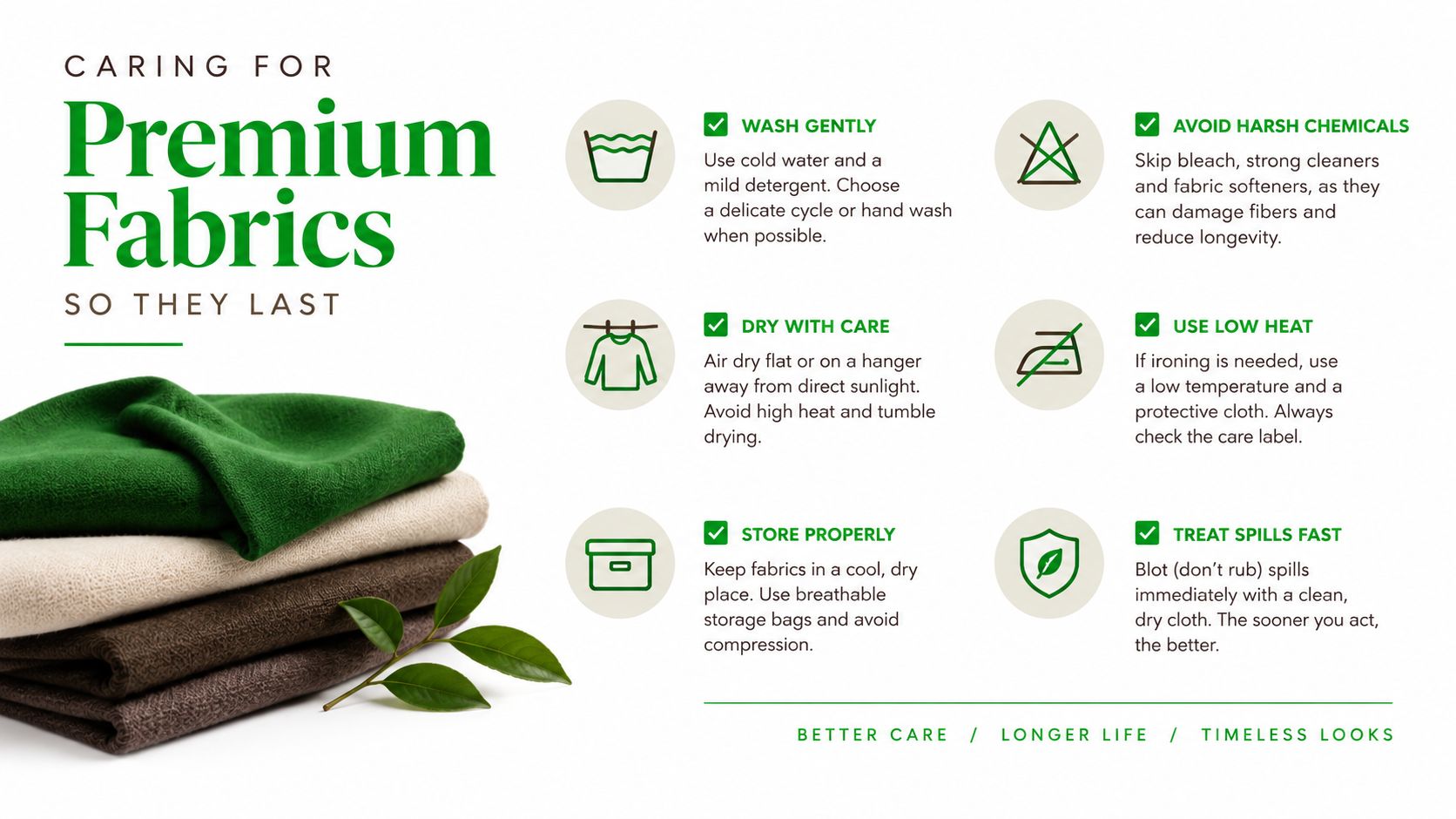
Premium fabric needs specific care, not a universal routine. Leather, wool, cashmere, and technical shells each respond differently to moisture, friction, heat, and cleaning products.
Leather benefits from conditioning about twice yearly, applied lightly and tested in an inconspicuous area first. A wide padded hanger helps preserve the shoulder, while prompt attention to rain spotting can prevent marks from setting. Leather should stay in a breathable garment bag, never sealed plastic.
Wool and cashmere need less washing than many wardrobes give them. Brush the surface between wears, rotate pieces so the fibers recover, and use cedar blocks in storage as a practical moth deterrent. Small marks usually deserve spot treatment before a full professional clean.
Technical shells require a different approach
Water-resistant shells should be washed according to the care label with a technical detergent when appropriate. Home washing can help refresh the durable water repellent finish, while dry cleaning may strip that treatment. The finish works by encouraging water to bead and roll from the face fabric rather than soak in.
A practical care checklist looks like this:
- After wearing: Air the jacket before returning it to the closet.
- Before storing: Inspect zippers, seams, cuffs, and pockets.
- For hanging: Use a suitable hanger that supports the shoulder shape.
- For storage: Choose a cool, dry closet and breathable garment protection.
- For cleaning: Spot-clean when possible and use professional care for set stains, lining damage, or material-specific repairs.
A detailed resource on leather jacket maintenance can help owners avoid overcleaning. Professional cleaning is necessary for deep stains, odors that airing won't remove, significant water damage, or care labels that require specialized treatment. It isn't automatically necessary after every wear.
One style guide recommends regular brushing for wool and cashmere, limited dry cleaning, breathable cotton garment bags, and annual reapplication of water-repellent treatments on suitable pieces, as outlined in this premium outerwear care guide. Those habits protect both appearance and structure.
Choosing Your Next Jacket and Where to Find It
You arrive at work in the morning, wear the same jacket to dinner, and pack it for a weekend away. That is the right test for a luxury jacket. Choose the piece that covers several occasions, not the trend that looks dated after one season.
Start with the jacket's main job, then check whether its material and construction support it. A dense wool blend suits polished workwear, while supple leather or weather-ready fabric may earn more wear across travel and events. Compare the price with realistic cost per wear. A well-made jacket that works with most of your wardrobe can justify its price more convincingly than an inexpensive piece worn once.
Try the jacket on in person. Check the shoulders, armholes, sleeve length, and room for the layers you wear. Bend your arms, sit down, and test the lining over knitwear. A stylist can also identify when a small alteration will solve the fit instead of sending you toward another size.
Cedar & Lily Clothier has storefronts at Utica Square in Tulsa and downtown Jenks, with an online store at cedarandlilyclothier.com. Shoppers can inspect fabric, discuss alterations, and arrange styling support for workwear or event dressing. Phone or video appointments suit clients outside Tulsa.
For more distinctive outerwear, horse-themed women's jackets show how personality can guide a practical purchase. Bring the jacket you wear most to an appointment. It gives the stylist a clear basis for finding the missing role rather than duplicating what you own.
Cedar & Lily Clothier offers curated designer and contemporary outerwear. Book a styling appointment, bring your frequently worn jacket, and choose the piece that will earn regular wear.