


The handbag is ready for the next outfit, but the closet tells a different story. A tote has slumped sideways on a shelf, a chain bag has tangled itself into a scarf, and a favorite leather piece is hiding beneath heavier accessories. That's not a styling problem. It's a storage problem, and the right routine keeps every bag looking ready to carry.
Learning how to store designer handbags isn't about turning a closet into a museum. It's about creating a simple ritual that protects the shape, material, hardware, and polish that make a bag worth reaching for. The payoff is practical: less dust, fewer distorted handles, cleaner linings, and a collection that works with more outfits.
Table of Contents
- Why a Good Storage Routine Matters for Your Collection
- Prepping Your Bag Before It Goes Anywhere
- Stuffing, Dust Bags, and Shape Retention
- Humidity, Temperature, and the Closet Environment
- Material-Specific Care for Leather, Suede, Canvas, and Exotics
- Short-Term Rotation and Travel Storage
- Damage Signals, Professional Care, and Your Storage Checklist
Why a Good Storage Routine Matters for Your Collection
A handbag ages while it sits in a closet. Pressure can flatten structured panels, handles can stretch, sunlight can fade leather, and trapped moisture can leave a lining smelling musty. Luxury and insurance guidance recommends breathable coverings, light stuffing, open storage, and protection from heat and direct sunlight because leather needs air circulation and can deform when compressed for long periods. See the designer handbag care guide for more wardrobe-minded ways to think about accessories.
The most useful approach treats storage as part of getting dressed. A bag should come off the shelf with its silhouette intact, its strap untangled, and its interior clean enough to move straight into the day's rotation. When bags remain easy to access, they're more likely to be worn regularly, which helps a collection feel like part of a wardrobe instead of a row of forgotten possessions.
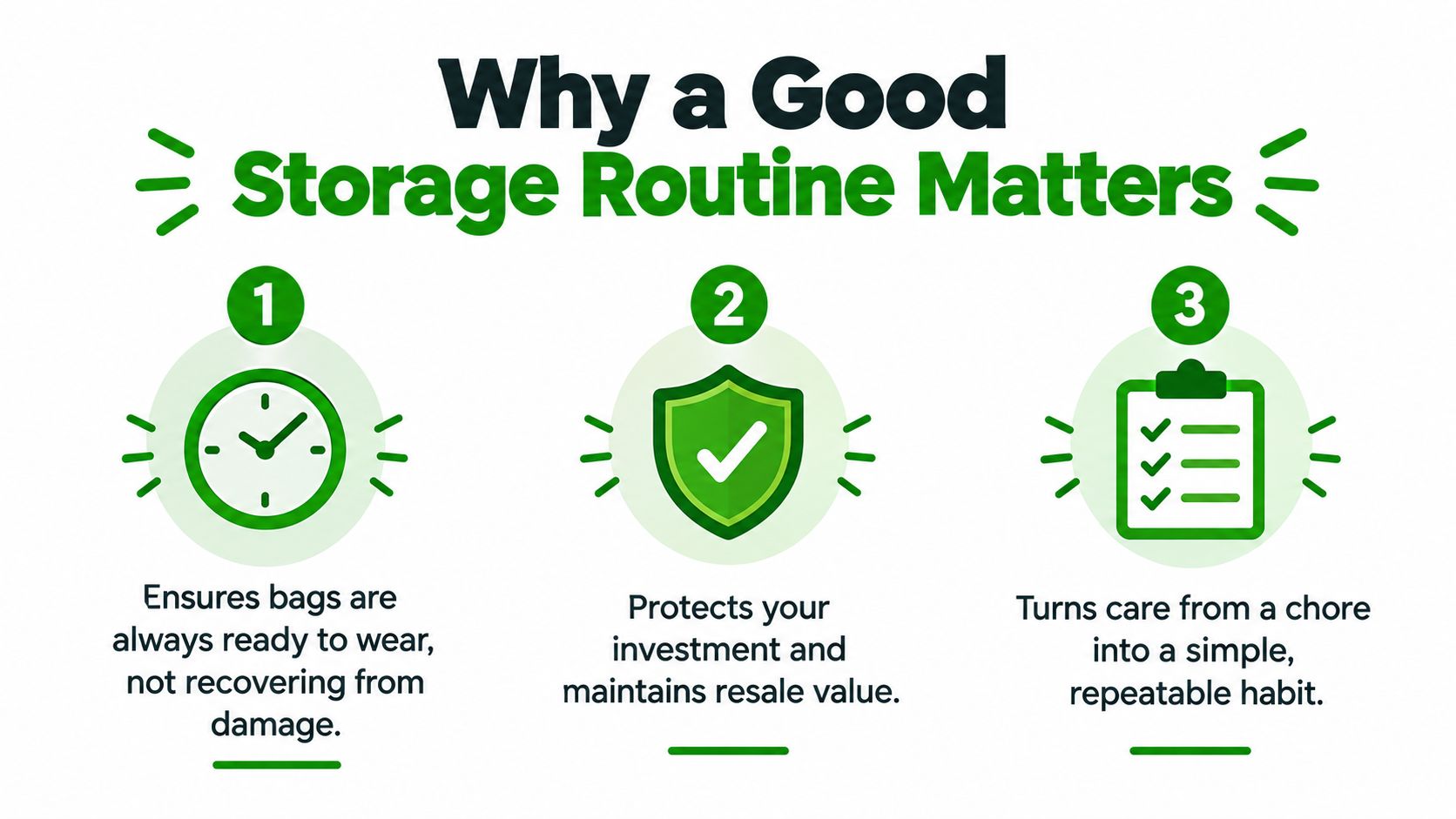
The storage habits that make the difference
- Keep bags supported: Light stuffing helps a bag hold its natural shape without forcing the leather outward.
- Protect the surface: A breathable dust bag blocks dust and light while allowing air to move.
- Give each bag room: Avoid stacking heavy pieces over delicate ones, since long-term pressure can distort the body and handles.
- Make rotation effortless: Open shelving lets a shopper see the collection and choose a bag that suits the next outfit.
Closet rule: A stored handbag should be protected, supported, and easy to pick up without rearranging the entire shelf.
That small standard changes the experience of owning accessories. A structured bag stays polished for work, a compact chain bag remains ready for dinner, and an everyday tote keeps its place in the work-to-weekend wardrobe. Good storage doesn't just preserve an object. It preserves the pleasure of wearing it.
Prepping Your Bag Before It Goes Anywhere
A bag shouldn't enter storage carrying the day with it. Crumbs, makeup residue, body oils, and dampness become harder to address after they've sat against leather or fabric. Preparation is the handbag equivalent of removing makeup before bed. It takes little effort, but skipping it creates avoidable problems.
Start inside. Empty every pocket, remove receipts and tissues, and shake out loose debris over a clean surface. A barely damp microfiber cloth can lift light dust from the lining, but the fabric needs to dry completely before the bag is covered.
For smooth leather, use a pH-balanced cleaner sparingly, working in small circles rather than scrubbing one spot aggressively. Follow with a thin layer of suitable conditioner, then buff away excess so the surface isn't left greasy. A bag should air-dry away from radiators, vents, direct sunlight, and other heat sources before it returns to the shelf.
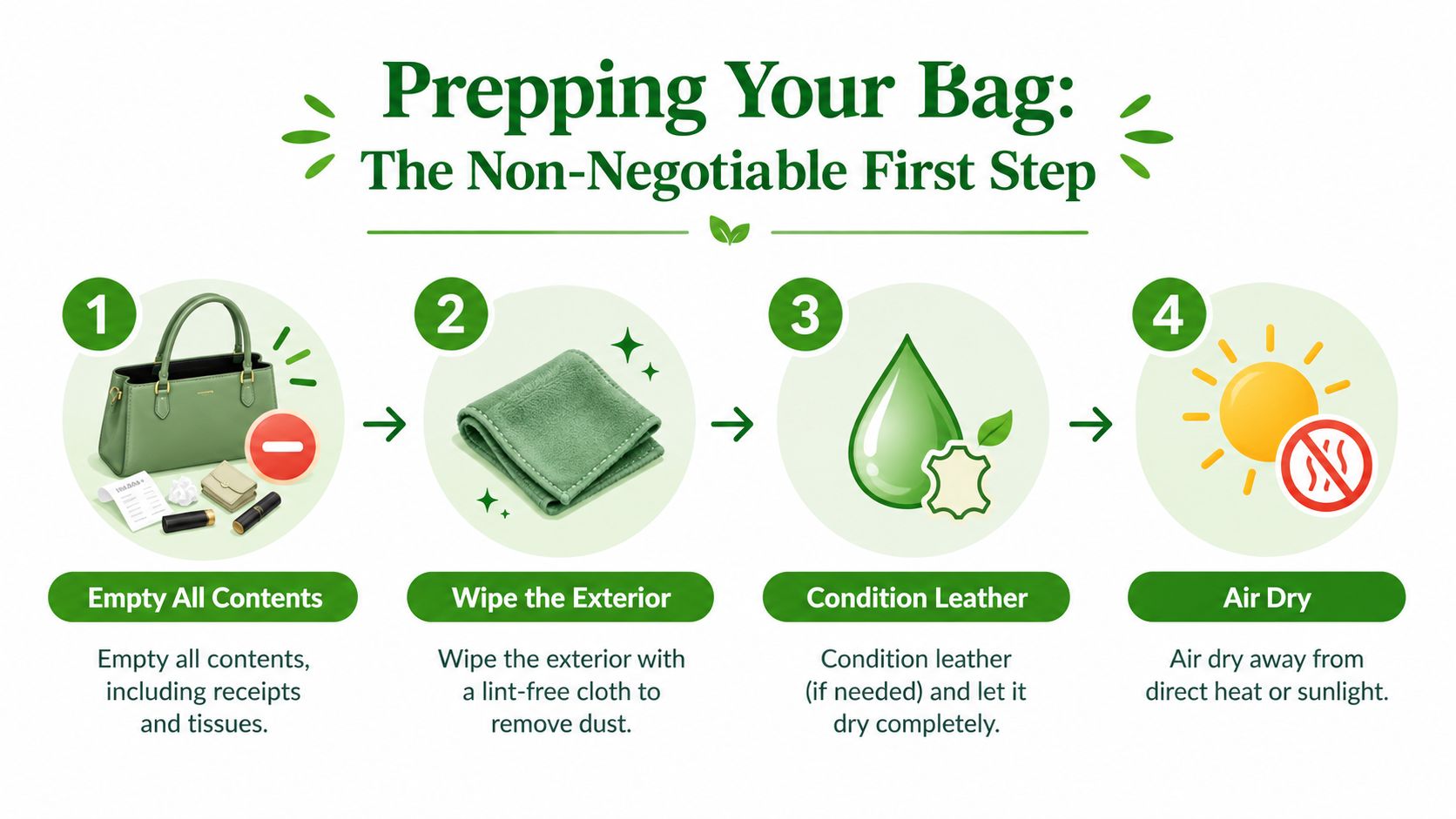
Adjust the method to the material
- Suede and nubuck: Use a dry brush and suede eraser. Conditioner belongs elsewhere because liquid products can flatten the nap or leave uneven marks.
- Hardware: Polish clasps and chain details gently with a dry cloth, keeping product and moisture away from the leather.
- Lining: Remove surface debris first, then use minimal moisture. Saturating the interior can create a bigger issue than the original mark.
- Odor or dampness: Let the bag breathe in a clean room before covering it. A useful companion resource on moisture and pest prevention offers broader storage principles that also apply to textile linings.
The rule is simple: a bag goes into storage clean, or it doesn't go in at all. Light surface marks may be manageable at home, but deep staining, dye transfer, or unfamiliar finishes deserve professional advice before a cleaner makes the situation worse. For related material-care guidance, Cedar & Lily Clothier's notes on leather jacket maintenance reinforce the same careful approach to leather.
Stuffing, Dust Bags, and Shape Retention
Shape retention comes down to support without pressure. Acid-free tissue paper is the safest starting point for most bags because it supports the body while remaining lightweight. Unbleached cotton batting can also work when it's clean and used gently.
Fill the cavity until the bag looks naturally supported, not stretched. Add material to the sides and around the handles where the silhouette needs help, then check the opening and panels. Newspaper and printed kraft paper should stay out of the bag because ink can transfer to light linings over time.
Chains and hardware need their own small layer of protection. A narrow strip of tissue between a chain and the leather can prevent clasp imprints, rubbing, and marks on adjacent surfaces. Straps should stay in their natural position rather than being sharply folded.
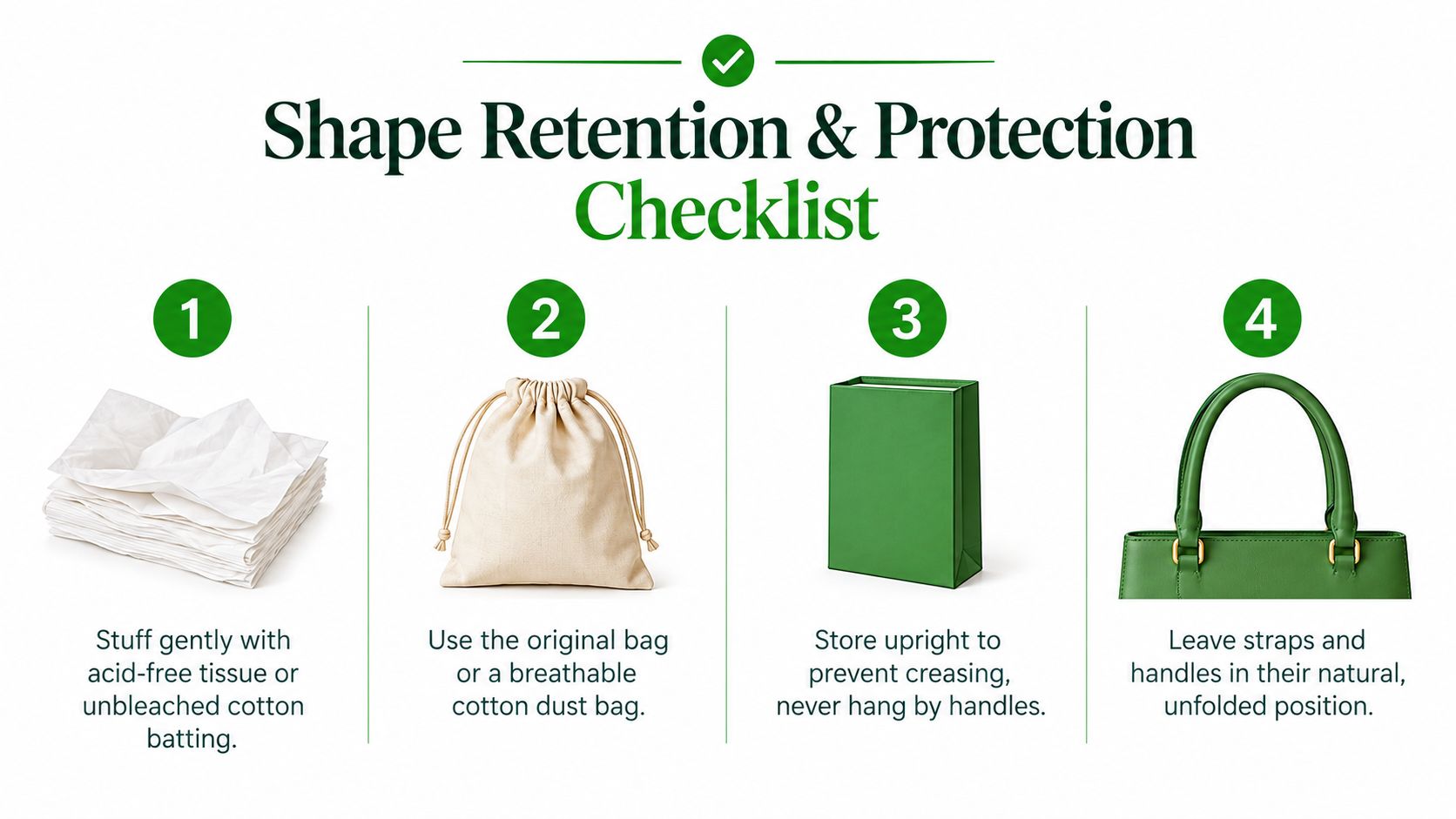
The right covering and shelf position
Slide the bag into its original dust bag, or use a breathable cotton alternative. Plastic is the wrong choice for extended storage because it traps humidity and limits airflow. The covering should fit comfortably, and the drawstring should be loosely closed rather than cinched tight.
Structured bags belong upright on a clean, open shelf. They shouldn't be hung by their handles, and they shouldn't sit under heavier pieces. A bag's own weight already places stress on its attachment points, while hanging can stretch handles and distort the opening.
Slouchy hobos are more forgiving. They can lie flat in a clean box with a divider, provided nothing heavy rests on top and the material isn't sharply folded. For archival boxes and other strong archive packing materials, the same principle applies: the container should support organization without turning the bag into a compressed package.
Practical rule: The bag should look relaxed inside its covering. If the stuffing pushes against seams or the dust bag pulls tightly around the body, remove some material.
Humidity, Temperature, and the Closet Environment
A closet can look tidy and still create the wrong conditions for leather. The key variables are airflow, humidity, heat, light, and pressure. Preservation guidance recommends a climate-controlled space with relative humidity around 45% to 55% to help prevent drying, cracking, and moisture damage. Another luxury-care source warns that risk rises above roughly 65% relative humidity, making humidity the more actionable variable than temperature alone. Read the luxury handbag storage guidance for the preservation rationale behind breathable storage.
The closet doesn't need complicated equipment. A small digital hygrometer makes the room measurable, while a dehumidifier can help in humid homes. Plastic containers and airtight boxes are poor choices because trapped moisture has nowhere to go.
| Factor | Target Range | What Goes Wrong Outside It |
|---|---|---|
| Relative humidity | 45% to 55% | Leather may dry and crack in overly dry conditions, while excess moisture encourages mildew and material damage |
| Airflow | Breathable, not sealed | Trapped moisture can create musty odors and mold-friendly conditions |
| Light | Cool, dark placement | Repeated UV exposure can fade leather and other materials |
| Heat | Away from heat sources | Heat can dry or warp leather and intensify environmental swings |
| Position | Upright on an open shelf | Pressure and hanging can distort shape or stretch handles |
Build a calmer closet setup
Avoid attics, basements, exterior walls, radiators, and sunny windows. A cool, dry, dark shelf is more dependable than a decorative cabinet that seals in humid air. Bags also need enough room that neighboring pieces don't rub against one another.
Open shelving makes rotation easier and keeps each bag visible. The closet organization guide offers a useful framework for creating clear zones, which helps accessories remain protected and wearable.
Material-Specific Care for Leather, Suede, Canvas, and Exotics
Different materials need different handling. Treating every handbag with the same cleaner, conditioner, or storage position is how well-intentioned care turns into damage.
| Material | Cleaning approach | Storage preference |
|---|---|---|
| Smooth leather | Use a suitable cleaner and a light conditioner when needed | Upright in a breathable dust bag, with handles natural |
| Suede and nubuck | Dry brush and eraser, without liquid conditioner | Lightly supported and protected from moisture |
| Coated canvas | Barely damp microfiber wipe, no conditioner | Supported according to its structure |
| Exotic skins | Minimal handling and skin-specific professional care | Breathable covering, away from plastic and environmental swings |
Smooth calfskin and lambskin benefit from restrained care. A light conditioner can help maintain suppleness, but over-conditioning leaves residue and can change the finish. Handles should remain unfolded, and the bag should sit upright in its dust bag when its structure allows.
Suede and nubuck need a dry brush after wear, especially around the corners and base. Waterproofing products should be compatible with the material and tested discreetly first. The bag shouldn't be stuffed tightly, since compressed fibers can lose their nap.
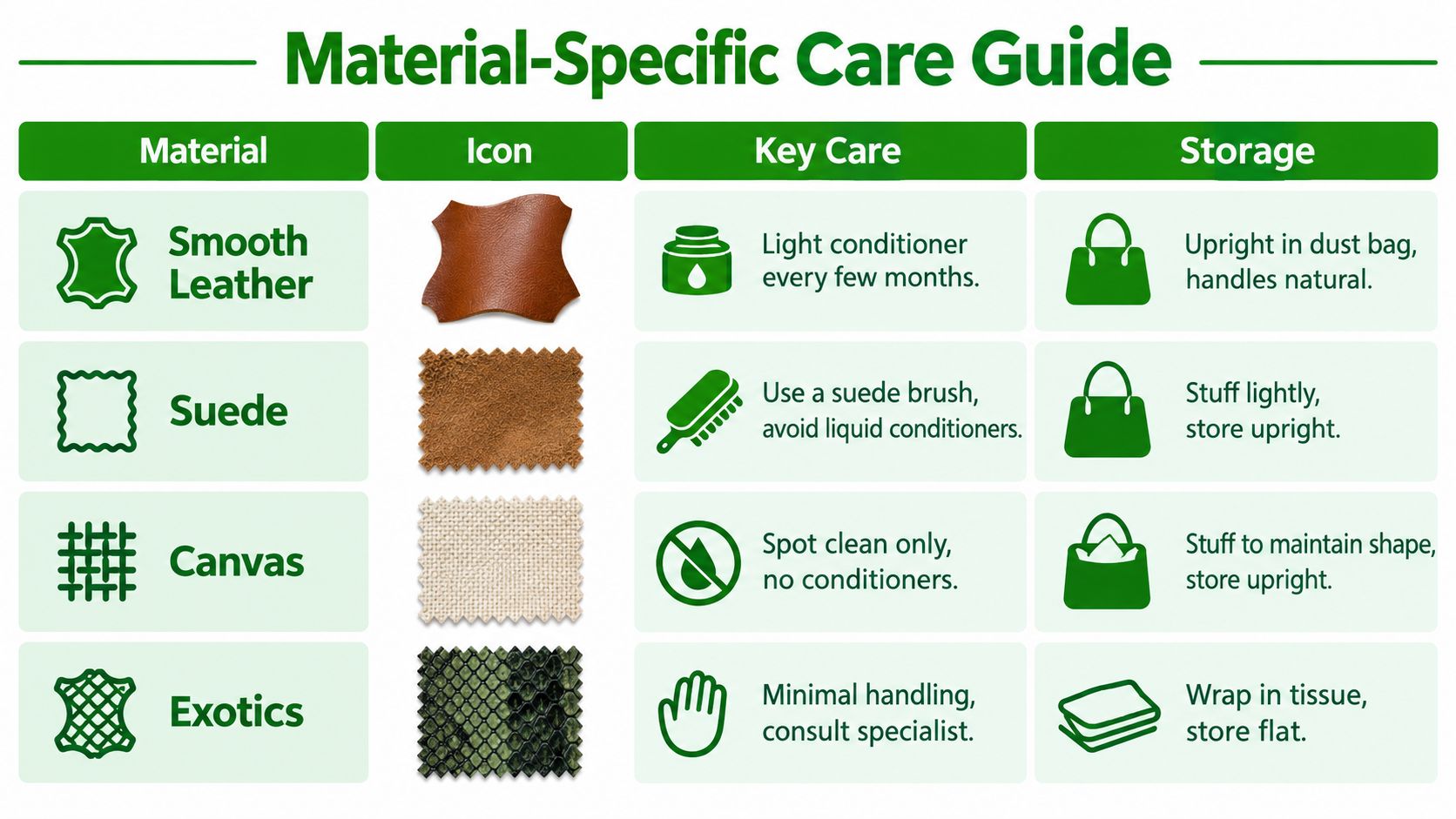
Keep the easy materials simple
Coated canvas is often more forgiving than leather, but it still deserves a careful wipe and breathable storage. Skip conditioners, avoid soaking, and support structured panels so they don't sag.
Exotic skins need the most restraint. Crocodile, alligator, lizard, and ostrich should be handled minimally, stored without plastic, and treated only with products specifically labeled for the skin. When the finish, scales, or surface feels unfamiliar, professional care is the sensible choice. The same material-first thinking appears in guidance on caring for silk clothing, where the fabric dictates the method rather than the other way around.
Short-Term Rotation and Travel Storage
Short-term storage should keep a bag rested but ready. A useful rotation rhythm gives each frequently carried piece time away from daily friction, packed interiors, and repeated handling. After use, remove the contents, loosen the strap, check the lining, and let the opening remain slightly open while the bag rests in a clean area.
The next outfit should be able to claim the bag without a lengthy recovery process. Light stuffing helps the silhouette settle, while a quick surface wipe prevents ordinary dust from becoming a set-in mark. Rotation also gives the owner a chance to notice changes before they become restoration jobs.
Travel calls for another layer
Travel is harder on handbags than a calm closet. Pack each bag in its dust bag, then place it inside a soft tote or its original box with the cavity gently supported. A handle wrapped in tissue is less likely to rub against another surface, and a structured bag should never carry heavy objects inside it during transit.
Keep bags out of overhead bins when possible. A protected tote under a seat is gentler than a crowded compartment where luggage can shift against it. Never hang a handbag by its strap from a hotel hook, since the anchor points can stretch under the bag's weight.
For broader packing context, these packing hanging clothes for moving tips offer a helpful reminder that soft barriers and stable positioning matter during transport. The same care applies when preparing garments and accessories for a trip. Once home, unpack the bag promptly, wipe it down, restuff it, and let it air before returning it to rotation. Related garment guidance on packing dresses without wrinkles can help keep the rest of the outfit ready too.
Damage Signals, Professional Care, and Your Storage Checklist
A musty smell isn't just an unpleasant detail. It can signal trapped moisture. Color transfer points to contact between surfaces or exposure to unstable dye. Cracked glazing, sticky hardware, mold spots, lifted stitching, and warped handles each indicate that storage conditions or handling need attention.
The common assumption is that every handbag problem deserves a home remedy. That's wrong. Surface smudges, light water spots, and minor dryness may be suitable for careful home maintenance, but deep stains, dye transfer, plating loss, and exotic-skin damage should go to a leather specialist.
Know when to stop experimenting
A restoration service deserves the same scrutiny as a tailor. Ask whether the specialist has handled the relevant material and construction, request before-and-after photographs, and get a written estimate before work begins. A professional should explain the proposed treatment rather than promising an instant fix.
A damaged bag also needs isolation while its condition is assessed. Keep it away from other accessories, use a breathable covering, and don't seal it in plastic to hide an odor. If moisture is suspected, address the closet environment as well as the bag itself.
The repeatable storage checklist
Weekly
- Empty the interior: Remove receipts, cosmetics, wrappers, and loose debris.
- Inspect the surface: Look at corners, handles, glazing, lining, and hardware.
- Rest the silhouette: Add light support and return the bag to its natural position.
- Rotate the collection: Choose a different piece for the next outfit instead of leaving one bag in constant use.
Quarterly
- Review the material: Confirm that leather, suede, canvas, and exotic skins are receiving the correct care.
- Check the covering: Replace unsuitable plastic with a breathable cotton dust bag or pillowcase.
- Read the closet: Check humidity, light, airflow, and shelf pressure.
- Escalate early: Send serious staining, structural distortion, or exotic-skin concerns to a qualified specialist.
Cedar & Lily Clothier offers curated designer and contemporary accessories, including pieces from Vanessa Mooney and Lace the Label, through its online store and its Oklahoma boutiques. Shoppers can visit Utica Square in Tulsa or downtown Jenks to see fit, finish, and fabric in person, then get styling help from the team as a new handbag joins the rotation.
Cedar & Lily Clothier can help build a wardrobe where every accessory has an outfit and every outfit has a finishing piece. Shop Cedar & Lily Clothier online, visit the Utica Square Tulsa or downtown Jenks boutique, and ask the team for hands-on styling help.