


A formal invitation is sitting on the counter, the venue looks grand, and the dress code leaves little room for guesswork. The familiar answer is a floor-length gown, but that isn't the only way to look unmistakably dressed for the occasion. A formal jumpsuit with train offers the entrance-making sweep of eveningwear with the structure and confidence of a fitted one-piece.
The catch is practical. A train can look magnificent in photographs and become awkward on stairs, around dining tables, or during the first dance if the fit and length aren't handled properly. The right choice depends on more than drama. It depends on the venue, the fabric, the fastening, the shoes, and whether the train can move with the wearer instead of dictating every step.
Table of Contents
- Redefining Black Tie With a Modern Silhouette
- Jumpsuits Versus Traditional Evening Gowns
- Mastering the Fit and Alteration Process
- Navigating Mobility Shoes and Undergarments
- Matching the Silhouette to the Dress Code
- Curating Your Look at Cedar and Lily Clothier
Redefining Black Tie With a Modern Silhouette
The woman decoding a black-tie invitation usually faces a familiar decision: choose a traditional gown and follow the expected formula, or select something with a stronger point of view. A formal jumpsuit with train belongs firmly in the second category. It doesn't ask the wearer to dress down. It gives formal dressing a cleaner, more contemporary shape.
The silhouette has the history to support that confidence. The jumpsuit traces back to a practical one-piece garment introduced in Italy in 1919 for parachuters and aviators, with its name reflecting that original function. By the 1930s, Elsa Schiaparelli had adapted the shape for high fashion, and by the 1940s it had entered both elegant fashion and wartime workwear. Vogue coverage in 1964 helped establish the jumpsuit as a mainstream fashion item, according to the history of the jumpsuit.
That evolution matters because the train isn't an arbitrary embellishment. It's an eveningwear extension of a silhouette that moved from utility to couture and then to occasion dressing. Vogue identifies the late 1960s and 1970s as especially important years for jumpsuits, including embellished evening designs, when the garment became established in both daywear and eveningwear forms. The fashion history of the jumpsuit makes the case clearly: a jumpsuit can carry real formal authority when the cut and finish are right.
The modern alternative to a gown
A fitted bodice, wide leg, refined fabric, and controlled train create the same sense of ceremony associated with a gown. The difference is architectural. Trousers give the lower half a deliberate, elongated line, while the train adds movement behind the body rather than surrounding the legs.
That makes the look particularly effective for a woman who wants polish without feeling disguised. A one-shoulder neckline, sculpted waist, or fluid crepe finish can feel refined without relying on heavy ornament. A train supplies the visual punctuation.
For black tie, the garment needs to look intentional from every angle. Casual jersey, thin straps without support, or a train that appears tacked on will weaken the effect. Silk, high-grade crepe, lace, hand-beading, and a well-constructed train all help move the jumpsuit into eveningwear territory, as outlined in this guide to formal evening jumpsuits.
A woman considering the traditional route can still use this black-tie gown guidance as a useful formality check. The same questions apply to a jumpsuit: Does the fabric look luxurious under evening light? Does the hem meet the shoe cleanly? Does the neckline feel appropriate for the invitation? If the answer is yes, choosing trousers over a skirt becomes a deliberate style decision, not a compromise.
Jumpsuits Versus Traditional Evening Gowns
The choice between a formal jumpsuit with train and a traditional gown should come down to the event and the wearer's habits, not a blanket rule about which one is more elegant. A gown offers romance and familiar ceremony. A jumpsuit offers structure, legroom, and a sharper modern profile.
The train changes the calculation. It gives the jumpsuit more visual drama, but it also adds another alteration point and another piece of fabric to manage. A woman who expects to spend the evening seated at a formal dinner may prefer a controlled or detachable train. Someone attending a spacious gala with a long entrance route can take advantage of a more expressive sweep.
| Feature | Jumpsuit with Train | Traditional Gown |
|---|---|---|
| Ease of movement | Trousers support walking and standing, while the train needs deliberate handling | Skirt shape determines stride, sitting comfort, and stair movement |
| Tailoring | Torso, inseam, trouser hem, bodice, and train may all need attention | Waist, bust, skirt length, and train are usually the main variables |
| Re-wearability | A detachable train or clean trouser silhouette can work for other formal settings | A simpler gown may transition well, while a highly formal skirt can feel occasion-specific |
| Style impact | Modern, architectural, and confident | Traditional, romantic, and ceremonious |
| Best suited to | Women who want structure and a distinctive entrance | Women who prefer established eveningwear proportions |
Choose based on the evening, not the hanger
A gown is often the easier emotional choice because its purpose is immediately understood. It can feel right for a romantic wedding, a formal ball, or an event where classic glamour is the central mood. A jumpsuit works best when the wearer wants the outfit to show personal style rather than merely satisfy a dress code.
The jumpsuit also has a practical advantage during standing conversations and short walks between spaces. The trouser base offers more stability than a narrow skirt, although the train becomes the point that requires attention. The gown reverses that balance. A sleek gown may be simple to manage, while a full skirt can require more space around chairs and crowded tables.
Practical rule: A jumpsuit with train is the stronger choice when the wearer wants a tailored, fashion-forward silhouette and is willing to invest in precise alterations.
The evening jumpsuit styling guide is useful for judging the overall level of polish. Heels, refined jewelry, and a compact evening bag can complete the outfit, but accessories can't rescue an incorrect rise, a dragging hem, or a train that pulls at the bodice.
The best decision is therefore personal. A woman who feels most herself in tailoring shouldn't force herself into a ballgown because the invitation says formal. A woman who loves the romance of a skirt shouldn't choose a jumpsuit to appear trend-conscious. Formal dressing works when the silhouette feels convincing on the body.
Mastering the Fit and Alteration Process
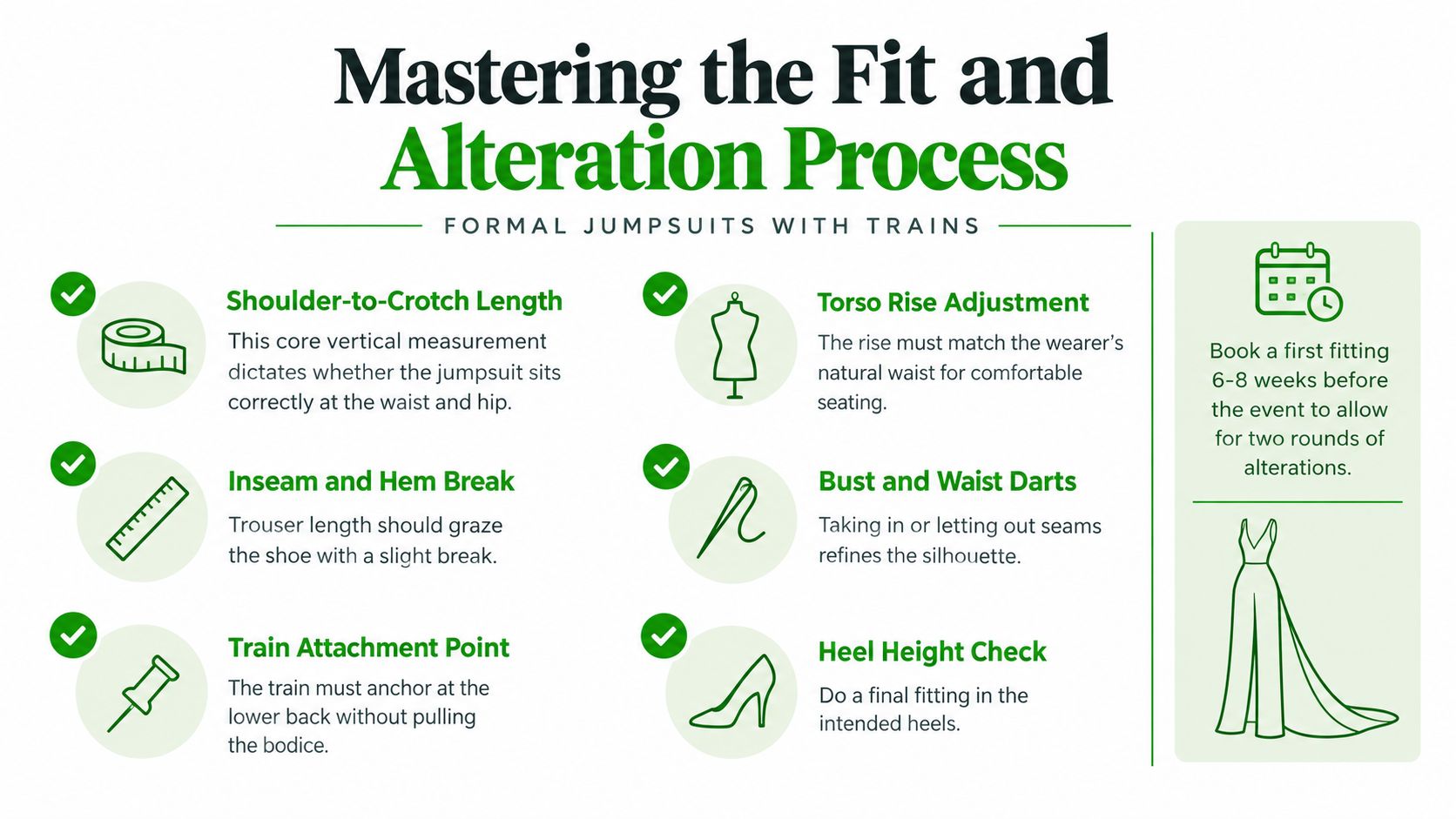
A formal jumpsuit with train is less forgiving than a loose evening dress because several proportions must align at once. The critical measurement isn't height alone. It's the distance from shoulder to crotch, often called the torso or body length, because that measurement controls how the garment sits across the shoulders, bust, waist, and hip.
If the torso is too short, the jumpsuit can pull at the shoulders, flatten the bust, and create tension across the crotch. If it's too long, the waist can sag away from the body and the crotch can sit lower than intended. Expert guidance on formal jumpsuit construction and fit identifies the shoulder-to-crotch measurement as a particularly important variable because it doesn't correspond neatly to a woman's overall height.
Start with the body, then set the leg
The fitting process should follow a clear order:
- Check the torso first. The shoulder seams should sit in the correct place, the bodice should rest securely, and the waist should meet the wearer's natural waist rather than drifting above or below it.
- Assess the bust and waist shaping. Darts, seams, and internal structure should create a smooth line without compressing the body. If the garment includes boning or other internal support, it should stabilize the upper body without digging in.
- Set the inseam against the event shoes. The trouser leg should fall cleanly over the intended heel. A hem chosen before the shoes are finalized can become too short, too long, or visually disconnected from the train.
- Examine the train attachment. The train should begin at the lower back or another deliberate anchor point. It shouldn't pull the bodice backward, distort the waist, or create tension at the seat.
- Hem each layer independently. The trouser leg and the outer train sweep need separate finishes so they can move at different rates. Layer-by-layer hemming preserves the train's drape and reduces the chance that the outer fabric catches beneath the shoe.
Test the garment like an event guest
A fitting shouldn't end with standing in front of a mirror. The wearer should sit, walk, turn, climb a few steps, and lift the train slightly as she would in a reception line. A professional women's tailoring guide can help frame the conversation, but the garment itself must be tested in motion.
The alteration specialist should know the exact shoe height, the likely venue conditions, and whether the train will stay attached for the entire event. A floor-length hem needs to be checked in the intended footwear, not with bare feet or a different pair of heels.
The fit should also account for the order of dressing. If the jumpsuit closes at the back, the wearer needs enough mobility to sit and use the restroom without fighting the fabric. If the train is detachable, the attachment points should be secure but manageable, especially if the look is meant to change between ceremony and reception.
The right alteration isn't about making the garment smaller everywhere. It's about correcting the relationship between torso, waist, hip, leg, and train. That distinction protects the original design and produces a silhouette that looks composed rather than overworked.
Navigating Mobility Shoes and Undergarments
The train is most beautiful when it moves behind the wearer with a controlled sweep. It becomes a liability when it drags, folds beneath the heel, or catches on the edge of a stair. The practical question isn't whether the train looks dramatic. It's whether the wearer can move through the venue without spending the evening monitoring it.
The shoe should provide enough height to clear the trouser hem and enough stability for standing, walking, and dancing. A narrow heel may look elegant, but it can catch delicate fabric more easily than a stable heel with a clean profile. The final choice should be tested with the complete jumpsuit, since the trouser leg and the train may respond differently to the same shoe.
Plan for stairs and crowded rooms
A woman wearing a train needs a simple movement strategy, especially in a busy reception space:
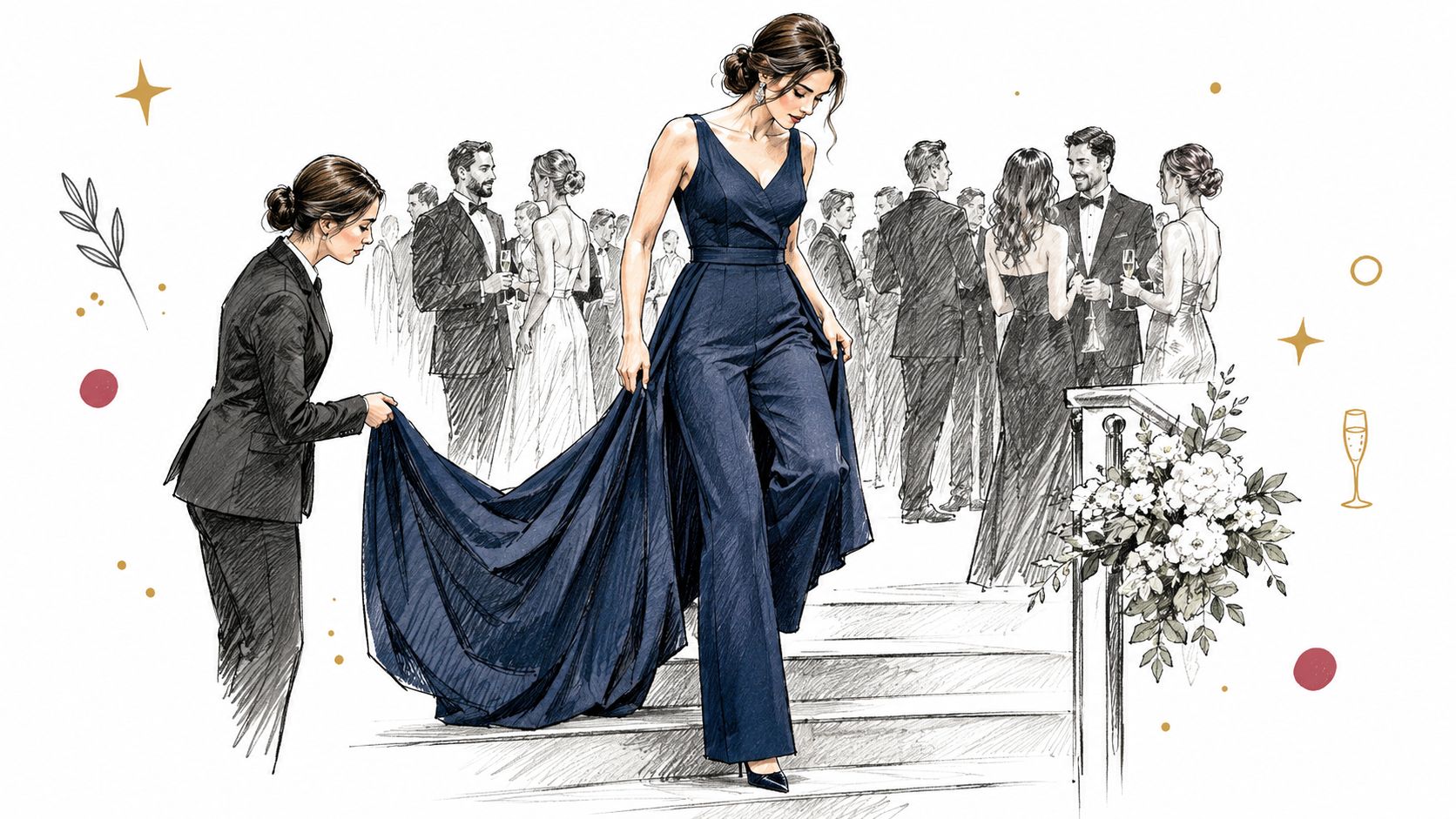
- On stairs: Lift the train from the lower back or gather it over one forearm before stepping down. The other hand should remain available for a railing.
- At the table: Clear the train from beneath the chair before sitting. A companion can help if the train extends beyond the wearer's reach.
- During dancing: Keep the train attached for a slower, spacious first dance if it moves freely. Remove it before crowded dancing if the design allows.
- In narrow spaces: Turn the body before turning the fabric. A train follows the lower back, so a quick pivot can pull it across another guest's path.
- For photographs: Arrange the sweep deliberately, then check that the trouser leg remains visible and the fabric isn't twisted at the attachment point.
Advice on shoes for wedding guests applies especially well here. The most attractive shoe is the one that supports the entire evening, not merely the first photograph.
Keep the foundation invisible
Undergarments should support the garment without competing with it. Structured crepe and silk can reveal seams, edges, or color differences, so the foundation layer needs a smooth finish and a close match to the jumpsuit. The correct option depends on the neckline, back, sleeve, and degree of internal support already built into the piece.
A bodysuit can reduce visible lines beneath a close-fitting torso, while a low-back or strapless solution may suit a more open neckline. The wearer should test sitting, bending, and reaching during the fitting. A foundation garment that looks invisible while standing may shift once the body begins moving.
A train should create a moment at the entrance, not become the evening's main responsibility.
The practical test is simple. If the wearer has to pull the bodice into place after every walk, tuck the train under the arm for every conversation, or avoid the dance floor entirely, the design isn't serving her. A shorter sweep, a lighter outer layer, or a detachable finish may deliver a better experience without sacrificing formality.
Matching the Silhouette to the Dress Code
A train doesn't automatically make a jumpsuit appropriate for every formal invitation. The full look has to match the event's atmosphere, the venue, and the host's expectations. Fabric, finish, proportion, and train design work together to determine whether the result reads as black-tie polish, bridal drama, or an overly elaborate interpretation of a less formal dress code.
Black-tie galas
A gala is the natural setting for a formal jumpsuit with train. A fluid silk, high-grade crepe, or refined lace construction can look as refined as a gown, especially when the neckline and waist are cleanly shaped. A controlled rear sweep keeps the silhouette dramatic without making it difficult to move through a cocktail reception.
Jewelry should support the line rather than compete with it. A sculptural earring, polished cuff, or restrained necklace may be enough. A compact clutch and a sleek hairstyle keep the train as the main visual event.
Weddings and formal ceremonies
Wedding dressing requires more discretion. A train can look modern and elegant in a rich color, a tailored black alternative, or a restrained neutral, but a long white or ivory sweep can move too close to bridal territory. The stronger choice is usually a color and finish that clearly belong to the guest rather than the ceremony.
A detachable train is particularly useful when the event includes both a formal ceremony and an active reception. It can create a dramatic entrance and then come away before dinner, dancing, or travel between venues. That change isn't merely convenient. It gives the garment two distinct functions without requiring a second outfit.
The train should clarify the occasion, not compete with the people being celebrated.
Prom and modern occasionwear
Prom allows more experimentation, but the jumpsuit still needs a deliberate balance. A wide leg with a short overskirt-style train can feel youthful and directional. A heavily embellished bodice with a large sweep can shift the look toward red-carpet drama, which may suit a confident wearer but can feel excessive in a smaller venue.
For gala, prom, and other modern occasion settings, the train often acts as the primary cue that lifts a jumpsuit into eventwear. Heavy embellishment isn't required when the fabric has depth, the tailoring is precise, and the rear silhouette has movement. The current bridal jumpsuit conversation also reflects how jumpsuits now extend beyond a single traditional category, although each shopper still needs to judge the specific garment against her invitation.
The safest buying test
Before purchasing, the shopper should ask four questions:
- Does the fabric look evening-appropriate? Matte crepe, silk, lace, and polished structured materials usually read more formally than casual stretch fabric.
- Is the train proportionate? The venue, body proportions, and expected movement all matter.
- Can the train be removed or managed? Conversion adds practical value for receptions and future wear.
- Does the outfit look like the wearer? A formal jumpsuit should feel expressive, not like a costume chosen to satisfy a trend.
When those answers align, the silhouette can work across weddings, galas, prom, and other highly formal occasions. The train becomes a styling tool, not a permanent limitation.
Curating Your Look at Cedar and Lily Clothier
A formal jumpsuit with train deserves a fitting environment where the shopper can evaluate more than a product photograph. The weight of the fabric, the behavior of the train, the placement of the waist, and the comfort of the shoulder line become obvious when the garment is tried on and walked in.
At the boutique, shoppers can compare dressy jumpsuit shapes with other occasion pieces and consider how the look fits the event rather than shopping from an isolated category. The assortment includes curated designer and contemporary labels such as Vanessa Mooney and Lace the Label, along with jumpsuits, dresses, accessories, and polished separates that support a complete formal wardrobe.
What the fitting appointment should answer
A useful appointment focuses on decisions that affect the night itself:
- The silhouette: Does the trouser line lengthen the body, and does the train add drama without overwhelming the frame?
- The fabric: Does it hold its shape, photograph well, and feel comfortable after extended wear?
- The movement: Can the shopper walk, sit, turn, and use stairs without fighting the garment?
- The styling: Do the shoes, jewelry, bag, and hairstyle reinforce the jumpsuit rather than distract from it?
- The alterations: Is the torso correct, and can the hem and train be finished cleanly?
The boutique has storefronts at Utica Square in Tulsa and downtown Jenks, giving Oklahoma shoppers the option to see fit and fabric in person and receive styling help from the team. That local service matters for a garment whose success depends on movement and proportion, not merely appearance on a hanger.
The online store also supports shoppers who aren't nearby, with fast shipping and complimentary gift packaging for qualifying orders. Whether the final choice is a formal jumpsuit, a gown, or a polished occasion separate, the eveningwear collection can help narrow the direction before a fitting or online purchase.
Cedar & Lily Clothier offers curated occasionwear, dressy jumpsuits, accessories, and personal styling support for shoppers seeking a formal look with confidence and ease. Explore the collection online or visit Cedar & Lily Clothier at Utica Square in Tulsa or downtown Jenks to test the fit, movement, and train in person.