


A white skirt and top can look flawless in a fitting room, then raise immediate questions outside it. Is the skirt transparent in daylight? Do the shades match, or does one piece look cream beside an optic-white blouse? Will the fabric survive sunscreen, lunch, commuting, and a second wear?
White skirts and tops work for offices, weekends, and events, but only when fabric, fit, lining, and styling are chosen together. The right set looks polished without feeling precious. The wrong one becomes a beautiful garment that stays in the closet. The guidance below helps shoppers assess opacity, silhouette, color, care, and occasion suitability before purchasing, with relevant pieces available through Cedar & Lily Clothier's curated assortment.
Table of Contents
- Why White Skirts and Tops Deserve a Place in Your Wardrobe
- How to Choose White Fabrics That Aren't See-Through
- Finding the Right Silhouette and Fit
- Outfit Ideas for Work, Weekend, and Special Events
- Seasonal Layering and Accessory Pairings
- Caring for White Skirts and Tops
- Where to Shop White Skirts and Tops
Why White Skirts and Tops Deserve a Place in Your Wardrobe
A woman tries on a white midi skirt with a tucked blouse. Under fitting-room lighting, the outfit looks crisp and composed. Near a window, the skirt reveals more than expected, the top pulls slightly across the bust, and the two whites don't quite agree. That isn't a styling failure. It's a buying decision that needed more scrutiny.
White separates earn their place when they're selected for the situation. A lined, substantial midi can handle professional settings. A relaxed white bottom with an airy off-white blouse suits weekends. A flowing maxi or refined satin pairing can work for an evening occasion, provided the event doesn't call for a different color convention.
White has a visual language
The modern white shirt has more than 200 years of documented cultural significance, functioning as a marker of class, gender, work, and social change, according to research on the cultural history of the white shirt. During the Victorian era, keeping a white shirt immaculate required frequent laundering, starching, and access to domestic labor or specialized services, so formal white clothing became associated with wealth.
The meaning broadened over time. The white shirt-waist became connected with cleanliness and the independent working woman, while IBM used white shirts in employee imagery during the 1920s to communicate trustworthiness and uniformity. In the 1940s, Hollywood figures including Katherine Hepburn, Ava Gardner, and Lauren Bacall helped establish the white shirt as practical off-duty clothing. In the 1990s, designers including Calvin Klein, Donna Karan, Jil Sander, and Celine used white separates to express minimalist sophistication.
That history explains why a white outfit often photographs so well. It has a clear visual presence. A clean white skirt and top can read as deliberate, capable, ceremonial, or subtly luxurious without relying on a loud print.
Stylist's rule: White should look intentional, not accidental. Fabric quality and shade matching do more work than extra decoration.
The practical test
A good purchase should answer four questions before checkout:
- Is it opaque? The answer should hold under daylight, not only flattering store lighting.
- Does it fit without strain? Stretching can make a fabric more revealing.
- Do the shades coordinate? Ivory and cream can work together, but a near-match often looks mismatched.
- Can it be worn again? A washable skirt or top usually earns more wardrobe space than a delicate piece reserved for one event.
For shoppers comparing options online, garment measurements, lining information, fabric composition, and full-length fit photographs matter as much as the product name. For local shoppers, seeing the outfit in person at Utica Square in Tulsa or downtown Jenks makes these judgments faster and more reliable.
How to Choose White Fabrics That Aren't See-Through
Opacity depends on fabric weight, weave density, and fiber content, not just on the fact that a garment is white. A lightweight fabric may look respectable in a dim fitting room and become noticeably sheer near a window. Textile transparency research coordinated by the Hohenstein Institute examined how yarn thickness and composition affect opacity and planned further testing of how wetness changes transparency, a useful reminder that fabric conditions matter when evaluating textile transparency.
Start with the fabric itself. Substantial woven materials generally provide more coverage than very light, loosely constructed cloth. A tight weave leaves fewer visible gaps between yarns. A lining adds another barrier and often improves drape, especially in a skirt intended for work, ceremonies, or photographs.
The daylight test
A simple in-store or at-home test catches problems early:
- Stand near a window. Check the skirt and top in strong natural light, not only under overhead fixtures.
- Inspect the weave. Hold the fabric close and look for open spaces, especially around seams and areas that curve over the body.
- Check the lining. A full lining usually offers more dependable coverage than a short lining that ends above the most visible area.
- Move and sit. Transparency can change when fabric shifts, stretches, or catches light at a new angle.
- Review the garment from behind. A piece that looks opaque from the front may reveal more across the seat, waistband, or upper back.
A skirt that fits too tightly can become sheerer because stretching opens spaces between yarns. A slightly easier fit often protects both coverage and comfort. That doesn't mean choosing an oversized silhouette. It means avoiding pressure across the hips, bust, and waistband.
Fiber content changes the decision
Fiber composition matters for more than maintenance. A study of 236 commercial summer fabrics found that 48% achieved a UPF of at least 30, and polyester, wool, and blends were substantially more likely to reach UPF 30+ than cotton, linen, or viscose, according to research on fabric composition and ultraviolet protection. White polyester can therefore offer stronger sun protection than a very light white cotton, but a product's verified UPF rating is more useful than guessing from color or fiber alone.
For professional settings, substantial lined wovens are the safest recommendation. For warm-weather dressing, a shopper can choose lighter fabric, but she should accept that breathability and opacity may involve a trade-off. More guidance on evaluating sheer clothing appears in this guide to sheer fabric dresses, especially for shoppers ordering online.
Finding the Right Silhouette and Fit
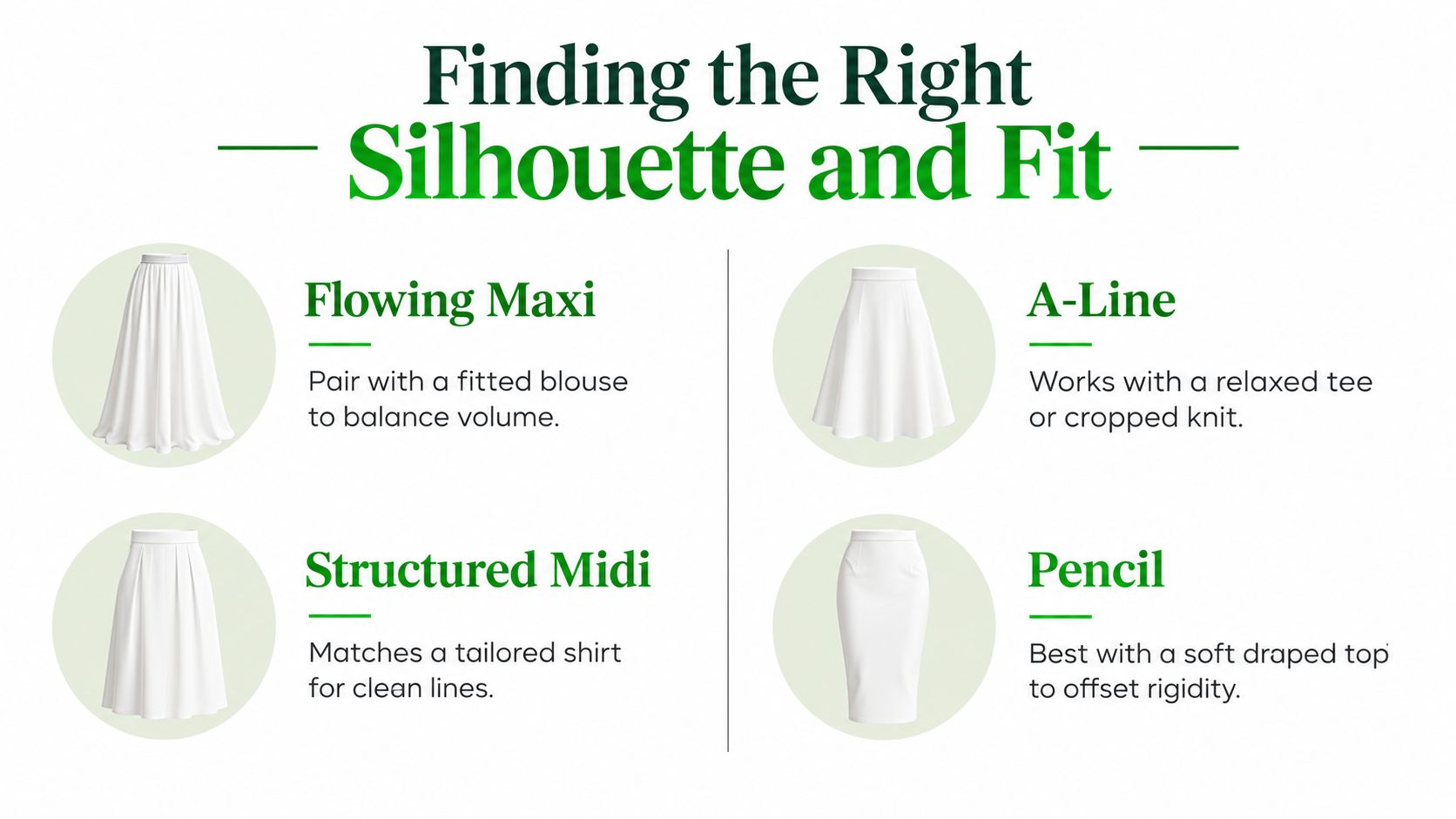
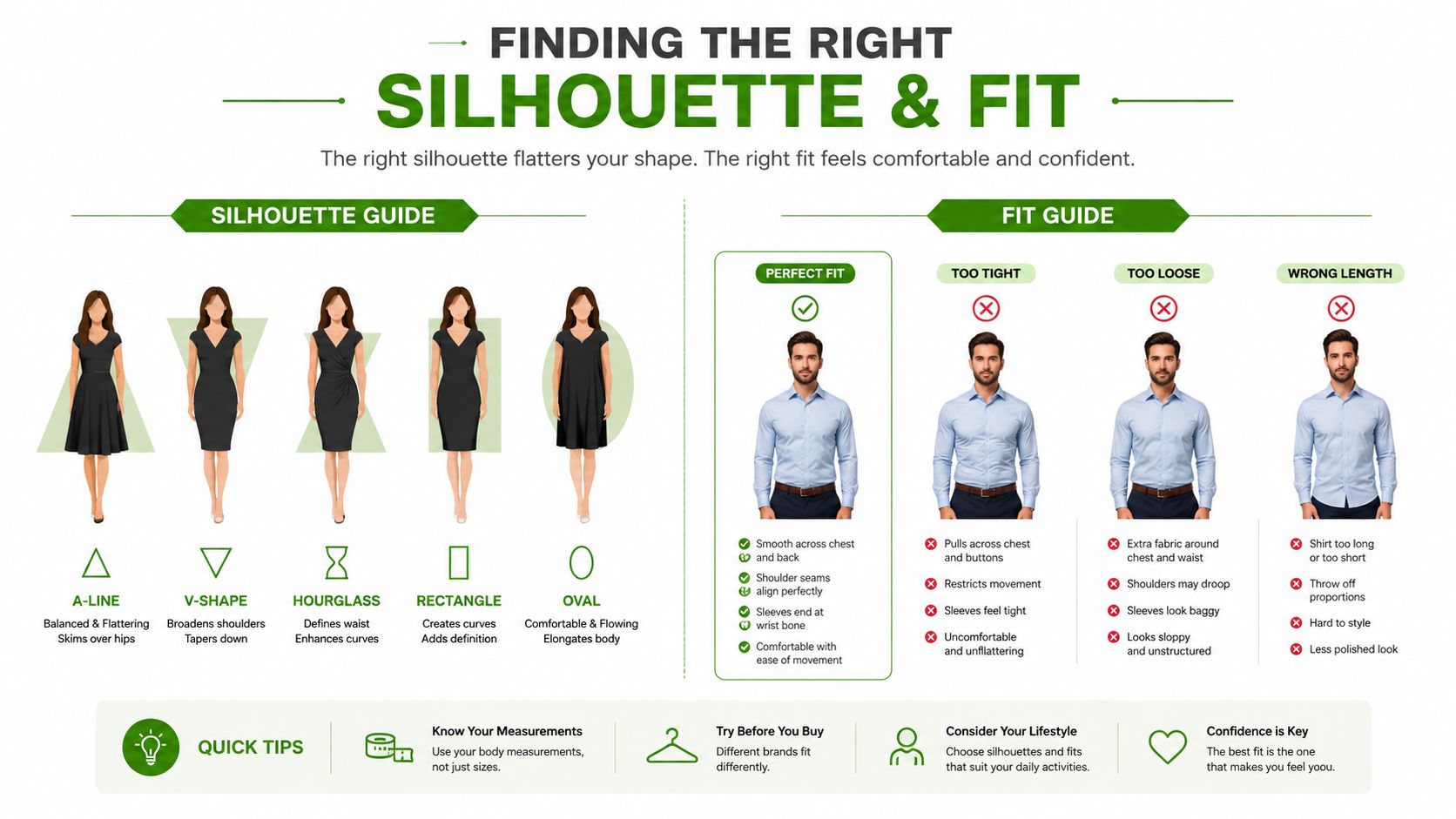
The best white skirt silhouette depends on the top half, the occasion, and where the fabric needs to move. A flowing maxi gains definition from a fitted blouse. A structured midi looks polished with a crisp shirt. An A-line skirt can handle a relaxed tee or cropped knit, while a pencil skirt benefits from a softly draped top that offsets its rigidity.
Match volume with balance
Flowing maxi: Choose a fitted blouse, defined shoulder, or neatly tucked top. Too much volume on both halves can obscure the body and make the outfit feel unfinished.
Structured midi: Pair it with a structured shirt or a clean knit. This combination suits offices and polished daytime occasions because the lines remain controlled.
A-line: Use a relaxed tee, cropped knit, or lightly tucked blouse. The shape already creates movement, so the top can be easy without looking careless.
Pencil: Select a soft draped top, fluid blouse, or slightly relaxed shirt. Rigid fabric on both the skirt and top can look severe, while contrast creates ease.
Fit also affects coverage. Fabric pulled across the hips, stomach, or bust becomes thinner and can reveal more than the same material in a relaxed position. That's why online shoppers should compare garment measurements with a well-fitting piece already in the closet, rather than relying only on a familiar numerical size.
Don't assume the same size works twice
A coordinated outfit may need different sizes in the skirt and top. The top should be judged at the bust, shoulder, and upper arm. The skirt should be judged at the waistband, hip, and hem movement. A shopper with a fuller hip and smaller waist may need a size that accommodates the hip, then use the waistband construction or an alteration for refinement.
The fit risk deserves attention. A 2025 research summary reports that 61% of consumers identify poor fit as the main reason for clothing returns, with inadequate sizing information also predicting returns, according to the apparel fit and return summary. For a white set, the return risk also includes unexpected sheerness and shade differences, so measurements and fabric notes should be read together.
Match white by intention
Optic white, ivory, and cream can share an outfit when the contrast looks deliberate. Pair a warm ivory skirt with a cream blouse and similarly warm accessories. For a sharper look, combine optic white with a cool, clear neutral and keep the rest of the accessories clean.
A near-match is the problem. If one garment reads yellowed beside a blue-white piece, the pairing looks accidental. Holding the pieces together in daylight is the fastest test. Online, product photography, stated color names, and customer service guidance can help, but in-person comparison remains more dependable. More proportion advice is available in this guide to dressing for body type.
Outfit Ideas for Work, Weekend, and Special Events
White separates become useful when they have repeatable formulas. The same skirt can look professional with a blazer, relaxed with sandals, or event-ready with jewelry and a refined layer. The difference comes from fabric structure, top proportion, and finishing pieces, not from buying an entirely new outfit for every setting.
Three reliable outfit formulas
For work, a structured white midi skirt should be paired with a tucked blouse and a blazer. The blazer adds authority and coverage, while a substantial or lined skirt handles bright office lighting more confidently. Neutral pumps, low-profile flats, or polished loafers keep the outfit useful for meetings and regular workdays. Additional workwear proportion advice appears in these business-casual outfit ideas for women.
For weekends, a relaxed white bottom works with the Farm Rio Milani Off-White Blouse, whose airy feel creates a softer, bohemian contrast. The Drew by CJ bottom offers another route for an easy daytime outfit, especially with simple sandals and a compact crossbody. The key is ease, not excess. One fluid piece should be balanced by a cleaner shape elsewhere.
For special events, a flowing white maxi or satin separates can take statement jewelry without looking overworked. The outfit should have enough structure to photograph well, but the accessories can provide the occasion signal through shine, scale, or color.
| Occasion | Skirt and Top Pairing | Finishing Touches |
|---|---|---|
| Work | Structured white midi skirt, tucked blouse, tailored blazer | Neutral shoes, restrained jewelry, structured handbag |
| Weekend | Relaxed white bottom with the Farm Rio Milani Off-White Blouse or Drew by CJ | Flat sandals, crossbody bag, lighter jewelry |
| Special event | Flowing white maxi or satin skirt with an elegant top | Statement jewelry, refined clutch, polished heels |
Read the invitation carefully
All-white clothing can look bridal-adjacent in Western contexts, particularly at weddings. White has also carried political and collective meaning. In 1908, Britain's Women's Social and Political Union introduced a white dress uniform for meetings and rallies, while white clothing appeared at a 1917 NAACP march on Manhattan's Fifth Avenue, where nearly 10,000 Black men, women, and children took part in a silent procession. Women lawmakers later used white clothing as a visual reference to the suffrage movement, as described in this history of color in fashion.
Meaning changes across cultures and ceremonies. White can represent purity in Western contexts but can signify death or mourning in some other cultures, while Western wedding traditions and some Asian funeral customs attach very different expectations to the color, as discussed in academic writing on dress symbolism. Event shoppers should confirm the host's expectations before wearing an all-white outfit.
Seasonal Layering and Accessory Pairings
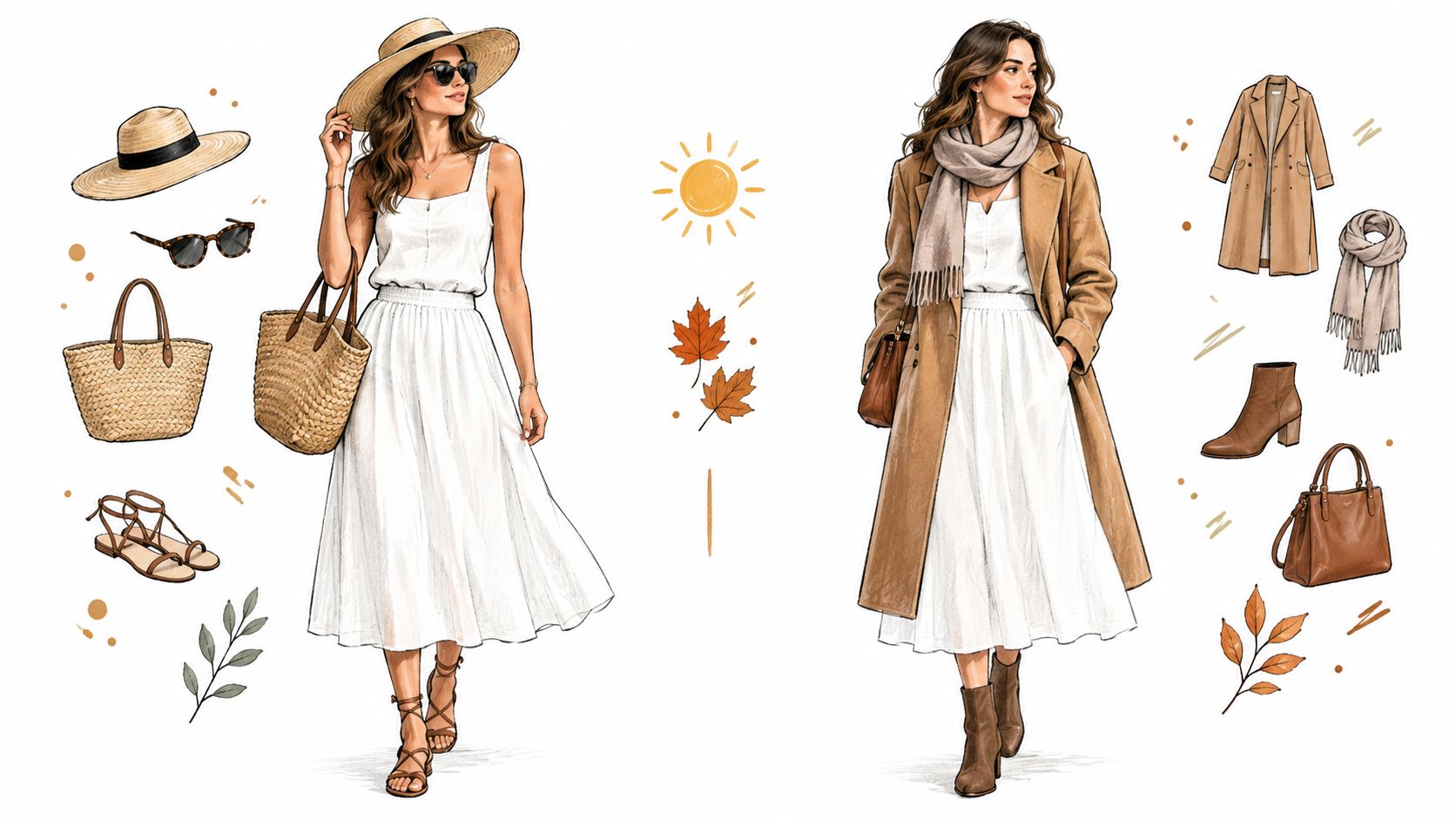
White separates shouldn't be limited to one season. In warm weather, a breathable top, an easier skirt fit, and lighter accessories keep the outfit comfortable. In cooler months, the same base can take a blazer, long coat, tights, or boots in complementary tones.
Sun protection deserves a practical note. White color alone doesn't determine protection, and a lightweight semi-sheer piece shouldn't be treated as sunproof. As the fabric research above indicates, construction and fiber content matter, so a documented UPF rating is the sensible choice when extended sun exposure is expected. A looser fit also helps prevent stretching the weave open.
Build the outfit from the hemline
A flowing maxi pairs naturally with flat sandals in warm weather and ankle boots when temperatures drop. A structured midi looks polished with a low heel, sleek flat, or tall boot, depending on the amount of leg coverage desired. An A-line skirt can take sneakers for casual errands, while a pencil silhouette benefits from a pointed flat or refined heel.
Accessories control the mood quickly:
- Handbags: A tan, black, espresso, or soft metallic bag grounds white without competing with it.
- Belts: A narrow belt defines the waist on a flowing silhouette; a wider belt adds structure to a simple midi.
- Jewelry: Sculptural pieces create modern contrast, while delicate layers keep an ivory outfit understated.
- Shoes: Sandals make a set feel relaxed, heels sharpen it, and boots carry it into cooler weather.
- Color accents: A colored bag, scarf, or jewelry piece can prevent an all-white outfit from appearing flat.
Cedar & Lily's accessory assortment includes pieces from Vanessa Mooney, allowing shoppers to change the character of a white skirt and top without replacing the foundation. Accessory strategy and proportion are covered in this guide to accessorizing an outfit.
Caring for White Skirts and Tops
White clothing needs more maintenance than darker clothing because surface soil, makeup, deodorant, sunscreen, and food marks are easier to see. That doesn't make white impractical. It means the fabric should match the wearer's actual routine.
Washable cotton and linen are convenient choices for repeat wear when the care label permits laundering. Polyester is nonabsorbent, which can make some stains harder to remove. Silk is especially difficult to spot-clean at home and generally calls for dry cleaning under the garment's instructions, as explained in this expert guide to caring for white clothes.
Use the garment label as the authority
Separate whites from colored laundry and remove surface soil before it settles. South Dakota State University Extension advises separating white garments from colored items and notes that sturdy whites may tolerate hot water with an all-purpose or mild detergent, subject to the garment's instructions, as outlined in its white-clothing care guidance.
A practical routine looks like this:
- Check the fiber and finish. Sturdy cotton may tolerate a warmer cycle, while stretch blends, lined skirts, structured pieces, and delicate tops often need cooler water or specialized care.
- Treat marks promptly. Blot food and sunscreen rather than rubbing them deeper into the fibers. Handle makeup and deodorant according to the care label and fabric sensitivity.
- Avoid casual stain experiments. Silk and embellished or lined garments can be damaged by aggressive home treatment.
- Dry with restraint. Excessive direct sun can fade or yellow fabric, so follow the label and avoid prolonged exposure during drying.
- Store clean and protected. Keep white pieces away from dye-transfer risks, dampness, and strong direct light.
Brightness isn't always cleanliness
Optical brighteners, also called fluorescent whitening agents, can make fabric appear whiter by converting some ultraviolet energy into visible blue light. They can visually counteract yellow tones, but they don't remove every discoloration. Research also notes that optical brighteners can reduce light fastness in dyed fibers, and optically whitened wool has been reported to yellow faster under light exposure through a photocatalytic process, according to textile finishing research on optical brighteners.
That distinction matters for premium white pieces. A detergent may improve visual brightness without resolving embedded oil, sunscreen, or food residue. Genuine stain removal, correct washing, and sensible storage protect the garment more effectively than repeated whitening treatments.
For general garment longevity, shoppers can also review this guide to avoiding pilling, particularly when white knits or layered pieces will rub against bags and outerwear.
Where to Shop White Skirts and Tops
White separates deserve more inspection than a quick online scroll. Before ordering, check the fabric composition, lining details, garment measurements, and fit photographs. The product description should make clear whether the piece is lined, structured, stretchy, washable, or intended for a more delicate occasion.
Online shoppers can use Cedar & Lily Clothier's easy size exchanges, free shipping on orders over $250, complimentary gift packaging over $100, and fast shipping across the U.S. Those conveniences help, but they don't replace careful evaluation of shade and opacity. A white garment still needs to suit the buyer's body, lighting conditions, and care routine.
Why local fitting matters
For Oklahoma shoppers, white skirts and tops are particularly worth seeing in person. At Utica Square in Tulsa or downtown Jenks, a shopper can examine a weave in daylight, compare ivory with optic white, check whether a lining changes the drape, and test whether a top and skirt move comfortably together.
The boutique carries curated designer and contemporary brands, including Favorite Daughter, Elliatt, Lace the Label, and Vanessa Mooney, along with occasion, workwear, and everyday pieces. The team can provide fit guidance and styling help without asking the shopper to guess how a white fabric behaves through a screen.
The best next step is practical: review the online collection, identify the silhouettes and fabrics that fit the occasion, then visit a storefront when shade and opacity need a closer look.
Cedar & Lily Clothier offers curated white skirts, tops, occasion pieces, and accessories online and at its Tulsa and Jenks storefronts. Shop Cedar & Lily Clothier for pieces that can move from work to weekend to special events, or visit Utica Square or downtown Jenks for in-person fit guidance and styling help.