

A familiar fitting-room dilemma: the dress looks striking on the hanger, but questions arrive when it's time to sit, walk, and wear it for an entire event. With a white sequin maxi dress, the finish matters, but fit, seam construction, and care determine whether the look feels polished or becomes uncomfortable.
The strongest choice balances the event's dress code with the weight and movement of the dress. A little time spent checking the lining, seams, and hem can prevent the most common disappointments.
Table of Contents
- Pick the Right Sequin Maxi for Each Occasion
- How to Check Fit Before You Order
- Fabric and Seam Checks Worth Doing First
- Shoes, Layers and Jewelry That Keep It Intentional
- Caring, Packing and Storing Between Events
- Shop Your White Sequin Maxi in Tulsa or Jenks
Pick the Right Sequin Maxi for Each Occasion
A white sequin maxi works for evening events when its sequin density and cut suit the dress code. It fails when it competes with the bride or reads as a costume.
| Occasion | Formality | Sequin approach | Avoid |
|---|---|---|---|
| Evening wedding guest | Semi-formal to formal | Full sequin coverage in ivory or champagne tone | Pure bridal white, veils, anything that mirrors the bride |
| Daytime or garden wedding | Semi-formal | Sequin panel or lower sequin density, lighter lining | Full metallic gown look at a daytime ceremony |
| Gala or charity dinner | Black tie to cocktail | Full sequin, structured bodice, tonal metallic accessories | Casual sneakers, bright colored clutches |
| Prom or formal dance | Formal | Fitted column or mermaid cut with secure lining | Loose sequin fabric that catches on hems and chairs |
| Dinner party or elevated everyday | Smart casual | Sequins over a slip or under a knit layer, lower density | Stacked statement jewelry that competes with the shine |
Keep wedding dressing considerate
For a wedding, skip the veil, pure bridal white, and anything that closely mirrors the bride's look. Tonal ivory or champagne sheen can soften the effect when the invitation and dress code allow it, but the guest's outfit shouldn't create doubt about who's getting married. When the dress is unmistakably bright white and fully sequined, another occasion is usually a better fit.
Full sequins can feel out of place at a daytime ceremony, even when the silhouette is right. A panel of embellishment or a lower-density finish keeps the look lighter; a more finished maxi can also preserve the length without bringing the same shine. The dress collection includes maxi options to browse, while the formal-event dressing guide offers ideas for coordinating the rest of an occasion outfit.
A maxi with an off-white base and distinctive bodice details, such as the Boho Glam Off-White Loopy Cups Maxi Dress, shows how a lighter color can be styled without relying on a fully sequined surface.
Before buying, check how the dress fits through the bust and lining, whether the hem works with the event shoes, and whether the seams look secure. Those practical details matter as much as the occasion match.
How to Check Fit Before You Order
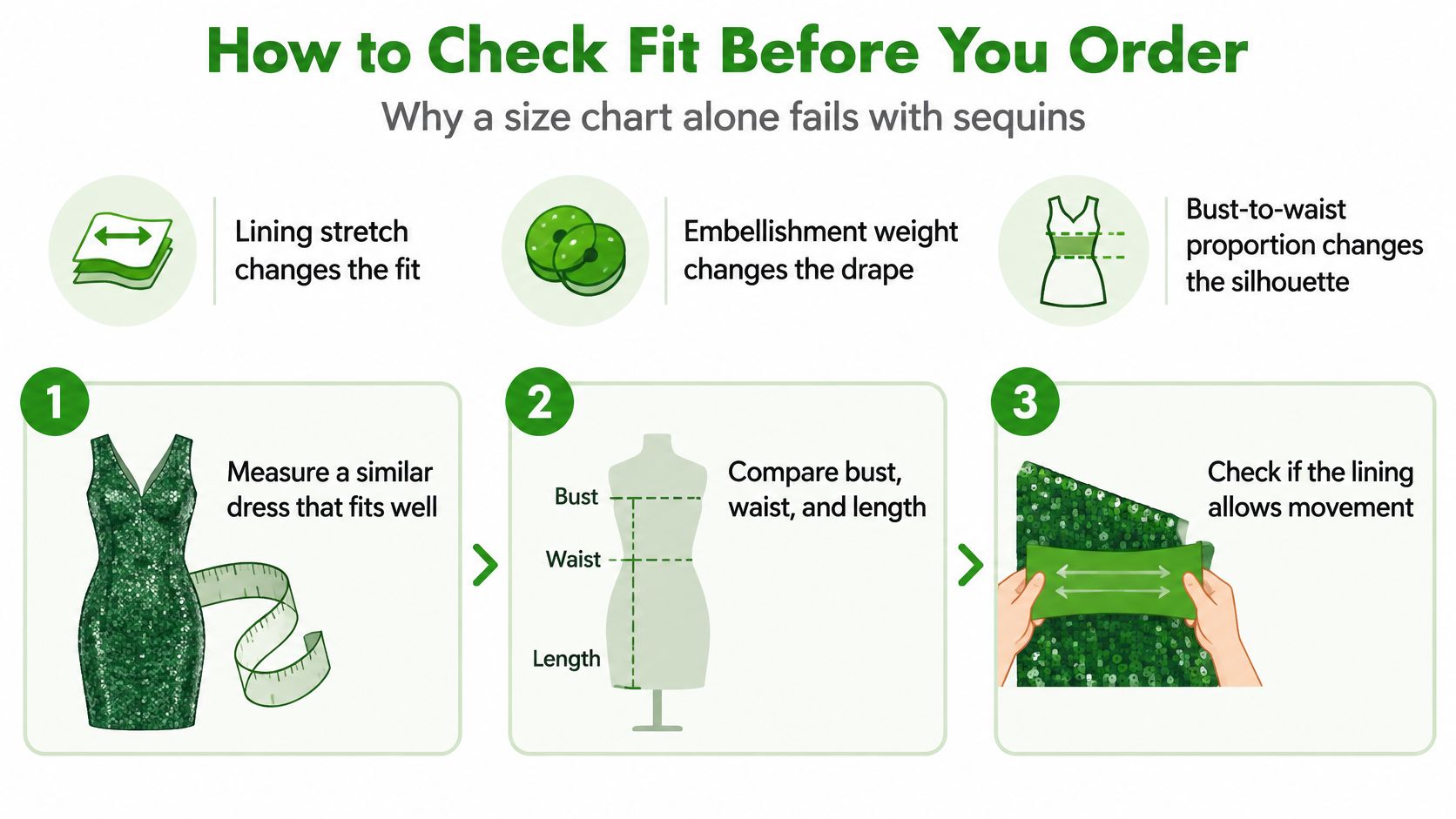
A size chart alone can't show how a sequined maxi will drape. The lining's stretch, the weight and rigidity of the embellishment, and the relationship between bust and waist can all change how a dress sits on the body.
A Vogue Business report on sizing found that 43% of respondents cite poor fit as a purchase deterrent, 36% cite inconsistent sizing, and 91% say their size changes between brands. That's a good reason not to rely on a familiar size label or the vague advice to size up. Compare garment measurements and evaluate the dress as a complete outfit.
Five checks before committing
- Measure a dress that already fits well. Lay it flat and record the bust, waist, hip, and length. A familiar garment provides a useful reference for the ease and silhouette that feel comfortable.
- Compare garment measurements with the listing. Use the dress measurements, not just body measurements, because the lining's stretch affects how much ease the dress provides.
- Check the model's height and heel height. A hem shown with heels may drag when worn with flats, and torso length can affect where the waist seam lands.
- Try the dress with the event shoes. This makes the hem length and walking room easier to judge before the occasion.
- Sit, reach, and walk. Check for fabric that pulls, a neckline that gaps, straps that slip, or a skirt that catches or drags.
When comparing fit references across clothing categories, a cashmere clothing size guide can be a useful reminder to read garment-specific measurements rather than assuming that one size label means the same fit in every style. A general dress size chart guide can help clarify how measurements are commonly presented, but the dress itself still needs to suit its construction and cut.
| Fit point | What good fit looks like | Realistic alteration |
|---|---|---|
| Bust | Fabric lies flat with no gaping or pull | Limited; heavily embellished bodices resist reshaping |
| Waist | Seam sits at the natural waist without pulling | Side-seam take-in, if the lining allows it |
| Hip | Skirt skims without drag lines across the front | Side-seam adjustment is usually practical |
| Length with heels | Hem clears the floor in the event heels | Hemming, keeping the original sequin edge where possible |
| Straps | Straps stay put without sliding or digging in | Strap replacement or re-anchoring, depending on construction |
| Lining | Lining moves with the sequin layer and doesn't show | Lining seams are often easier to adjust than the face fabric |
For an in-between size, fit the bust first, then consider whether a tailor can adjust the side seams. Reshaping a heavily embellished bodice is difficult; hemming and modest side-seam adjustments are usually more practical, though a sequin edge may need careful finishing.
Fabric and Seam Checks Worth Doing First
Sparkle doesn't prove quality. Start by identifying the base fabric and whether it's woven or stretch knit. The base affects how the sequins sit, how the dress moves, and how much recovery the fabric provides after tension.
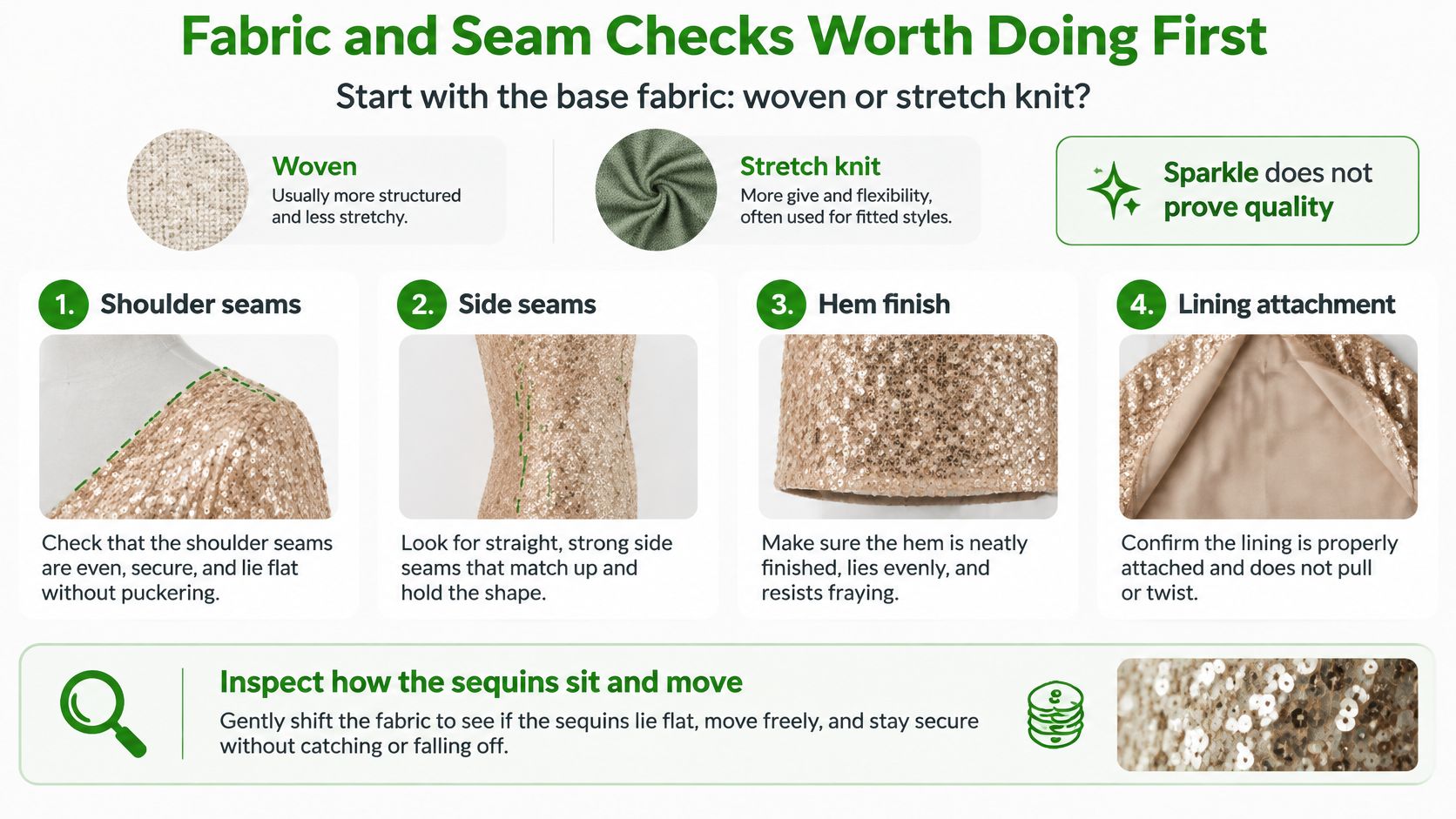
Inspect the garment in order, starting at the shoulder seams and moving down the body. Look for skipped stitches and exposed thread at the shoulders; puckering or sequins caught inside the stitch line at the sides; and a flat waist seam with the lining still attached. At the zipper ends, check for reinforcement. At the slit or hem, look for clean finishing and enough ease to sit and walk.
| Inspection point | What to check | Red flag |
|---|---|---|
| Shoulder seam | Stitch line straight with no gaps | Skipped stitches or exposed thread |
| Side seam | Flat seam with sequins clear of the stitch line | Puckering or sequins caught in the seam |
| Waist seam | Lining attached and seam lies flat | Lining pulling away or seam twisting |
| Zipper ends | Reinforced stitching at both ends | Thin stitching or sequins trapped under the teeth |
| Slit or hem | Clean finish and room to walk | Loose hem edge or fabric that binds at the knee |
The ASTM D1683/D1683M sewn-seam test standard measures seam strength, slippage, integrity, and efficiency. ASTM cautions that its test doesn't directly predict real-world wear. For garment inspection, that means a strong seam reading isn't a substitute for checking high-stress areas; a useful intake practice is to inspect every garment at those points and reserve destructive tests for a sample from each fabric-and-construction batch.
What a seam test can't tell you
Three errors can make an inspection less useful: testing a plain section instead of an embellished seam, ignoring stretch recovery, and assuming a strong seam proves the sequins won't detach. Check the actual areas that bend or bear tension, and consider how the lining and embellished layer move together.
For a closer look at construction choices beyond this particular dress type, Cedar & Lily Clothier's guide to quality women's clothing brands provides further reading on what to assess in clothing. For this purchase, prioritize a stable lining attachment, reinforced zipper ends, a clean hem, and enough ease to move without pulling at the seams.
Shoes, Layers and Jewelry That Keep It Intentional
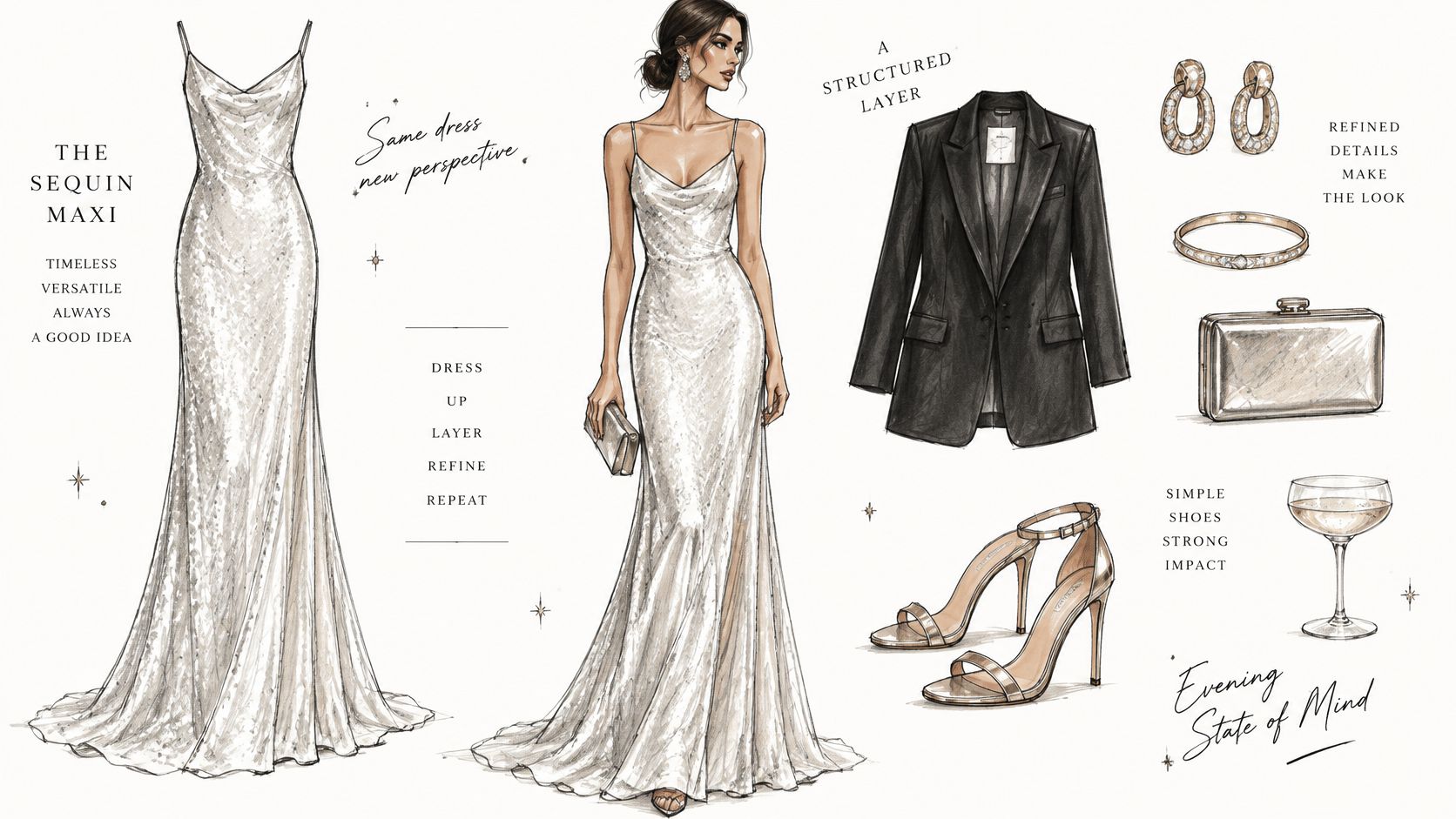
A white sequin maxi earns its cost when it works twice in a season. Send one dress to a Saturday evening wedding in strappy sandals, a slim clutch and small earrings. Send the same dress to a Thursday dinner under a camel blazer with structured shoulders, a metallic block heel and a soft tote. Only the texture, proportion and formality around the dress change. The sequins stay exactly as they are, and the second wear reads as a different outfit entirely.
| Setting | Styling choice | Check before wearing |
|---|---|---|
| Evening event | Strappy heeled sandals and restrained jewelry | Make sure the straps don't cut across or catch the sequin edge |
| Daytime or smart dinner | Metallic block heel and a cream knit cardigan | Avoid metallic-on-metallic overload and open-weave knits that snag |
| Dinner or work-to-weekend | Camel blazer with structured shoulders and matte leather clutch | Button the blazer and check that the sleeves don't rub at the armholes; test the clutch zipper |
| Gala or prom | Architectural jewelry or a controlled statement piece | Avoid hooks that catch the sequins |
| Wedding guest | Matte leather clutch and shoes suited to the dress code | Choose accessories that don't echo the bride's exact white |
Run every shoe, layer and bag against the dress before the event, not at the door. Button the blazer and swing your arms forward: if the sleeve lining drags across the sequin edge at the armhole, the shoulder is cut too narrow for this dress and the sequins will abrade within an hour. Press the clutch against your hip and work the zipper open and closed. A rough pull or a sharp tooth grabs the thread holding each sequin, and the damage shows up later as a bald patch near the waist.
Jewelry fails the same test in a different spot. Thin earring hooks slide along the shoulder seam when you turn your head, and rigid bangles score the sequins at the wrist. Save the architectural piece for a gala where you will be standing and photographed, and wear studs or a fine chain to a dinner where you will be sitting, reaching and eating.
Sequins have moved well past December. The fashion trend archive tracks renewed interest in the finish across seasons, which is precisely why the surrounding pieces decide whether the dress reads as eventwear or something quieter. Metallic tone is a styling question rather than an investment one: if you are matching gold, spot prices for Boise gold sellers give the market context, while your choice should follow the dress's undertone and the room you are walking into.
Heel height matters as much as heel style here. Our guide to shoes to wear with maxi dresses covers the heights that keep a sequin hem clear of the floor, which protects both the finish and the hem stitching. Change the layer, shoes and bag between wears, then run your hand along the armhole, the hip and the hem before the next outing.
Caring, Packing and Storing Between Events
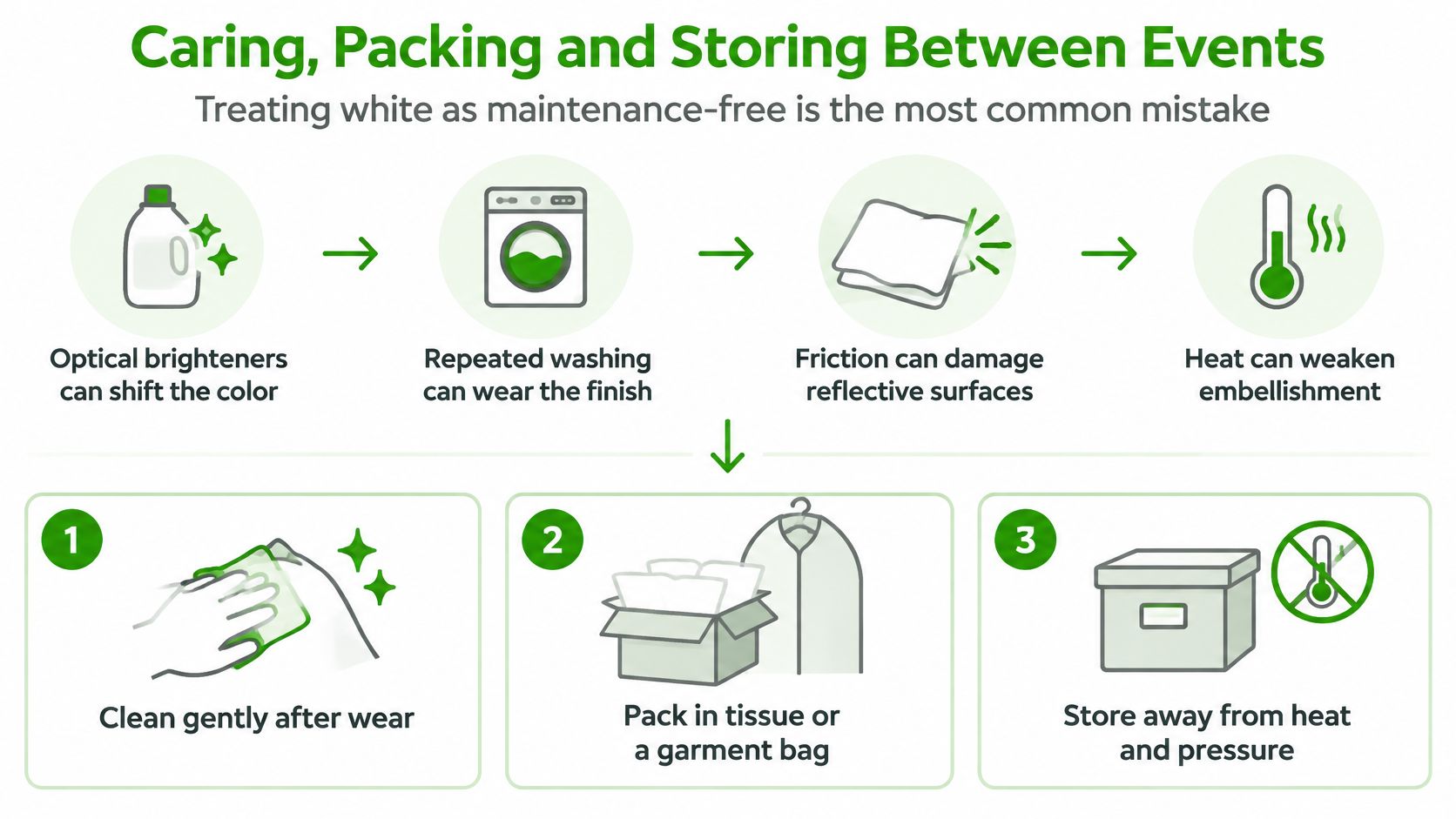
The common mistake is treating white as maintenance-free. Optical brighteners, repeated washing, friction, and heat can create uneven color or harm reflective finishes, even if the base fabric still looks sound.
Five steps for cleaning carefully
- Record the original appearance. Note the dress's whiteness and any difference among the sequins, lining, and base fabric. That makes a change easier to spot after cleaning.
- Test a hidden area. Check for dye transfer, the adhesive's response, and whether sequins remain attached. Avoid testing in a visible place.
- Follow the care label exactly. If the label requires professional cleaning, use a cleaner who can follow that requirement. A dry-cleaning service is one option to review when a garment needs professional care.
- Keep heat, abrasion, and solvents away. Use them only if the maker specifically approves them. These can affect the fabric, reflective finish, adhesive, or stitching.
- Inspect again after cleaning. Look for yellowing, gray transfer, warped sequins, loose stitching, and a shrunken lining before hanging the dress for its next wear.
An accelerated study of 25 laundering cycles found detergent-dependent changes in color strength and whiteness in cotton and cotton-polyester fabrics, with fading, dye bleeding, and loss of whiteness among the deterioration mechanisms described by the study on laundering and color change. Those results aren't a sequin-specific failure rate. They support a cautious care routine, not a prediction that a particular sequin dress will fail after a set number of cleanings.
Pack and store to prevent snags
For travel, use a breathable garment bag and keep the dress away from dark-dyed clothing. If it must be folded, avoid a sharp fold across heavy embellishment; lay tissue between sequin layers to reduce rubbing. Keep the dress clear of zippers and rough shoes, and pack a backup pair of shoes and a lint roller. The guide to packing dresses without wrinkles can help with the broader packing routine.
To refresh wrinkles, steam the garment inside out from a distance rather than applying direct iron heat. Store it in a cool, dry closet on a padded hanger, and check the seams and hem after each wear.
Care rule: If the care label and a general cleaning tip disagree, follow the label. A cautious test in a hidden area is better than risking a visible finish.
Shop Your White Sequin Maxi in Tulsa or Jenks
Cedar & Lily Clothier runs two Oklahoma storefronts, one in Jenks and one in Tulsa's Utica Square, and both stock dresses in Mini, Midi, and Maxi lengths. Call before you drive over and ask whether the sequin maxi you spotted online is on the floor. New arrivals land weekly, and a two-minute local availability check beats a wasted afternoon.
The Jenks store also handles pickup for online orders, usually ready within 24 hours. That route suits a white sequin maxi you want to inspect before an event: order it, collect it, and try it on with your event shoes while you are still in the building.
Compare designers, cuts, and lengths in person
Associates give fit guidance at the rack and can confirm whether a size you need is in stock locally or has to be ordered. Ask which size they would pull for your measurements rather than working it out from the hangtag alone, and have them look at the dress on you from the back, where a sequin maxi usually reveals whether the seat and hem sit clean.
The designer floor runs wide, from LoveShackFancy and Misa to FRAME, Paige, rag & bone, Mother, Retrofete, Shoshanna, and Spanx, so you can compare how different houses cut a long dress in one afternoon. If you want a softer alternative for a second look, the Althea Dress from LACE the Label hangs in the same conversation.
Online, browse the dress collection first, then read the shipping and returns terms before you commit. Orders over $250 ship free, gift packaging comes with purchases over $100, and size exchanges are easy if the fit is off when the box lands. When the dress code is unclear, describe the venue to the styling team and let them narrow the field.
Visit Cedar & Lily Clothier to browse dresses, compare lengths in person at either boutique, or send the team your event details and size.