

A white faux fur jacket usually enters the wardrobe through a moment of doubt. She sees it online or tries it on beneath boutique lighting, then studies the mirror and wonders whether it looks too dramatic, too bridal, or far too impractical for real life. The right one answers those objections quickly. It brings light to winter outfits, adds polish without stiffness, and gives everyday clothes a finished quality that a standard dark coat often can't.
The decision still deserves more than a pretty photograph. Pile density, backing, warmth, shedding, silhouette, and care labeling determine whether the jacket remains plush after a season of dinners, commutes, and event dressing. A stylist's eye helps with the rest, from choosing a cropped hem for high-rise trousers to finding a longer shape that works over a dress.
Table of Contents
- Why a White Faux Fur Jacket Belongs in Your Closet
- How to Judge a White Faux Fur Jacket Before You Buy
- Choosing the Right Silhouette and Length for You
- Outfit Recipes for Work, Weekend, and Events
- What Makes One Faux Fur Better Than Another
- Caring for Your Jacket So It Stays Bright White
- Shop the Collection at Cedar & Lily Clothier
Why a White Faux Fur Jacket Belongs in Your Closet
A white faux fur jacket earns its place because it solves several styling problems at once. Winter wardrobes can become a rotation of black wool, charcoal knitwear, and dark denim. White fur breaks that pattern without demanding a bright color underneath, so even a simple neutral outfit gains contrast and dimension.
The jacket also makes casual clothing look intentional. High-rise jeans and a weekend sweater can feel pulled together with one soft outer layer, while a simple black dress gains event polish when the jacket is draped over the shoulders. It works particularly well for holiday dinners, rehearsal dinners, daytime weddings, work events after five, and Saturday errands when comfort matters but looking composed still matters more.
The right kind of statement
White faux fur is expressive, but it doesn't have to be loud. A short, clean silhouette feels modern over slim-fit trousers. A hip-length version gives denim and knitwear a refined finish. A longer coat can replace a wool coat for evening, especially when the occasion calls for warmth and visual softness rather than corporate structure.
The material also has a meaningful fashion history. The Smithsonian's account of faux fur's development connects early imitation fur with the late-nineteenth-century surge in real fur garments, including sealskin coats, capes, jackets, and muffs. Early versions used pile fabric, while later textile advances from the 1920s through the 1950s moved toward synthetic fibers such as acrylic polymers, making more realistic and practical faux fur possible.
Stylist's rule: If the jacket works with denim, tailoring, and an evening dress, it isn't an occasional novelty. It's a wardrobe tool.
Why white works at events
Restaurant lighting, candlelight, and evening photography all reward a pale textured layer. White faux fur frames the face and creates a clean contrast against satin, black crepe, jewel tones, and metallic accessories. It also gives occasion outfits warmth without the visual heaviness of a dark coat.
The wider category has moved well beyond a niche fashion idea. A 2025 estimate valued the global faux fur market at $6.8 billion, with a projection of $12.4 billion by 2034 at a 6.9% CAGR, while another estimate placed the faux fur clothing market at $634.1 million in 2025 and projected $2.97 billion by 2035 at a 16.7% CAGR. Those figures are projections from market analysis of faux fur, not a promise about any individual jacket, but they show why faux fur outerwear now appears across everyday, work, and occasion dressing.
How to Judge a White Faux Fur Jacket Before You Buy
A beautiful white faux fur jacket should pass a tactile inspection before it passes the mirror test. In a store, the process takes only a few minutes, and each check reveals something the product photograph can't show.
Start with the pile
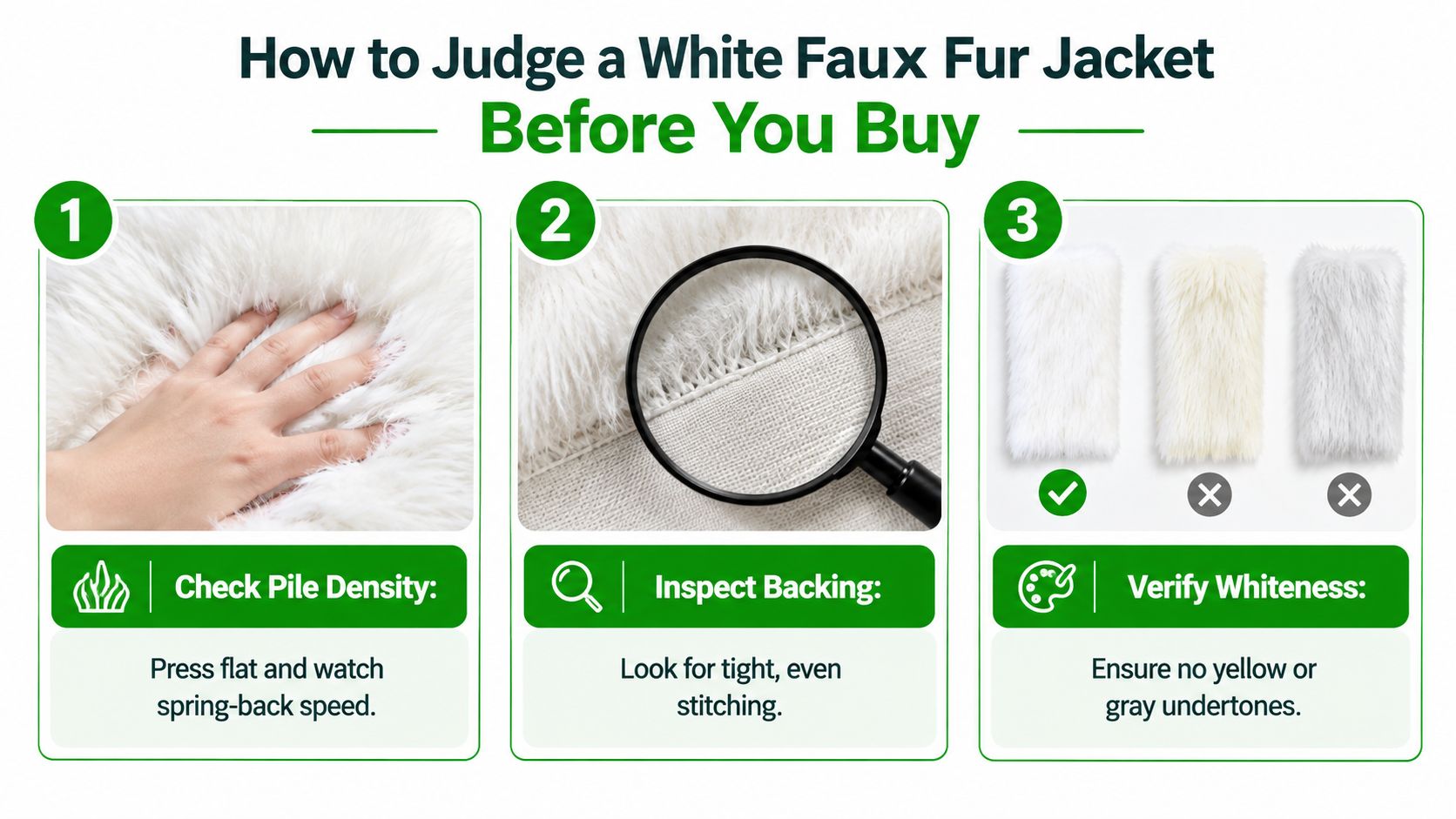
Press the fur flat with an open palm, then release it. Dense pile should recover with visible spring, while a slow, weak rebound suggests a thin construction that may flatten or shed more easily. Run the fingers with and against the nap, checking whether the surface feels even or reveals sparse patches.
White makes gaps and crushed areas easier to see. A jacket that already looks thin along the sleeve, collar, or front edge won't become more luxurious with wear.
Next, rub the palm firmly against the pile against the grain for roughly ten seconds. A few loose fibers can occur during initial wear, but a visible bald patch indicates weak anchoring. For professional sourcing, guidance recommends third-party testing after abrasion or repeated flexing, with a target of less than 0.5 grams shed per 100 grams of fabric after 500 cycles and a Grade 4 to 5 pilling-resistance rating on the AATCC scale, as outlined in faux fur performance guidance.
Inspect the backing and construction
Gently tug the lining and feel beneath the pile. A tight, even, breathable substrate should feel stable rather than like a stiff plastic-coated mesh. The backing anchors the fibers and influences how the jacket holds its shape, how warm it feels, and how it responds to cleaning.
Check the shoulder seams, sleeve width, and body shape. White amplifies every cut line, so a dropped shoulder may look intentionally relaxed or just oversized. A body that skims the torso usually layers more elegantly than one that flares without structure.
Length changes the message:
- Hip length layers neatly over blazers and sweaters.
- Mid-thigh length looks more polished and coat-like.
- Below the knee moves decisively into evening territory.
Finish by testing the closure. Buttons or hooks shouldn't strain across the bust, and the armhole needs room over a chunky knit without pulling across the back. The collar should sit close to the neck without gaping or forcing the chin forward. Readers comparing construction across outerwear can also use this guide to luxury women's jackets as a useful fit reference.
Choosing the Right Silhouette and Length for You
The most flattering white faux fur jacket is the one whose hem and volume support the rest of the outfit. Cropped and midi lengths create very different proportions, so body frame matters, but lifestyle and occasion matter just as much.
A cropped jacket ending at the high hip or waist suits petite frames and looks especially good with high-rise trousers, pencil skirts, and sheath dresses. Because the shorter hem visually shortens the torso, the cleanest styling uses a longer bottom or a tonal column underneath. It makes a strong choice for date night, brunch, and creative-work offices.
A midi jacket, ending around mid-thigh to just above the knee, behaves more like a true coat. It works over midi dresses, wide-leg trousers, and chunky boots without stacking too much volume at the hips. Taller frames often carry this length naturally, but the deciding factor should be where the hem lands on the individual body. It suits travel days, parent-teacher conferences, and evening occasions that call for more coverage.
Cropped versus midi
| Feature | Cropped White Faux Fur Jacket | Midi White Faux Fur Jacket |
|---|---|---|
| Best proportion | High-rise bottoms and longer layers | Dresses, wide-leg trousers, and slim bases |
| Visual effect | Defines the waist and lifts the outfit | Creates a longer, coat-like line |
| Useful occasions | Date night, brunch, creative offices | Travel, work appointments, evening events |
| Petite styling | Keeps the frame from feeling overwhelmed | Choose a cleaner, less bulky shape |
| Weather role | Better for mild conditions or indoor transitions | Offers more coverage over the legs |
| Footwear | Sleek boots, loafers, or heels | Tall boots, chunky boots, or pointed shoes |
The hemline rule is simple: end the jacket where the eye should stop, usually at a narrow part of the frame. A waist-length hem can highlight the waist. A mid-thigh hem can create a long vertical line when the outfit underneath stays clean.
For further proportion guidance, the body-shape dressing guide can help translate the same principles to dresses, trousers, and jackets already in the wardrobe.
Outfit Recipes for Work, Weekend, and Events
A white faux fur jacket becomes easy to wear once the base outfit has a clear purpose. The jacket supplies texture and light, while the pieces underneath control how formal, relaxed, or practical the finished look feels.
Work outfit
For the office, layer the jacket over a fine merino turtleneck in camel and wide-leg trousers in charcoal. The warm camel keeps the white from looking stark, while charcoal grounds the texture and prevents the outfit from drifting into bridal territory. A structured leather tote gives the look enough architecture for meetings.
The jacket should sit cleanly over the shoulders, not swallow the turtleneck collar. A cropped or hip-length style usually works best with the wide-leg trouser because it protects the waistline and keeps the legs visually long. For a more conservative workplace, wear the jacket as an arrival layer and remove it indoors.
Weekend outfit
Weekend dressing needs softness without looking unfinished. A chunky cream knit, high-rise straight-leg jeans, and clean white sneakers create a tonal base that lets the pile provide the interest. Tan ankle boots offer a warmer alternative when the weather is damp or the outfit needs a little more polish.
The tonal combination works because the textures differ. The knit looks substantial, the denim supplies structure, and the faux fur adds softness. If the sweater is especially thick, a midi jacket may feel crowded at the arms, so a hip-length cut with a generous armhole makes the easier choice.
Evening outfit
For dinner, a black slip dress or silk camisole with heels and a small clutch gives the jacket a clear role. The contrast between sleek satin and soft white pile creates the entire point of the outfit, so accessories should stay edited. A silver earring, a dark clutch, and a simple heel are enough.
A longer jacket adds ceremony to a daytime dress, while a cropped bolero is ideal over a fitted slip silhouette. If the evening is outdoors, choose a denser, fully lined construction and add opaque hosiery or a fine base layer underneath. For more work-to-evening combinations, the day-to-night outfit guide offers useful wardrobe-building direction.
Cedar & Lily's knits, denim, slip dresses, footwear, and outerwear categories make these outfit formulas practical to shop as complete looks rather than isolated pieces. The strongest version is the one that fits the reader's actual calendar, not merely the one that looks striking on a hanger.
What Makes One Faux Fur Better Than Another
Fiber content gives a useful starting point, but hands-on construction tells the fuller story. Quality faux fur commonly uses acrylic, modacrylic, and polyester fibers in a dense pile. Commercial jacket compositions can include blends such as 67% acrylic and 23% modacrylic or 80% acrylic and 20% polyester, with acrylic supporting softness and loft while polyester contributes shape retention and wear resistance, as shown in commercial faux fur jacket composition guidance.
Modacrylic often gives the pile a plush hand, while polyester helps the fabric remember its shape. The ideal blend depends on the desired finish, but sparse pile can't be rescued by an impressive fiber label.
| Signal | What to Check | What It Means |
|---|---|---|
| Pile density | Press, release, and inspect exposed backing | Fuller coverage usually supports warmth and a richer appearance |
| Fiber anchoring | Rub against the nap and check for loose tufts | Persistent loss points to weak construction |
| Backing | Look for tight, even stitching and a stable substrate | Better support helps the jacket hold its shape |
| Lining | Check whether it slides smoothly over clothing | A quiet, fluid lining reduces drag and bunching |
| Loft versus weight | Compare plush volume with the actual drape | Loft can feel warm, while excessive bulk limits layering |
A woven cotton or rayon backing generally holds its shape more reliably than a thin knit. A silk-blend or Bemberg cupro lining can glide smoothly over a dress or sweater, which matters when the outer pile already supplies visual volume.
FTC care labeling provides another useful checkpoint. In the United States, manufacturers and importers must provide complete care instructions or warnings, attach them permanently and securely, and ensure the guidance won't cause substantial harm when followed, according to the U.S. apparel care-labeling guide. The label tells the wearer how the garment should be cleaned. It doesn't prove that the pile is dense, the backing is durable, or the jacket is warm enough for extended outdoor use.
Caring for Your Jacket So It Stays Bright White
White faux fur needs a routine, not anxiety. Most damage comes from friction, compression, heat, and delayed treatment of makeup or food marks. A jacket that receives gentle maintenance keeps its loft and color far better than one left crushed on a chair or packed into a tight closet.
After wearing
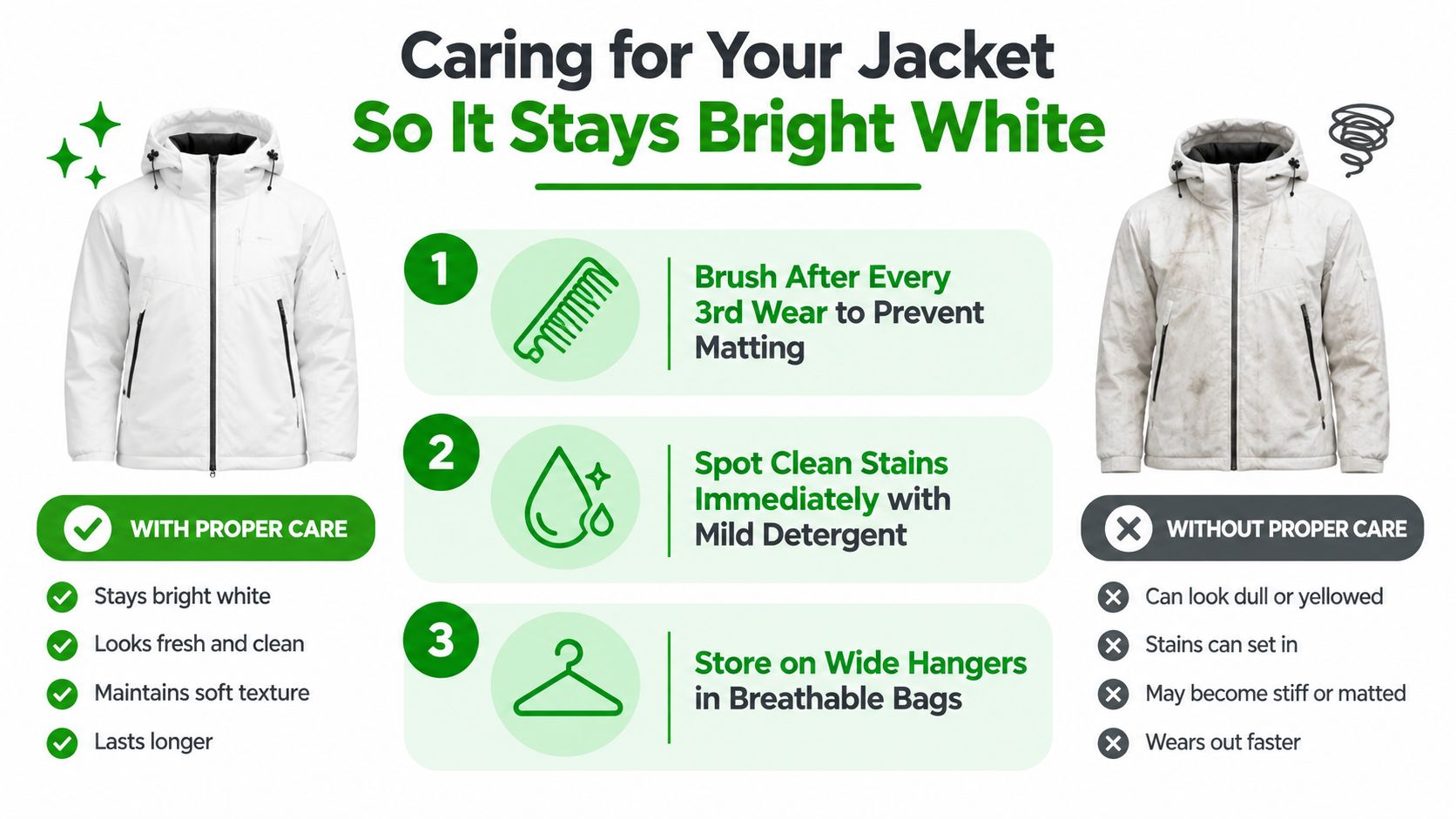
Brush the jacket after every third wear with a wide-tooth comb or a dedicated faux fur brush. Work in the direction of the nap, lifting the fibers rather than scraping through them. This removes surface lint and helps prevent the compressed, gray-looking areas that develop around cuffs, underarms, and the back of the neck.
Some loose fibers during the first two wears can be normal. Persistent shedding after that points toward poor anchoring, especially if the pile becomes visibly thin. Don't pull individual strands. If a jacket continues to shed heavily, the problem is construction rather than a care failure.
Treat marks quickly
For makeup, coffee, or food, spot clean with a damp microfiber cloth and a small amount of gentle detergent. Dab in the direction of the nap rather than rubbing across it. Thorough but gentle brushing, damp-cloth spot cleaning, and drying away from direct heat are also recommended in extension guidance for faux fur care.
Steam can refresh the surface, but the nozzle shouldn't press into the pile. Ironing is out because direct heat can crush or distort synthetic fibers. Follow the garment's own care label for any deeper cleaning, and use a professional cleaner familiar with faux fur when a seasonal refresh is needed.
Store for recovery
Use a wide padded hanger and a breathable cotton garment bag. Keep the jacket in a cool, dry closet away from direct sunlight, which can contribute to yellowing. Rotate it between wears so the pile can recover instead of staying compressed in the same contact zones.
A simple seasonal routine includes brushing, checking the collar and cuffs for matting, inspecting the lining, and arranging professional cleaning when needed. The guide to avoiding pilling offers additional fabric-maintenance principles that apply to the knitwear worn beneath the jacket.
Shop the Collection at Cedar & Lily Clothier
A white faux fur jacket should be chosen with the same care as an occasion dress. The right silhouette needs to fit the shoulder, accommodate the intended layers, and suit the reader's actual schedule. Online photographs can show color and styling, but they can't show whether the pile springs back, whether the collar gaps, or whether the armhole works over a substantial knit.
Cedar & Lily Clothier carries curated designer and contemporary womenswear, including lines such as Vanessa Mooney and Lace the Label, alongside jackets, knits, denim, slip dresses, footwear, and accessories that complete the outfit. The retailer doesn't manufacture its own line, so the buying experience centers on selecting pieces from the brands in the assortment and building a wardrobe around them.
The Generation Love Carla vegan leather and faux fur combo coat offers another way to approach the texture, pairing faux fur with a structured vegan-leather element rather than relying on an all-fur silhouette. That kind of contrast can feel more versatile for workdays, travel, and casual evening plans.
Local shoppers can visit the boutiques at Utica Square in Tulsa or downtown Jenks to assess fit and fabric in person and receive styling help from the team. Online shoppers can use the store's fit guidance and outfit suggestions when deciding between a cropped, hip-length, or longer outer layer.
Cedar & Lily Clothier offers curated outerwear and the accompanying knits, denim, dresses, and footwear needed to make a white faux fur jacket work beyond one event. Visit Cedar & Lily Clothier online, or stop by Utica Square in Tulsa or downtown Jenks for an in-person fit check and styling help.