

A senior scrolls through prom gowns while her mother asks the practical question she has been holding back: “What happens with the bra?” The daughter sees a dramatic back, beautiful photographs, and a dress unlike anything she has worn before. Her mother sees straps, slipping fabric, school rules, and several hours of dancing.
Both perspectives matter. An open-back prom dress should look striking from the entrance to the final photograph, but it also needs to stay smooth when the wearer sits, raises her arms, turns, and moves. The best choice balances the back opening with the gown's silhouette, fabric, support, styling, and the event's expectations.
A thoughtful fitting also looks beyond prom night. The right gown can become a keepsake for weddings, galas, formal dinners, or future celebrations when its color, construction, and alterations remain adaptable. The historical record of prom fashion supports that perspective. Prom became a broadly popular American high-school tradition during the 1930s, developing from earlier debutante balls and college dances, while The Henry Ford's documented prom-dress collection spans 1960 to 2006, showing how formal silhouettes and levels of exposure have changed over time (The Henry Ford's prom-dress history).
Table of Contents
- Finding the Open-Back Prom Dress That Feels Like You
- What Makes a Prom Dress Open Back
- Fabrics and Construction That Shape the Look
- Bras and Support That Actually Work
- Hair, Jewelry, and Shoes for an Open Back
- Modesty Panels and Smart Alterations
- Matching the Dress to Your Body, School, and Night
Finding the Open-Back Prom Dress That Feels Like You
A shopper usually knows the feeling before she knows the terminology. She pulls a gown from the rack because the front looks polished, then turns it around and discovers a low scoop, a narrow V, or a sweeping opening framed by straps. That moment is where a stylist starts asking better questions. Does the wearer want the back to be the surprise, or should it support an embellished front? Does she feel secure in a fitted column shape, or does she prefer an A-line skirt that gives her room to move?
A useful prom dress shopping guide begins with the entire night, not just the mirror. The dress needs to work under flash photography, beside a date or group of friends, on a dance floor, and during the practical business of sitting down. The most successful open backs look intentional from every angle because the front neckline, waist placement, skirt movement, and back cut speak the same design language.
Start with the back, then check the whole silhouette
A column gown gives a low or deep V back a sleek, editorial effect. A fitted crepe style often feels refined because the clean skirt keeps the exposed back from looking overworked. An A-line or princess silhouette creates a softer contrast, especially when the back includes lace, beading, or a delicate strap arrangement. The opening should enhance the shape, not compete with it.
The shopper should turn slowly in the dressing room and inspect the gown from the side. A beautiful back can still feel wrong if the opening sits too low for her comfort, pulls the waist seam upward, or exposes more than expected when she moves. Garment-fit principles emphasize ease, balance, line, and the relationship between the garment and the wearer's body contour, particularly when the back neckline and side seams are exposed (garment fit and body-shape research).
Stylist's rule: The right open back is the one the wearer stops thinking about after the first dance.
Treat the gown as a milestone purchase
A dramatic design doesn't have to mean a single-use dress. Clean lines, durable fabric, removable embellishment, and an opening that can be layered with a jacket or sheer wrap give a gown a longer life. A highly themed cutout or fragile decoration may look memorable in one set of photographs but become difficult to restyle later.
The fitting process should therefore cover more than visual appeal. The shopper should learn how the fabric reacts to flash, whether the bodice contains built-in support, how the back edge is finished, and whether an illusion panel could solve a school-policy or comfort concern. A gown that looks elegant, photographs beautifully, and stays wearable for several hours is a better keepsake than one that requires constant adjustment.
What Makes a Prom Dress Open Back
Marketing language can blur important differences. A dress may have a small keyhole, a lace overlay, a sheer panel, or a genuinely exposed back, and each design behaves differently on the body.
A true open-back gown removes fabric from a meaningful portion of the back while preserving enough structure at the shoulders, sides, waist, or front to hold the garment in place. The opening may be shallow and sit just below the shoulder blades, or it may descend toward the natural waist. A fully backless style leaves the greatest amount of skin visible and places the greatest demand on the front bodice and side construction.
Read the opening from the rack
The back view tells more than the product name. A shopper should inspect the following details before stepping into the gown:
- Find the lowest point. A rounded scoop usually exposes the back gradually. A deep V concentrates the visual line toward the waist. A keyhole leaves more surrounding fabric in place and often feels less exposed.
- Check where the zipper ends. A zipper that stops high on the back may signal a larger opening below it. A closure that continues toward the waist can provide more anchoring, even when the upper back is exposed.
- Look at the lining. A lined bodice usually offers more coverage and stability than an opening finished only with a narrow binding. A sewn-in mesh panel may create an illusion effect rather than a fully bare back.
- Identify the straps. Wide straps, crossed straps, and halter structures usually contribute to support. Thin decorative straps may frame the opening without carrying much of the garment's load.
- Separate skin from illusion. Lace, tulle, and mesh can make a back appear open from a distance while providing real coverage. That can be an advantage for comfort, support, and school approval.
Match depth to confidence and movement
A shallow keyhole or low scoop works well for a first open-back experience because it offers drama without removing as much anchoring fabric. A mid-back opening can flatter many silhouettes while leaving room for cups, side seams, or a structured waist. A deep V or waist-level opening creates a stronger photograph, but the fit must be exact because excess ease can lead to gaping, strap displacement, or tension across the front bodice.
The wearer should sit, walk, rotate, and lift both arms before deciding. The opening should remain smooth, the waist seam should stay level, and the edges shouldn't cut into the skin. A back that shifts during a simple dressing-room movement test will demand even more attention during dancing.
Fabrics and Construction That Shape the Look
Fabric determines whether an open back reads as sleek, romantic, soft, or overtly dramatic. Construction determines whether that impression survives movement.
Satin and mikado create a sculpted effect. Their firmer hand can support boning, hold a clean waistline, and reflect light clearly in portrait photographs. High-shine surfaces can reveal every ripple, so the bodice must lie smoothly and the zipper must sit flat. A structured satin gown can look exceptionally polished, but it has little patience for poor fit.
Crepe and matte jersey produce a quieter line. They skim the body, soften the contrast between skin and fabric, and usually photograph with less reflective glare. That makes them a strong choice for a shopper who wants the back opening to feel elegant rather than theatrical. Stretch can improve comfort, but too much stretch may let the opening roll or migrate.
Lace changes depending on what sits beneath it. Lace over bare skin gives a more dimensional, romantic effect, while lace over illusion mesh provides visual texture with additional coverage. Chiffon godets and layered skirts make the opening feel lighter because the eye moves between the exposed back and the fluid lower half of the gown.
Construction details worth checking
Look inside the bodice, not only at the surface. Boning can support the front and side seams. Molded or sewn-in cups can shape the bust without a visible bra. Underbust elastic can help transfer support through the torso. Gripper elastic along the back edge may reduce sliding, while a lined bodice prevents the outer fabric from stretching independently of the structure.
A weighted hem can help a flowing skirt hang cleanly, especially when the wearer walks or turns. The zipper should lie flat without rippling, and the back edge should follow the body rather than flare away. For a deeper opening, stable closures and carefully distributed support matter more than adhesive alone.
| Fabric | Drape & Support | Flash Photo Result | Care & Longevity |
|---|---|---|---|
| Satin or mikado | Sculpted, stable, well suited to structured bodices | Reflects light cleanly and emphasizes smooth construction | Requires careful storage and protection from snags and creasing |
| Crepe | Skims the body with a refined, matte line | Softens glare and photographs with understated polish | Often adaptable for later formal events when properly stored |
| Matte jersey | Comfortable and fluid, with useful movement | Creates a softer, less formal visual effect | Stretch should be protected from prolonged strain |
| Lace over skin or mesh | Adds texture and visual detail around the opening | Shows dimension and contrast in close photographs | Delicate areas and embellishment need careful handling |
| Chiffon layers | Light, fluid, and less rigid through the skirt | Moves beautifully in walking and turning photographs | Needs protection from pulls and rough surfaces |
For a broader look at how fabric changes comfort and wear, the summer dress fabric guide offers useful context. The same principle applies here: the most attractive textile is the one that supports the intended shape and the wearer's plans.
Bras and Support That Actually Work
A traditional bra band rarely belongs beneath a true open-back gown. The correct solution depends on the opening depth, the bodice structure, the wearer's bust, and the amount of movement expected.
Adhesive cups work best when the front neckline is secure and the back is too low for a conventional band. They suit shallow-to-deep openings when the gown already provides most of the shaping. The skin must be clean and dry, with no lotion or oil where the adhesive will sit. Silicone products also need a skin-sensitivity test before the event, not during the final dressing rush.
Low-back converter bras can suit a scoop or moderate opening, especially when the gown leaves enough room at the sides and waist for the altered band placement. They're less useful for a very deep V or a fully exposed back because the hardware can still rise into view.
Built-in shelf construction is often the cleanest option. Molded cups, sewn-in cups, side boning, underbust elastic, and a stable waist seam can distribute support through the gown itself. Sewn-in cups may shift if the bodice is too loose or if the cup placement doesn't match the wearer's bust, so the fitting must include bending and rotation, not only standing still.
| Back Depth | A–B Cup | C–D Cup | DD+ Cup |
|---|---|---|---|
| Shallow scoop or keyhole | Built-in cups or a low-back bra may work well | Structured cups with side support offer a cleaner line | Wider side panels, firm boning, and a higher opening are usually the safer direction |
| Mid-back opening | Adhesive cups can preserve the open effect | Built-in molded cups or a supportive converter may suit the design | Favor strong front construction, underbust anchoring, and a moderate back opening |
| Deep V or fully backless | Adhesive cups or a well-built bodice can keep the back clear | Choose substantial front structure and test the gown through movement | A higher back, wider straps, or custom support may provide more confidence than maximum exposure |
Run the complete outfit test
A fitting isn't finished until the wearer tests the gown with the intended undergarment, shoes, jewelry, and hairstyle. The complete outfit should be worn for 30 to 60 minutes, with time spent sitting, raising both arms, bending, rotating the torso, walking, and moving as if dancing. That practical test follows fit guidance that emphasizes dynamic movement rather than standing posture alone (open-back garment fit guidance).
The mirror should show no visible adhesive edges, cup spillover, strap displacement, zipper rippling, or ride-up. If the dress gaps, tighter adhesive isn't a real fix. The bodice, cups, straps, or waist may need alteration, because support should transfer through the bust, side seams, waist, and shoulders rather than rely on the exposed back edge.
A useful related resource is this large-bust occasion-dress guide, particularly for shoppers deciding whether a slightly higher back will deliver better security and a more composed silhouette.
Hair, Jewelry, and Shoes for an Open Back
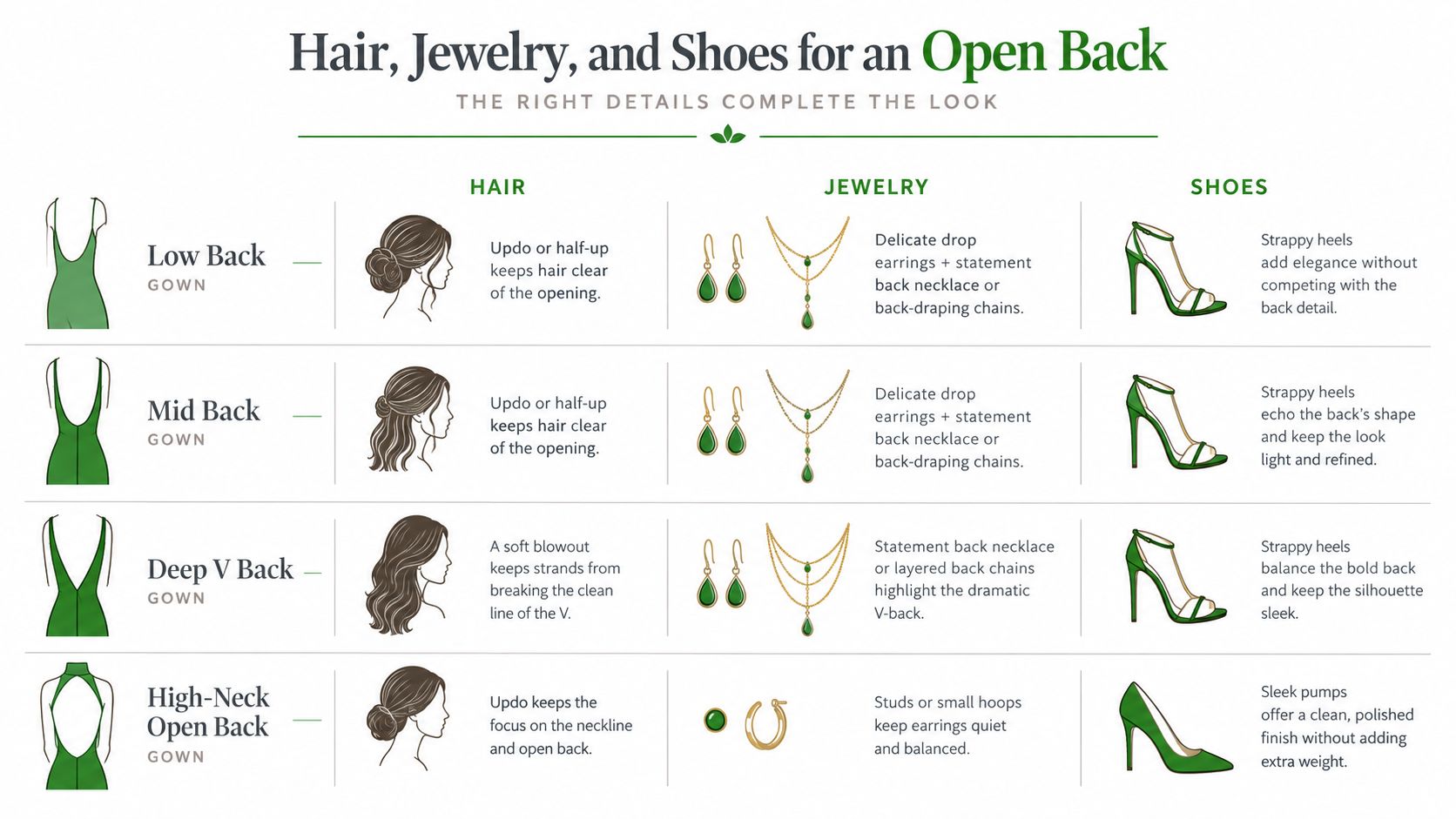
The back opening should determine the finishing choices. An updo or half-up style keeps hair clear of a low or mid-back cut, allowing the gown's architecture to show in photographs. A soft blowout can work with a keyhole or deep V when the hair falls forward instead of tangling across the opening.
A high-neck open back already creates a strong frame around the face and shoulders. Quiet studs or small hoops may be enough. For a lower back with minimal embellishment, drop earrings can draw attention upward while preserving the back as the focal point. A bulky choker usually competes with a high front neckline, and a back-draping necklace can become cluttered when the gown already includes lace, beading, or crossed straps.
Let the venue decide the shoe
A block heel is the practical choice for grass, uneven outdoor surfaces, or a night that includes substantial walking. A pointed stiletto sharpens a floor-length satin or crepe gown for a ballroom setting. Embellished flats can look intentional with a shorter dress or a fluid skirt, especially when dancing matters more than additional height.
Shoe weight should echo the gown. A delicate strap works with a fine, barely-there back, while a substantial heel can balance a corseted or heavily embellished design. Hem length matters just as much. The wearer should try the exact shoe during alterations so the skirt clears the floor without losing its intended proportion.
The earring style guide from EP Fine Jewelry can help a shopper choose between drops, studs, and hoops while keeping the open-back detail visually central.
A quick coordination guide
- Low or mid-back gown: Hair up or half-up, delicate drops, and a balanced heel.
- Deep V back: Soft blowout or side-swept hair, restrained earrings, and a sleek pump.
- High-neck open back: Quiet studs or a small hoop, clean hair pulled away, and shoes that add polish without competing.
- Embellished or lace back: Skip a back necklace, keep jewelry near the face, and choose shoes with a simpler finish.
- Outdoor venue: Secure the hem, choose a block heel, and avoid a shoe that sinks into the ground.
- Dance-heavy evening: Choose stable straps or embellished flats, then confirm that the gown moves without pulling at the bodice.
More accessory pairing ideas appear in this guide to accessorizing an outfit, where the central principle remains the same: every finishing piece should support the gown's strongest line.
Modesty Panels and Smart Alterations
Coverage adjustments don't make a luxury gown less special. They can make the design more wearable, more comfortable, and more appropriate for a particular school or venue.
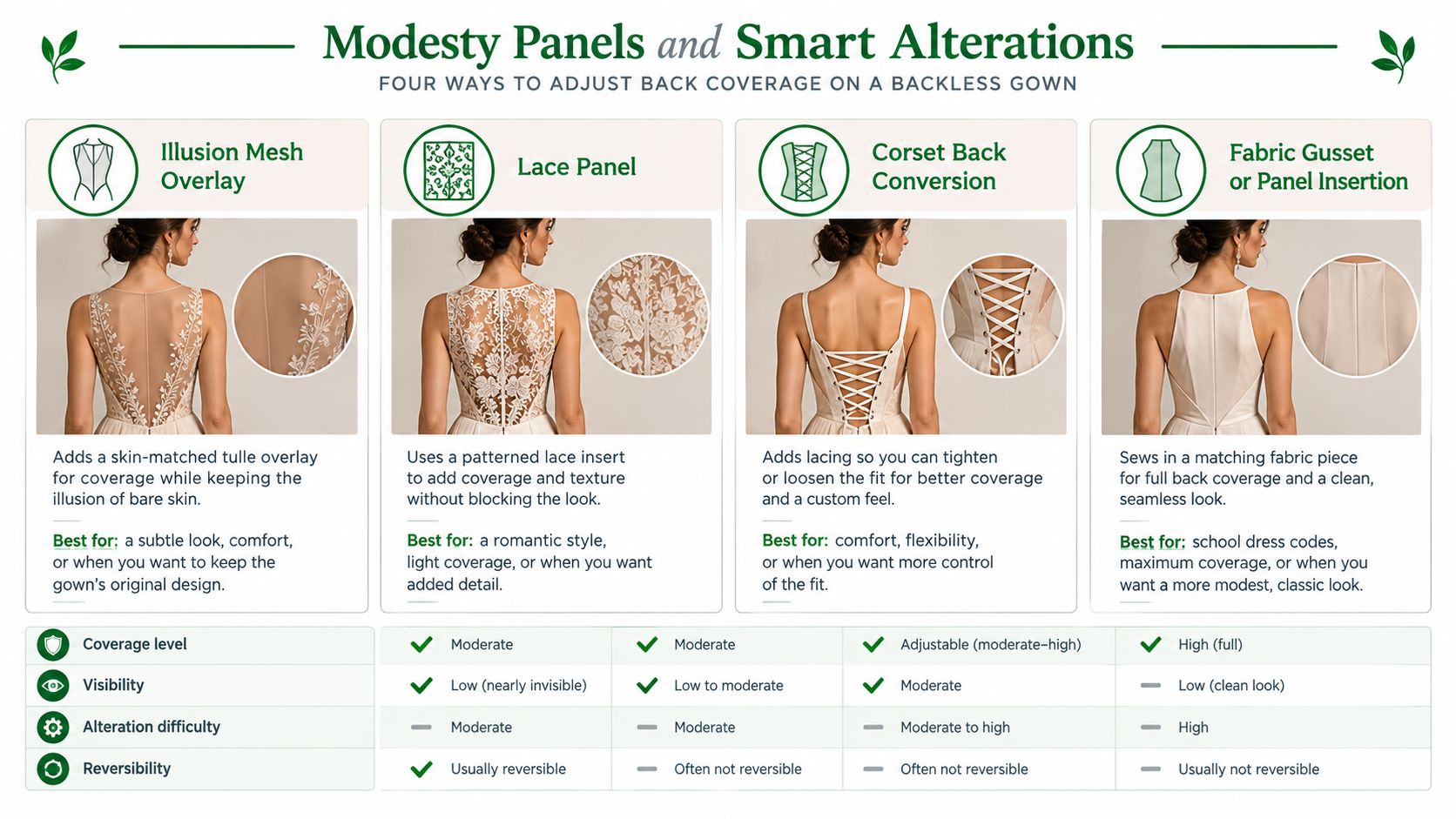
An illusion mesh overlay places skin-toned tulle across part or all of the opening. From a distance, it can preserve the impression of bare skin while giving the wearer more security. A lace panel adds coverage with visible texture and can look like an intentional part of the original design, especially when it echoes lace elsewhere on the gown.
Choose the least visible solution that solves the concern
A removable strap can add confidence during dancing without changing the gown permanently. It works best when the design has a natural place for the strap to attach and when the added line looks deliberate from the front and back.
A fabric gusset or modesty panel offers the most coverage. It may be the right choice when the school requires more back coverage or when the wearer wants a gown that feels less exposed. A corset-back conversion can improve adjustability, but it changes the original construction and deserves careful planning if the gown includes structured fabric or intricate embellishment.
School policies vary. Some published formal-event standards allow an open back only to the natural waistline, while others allow bare backs but prohibit exposed stomachs, visible undergarments, or excessive cutouts. One prom standard permits open backs while disallowing bare midriffs and visible undergarments, and another requires mesh lining for certain cutouts (formal-event dress-code example, school prom standard).
Schedule alterations around complexity
A clean hem adjustment may be straightforward, but the timing depends on the fabric, lining, train, and embellishment. Adding mesh, matching lace, new straps, or internal support requires more planning because the alteration must remain invisible in photographs and preserve the gown's balance. The women's tailoring guide offers helpful perspective on why a professional fitting matters.
Oklahoma shoppers should confirm the current policy with the school, administrator, or event sponsor before purchasing. Oklahoma Union Public Schools states that event sponsors may establish and enforce standards for public events, including prom, and that attire expectations can be enforced at the event (Oklahoma Union Public Schools event-dress guidance).
A modesty panel is not a failure of the original design. It is a finishing choice that helps the wearer enjoy the gown without second-guessing every photograph or movement.
Matching the Dress to Your Body, School, and Night
The most flattering open back is selected through three filters: body proportions, event rules, and the actual plans for the evening. Trend appeal comes last.
A pear-shaped figure often benefits from a lower-back V paired with eye-catching straps or detail higher on the body, which balances the visual line. A petite wearer should check that the opening doesn't sit too low and overwhelm the torso. A structured crepe gown can define the waist beautifully on an hourglass figure, while ruching or a softly draped cowl back can add dimension to a straighter frame.
These are starting points, not restrictions. The body-shape test is simple: the back opening should draw the eye where the wearer wants it to go, the waist should remain level, and the skirt should create the movement appropriate for the venue.
| Body Shape | Recommended Back Cut | Coverage for School Policy | Event Formality |
|---|---|---|---|
| Pear | Lower V with detailed straps or an embellished upper back | Add illusion mesh if the opening extends too low | Works with a floor-length gown for formal venues |
| Petite | Keyhole, shallow scoop, or carefully proportioned mid-back | Choose a higher opening or modesty panel when required | A shorter or lighter style can suit a less formal event |
| Hourglass | Structured mid-back with a defined waist | Keep the natural-waist boundary clear and confirm local rules | Crepe, satin, or mikado suits elevated occasions |
| Rectangular | Ruching, draped cowl, or layered back detail | Lace or mesh can add coverage without flattening the design | Fluid jersey or chiffon works for relaxed formal settings |
Confirm the rules before falling in love
Prom policies belong to the individual school or venue. Some use the natural waistline as the practical limit for an open back. Others address midriff exposure, straps, slits, lining, or visible undergarments separately. A gown that passes one school's standard may not pass another's, so the shopper should confirm the current requirements before committing.
The event itself also determines the right fabric and finish. Black-tie surroundings call for a floor-sweeping satin or mikado gown with controlled structure. Semi-formal plans can accommodate crepe, jersey, or chiffon. A post-prom gathering may favor a shorter style or a removable train that changes the dress after the formal photographs.
Regional preferences also support a flexible approach. A prom survey reported the highest average dress spend in the Northeast at $699.56, with the column silhouette most common there at 31%. The South showed a 30% preference for the princess silhouette and a 76% attendance rate, while the Midwest showed a 38% preference for the princess shape. Ticket costs in that survey ranged from $24.56 in the Midwest to $63.71 in the Northeast (Teen Vogue's regional prom survey). The useful lesson isn't to copy one region's taste. It's to offer the open back across recognizable silhouettes and different levels of structure, then choose through personal fit and event needs.
A private fitting at Cedar & Lily Clothier gives the shopper a chance to compare back depths, feel fabrics, test support, and discuss alterations before the decision becomes urgent. The collection is available in person at Utica Square in Tulsa and downtown Jenks, where the team can help match an open-back silhouette to measurements, school policy, shoes, and the full evening ahead.
Shop the curated occasion collection at Cedar & Lily Clothier for polished open-back styles and personalized guidance on fit, support, and finishing details. Visit the boutique at Utica Square in Tulsa or downtown Jenks to see the fabric and back construction in person, or reach out to the styling team for help choosing a gown that feels beautiful all night and remains worth wearing again.