


The dress looks perfect on the hanger, but in the mirror the neckline gaps, the bust seam pulls, and the waist rides upward. A wedding guest dress for a large bust rarely fails because of taste. It fails because the pattern, support, and body measurements aren't working together.
The solution starts with engineering, not concealment. A dress should hold the bust securely, leave enough room at the fullest point, and keep the waist and hem in their intended positions. Once that foundation works, the neckline, color, fabric, and silhouette can do their style work.
Table of Contents
- The Fitting Room Moment Every Busty Shopper Knows
- Measure Yourself the Right Way Before You Shop
- Necklines and Silhouettes That Actually Flatter
- Bras and Undergarments That Do the Real Work
- Fabric and Construction Choices That Hold You Up
- Tailoring the Dress So It Fits Like It Was Made for You
- Your Next Step and Quick Answers to Last-Minute Questions
The Fitting Room Moment Every Busty Shopper Knows
She stands in front of the fitting-room mirror and smooths the dress down for the third time. The waist looked promising when she first pulled it on, but the neckline has opened away from her chest, the seam strains across the bust, and the skirt has climbed slightly higher in front. Tugging the fabric into place helps for a moment, then the dress returns to the same position.
Those aren't minor annoyances. They're evidence that the bodice can't accommodate the bust volume.
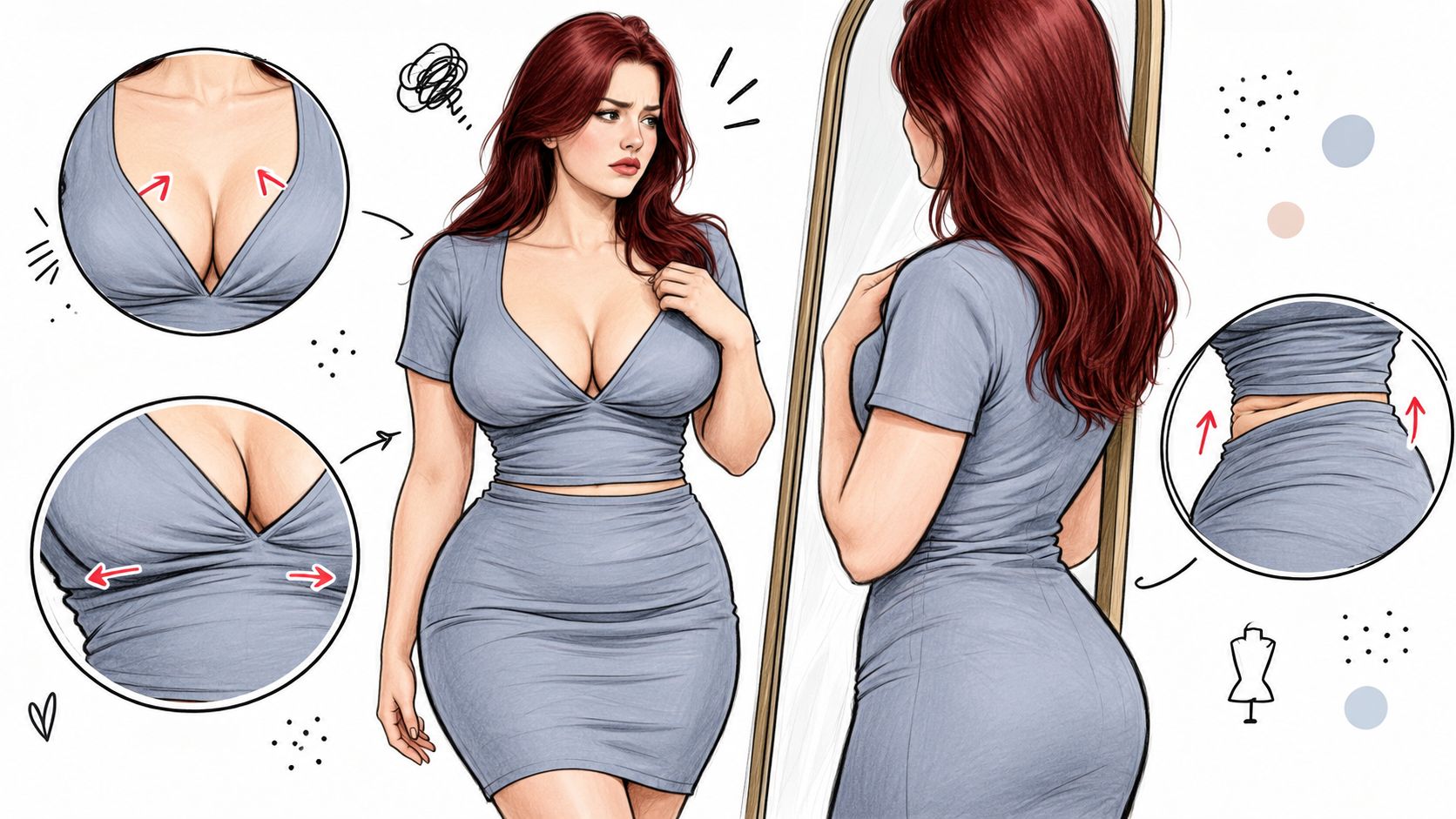
Three signs the bodice is under strain
- Fabric tenting over the apex: When the fabric floats outward over the fullest point, the bust needs more room than the pattern provides. A larger bust cup, a different cut, or added shaping through darts or princess seams can correct it.
- Diagonal drag lines toward buttons or closures: These lines show tension traveling from the bust toward the point of closure. The front needs additional ease or a more stable construction, not a tighter waist.
- A hemline that rises in front: A bodice that lacks enough length over the bust can pull the entire dress upward. Adding a belt or tugging at the skirt won't fix the pattern imbalance.
Standard size charts can't reliably solve this because bust, waist, and hip proportions don't always move together. One clothing-fit analysis found that only 23% of people matched the same letter size across bust, waist, and hips, while 77% needed mixed sizes or fell outside one size category. The same source reported that 27% fit a completely different size from the one they said they wore, which explains why the bust can fail even when the waist appears correct. The clothing size and fit analysis gives useful context for why alterations and flexible designs matter.
Practical rule: A label size is the worst place to start. A measuring tape is the best.
The reliable order is straightforward: measure the body, choose a neckline with a workable support structure, establish the right bra foundation, then tailor the dress. A wrap shape, stretch fabric, or built-in structure may help, but none replaces a bodice that fits the fullest point without pulling.
Measure Yourself the Right Way Before You Shop
A bust measurement taken over a sweater tells a dressmaker almost nothing useful. For a dependable starting point, measurements should be taken over a non-padded bra, with the body standing naturally and the shoulders relaxed.
Take the measurements in order
- Measure the full bust. Place the tape around the fullest part of the bust, usually at apex or nipple level. Keep the tape parallel to the floor and comfortably close to the body. It should touch the body without compressing the tissue.
- Measure the underbust. Place the tape directly beneath the breasts, where a bra band sits. This number belongs to the undergarment conversation, not just the dress size conversation.
- Measure the torso length. Measure from the shoulder point near the bust apex down to the natural waist. This helps flag dresses with a short bodice that may ride upward in front.
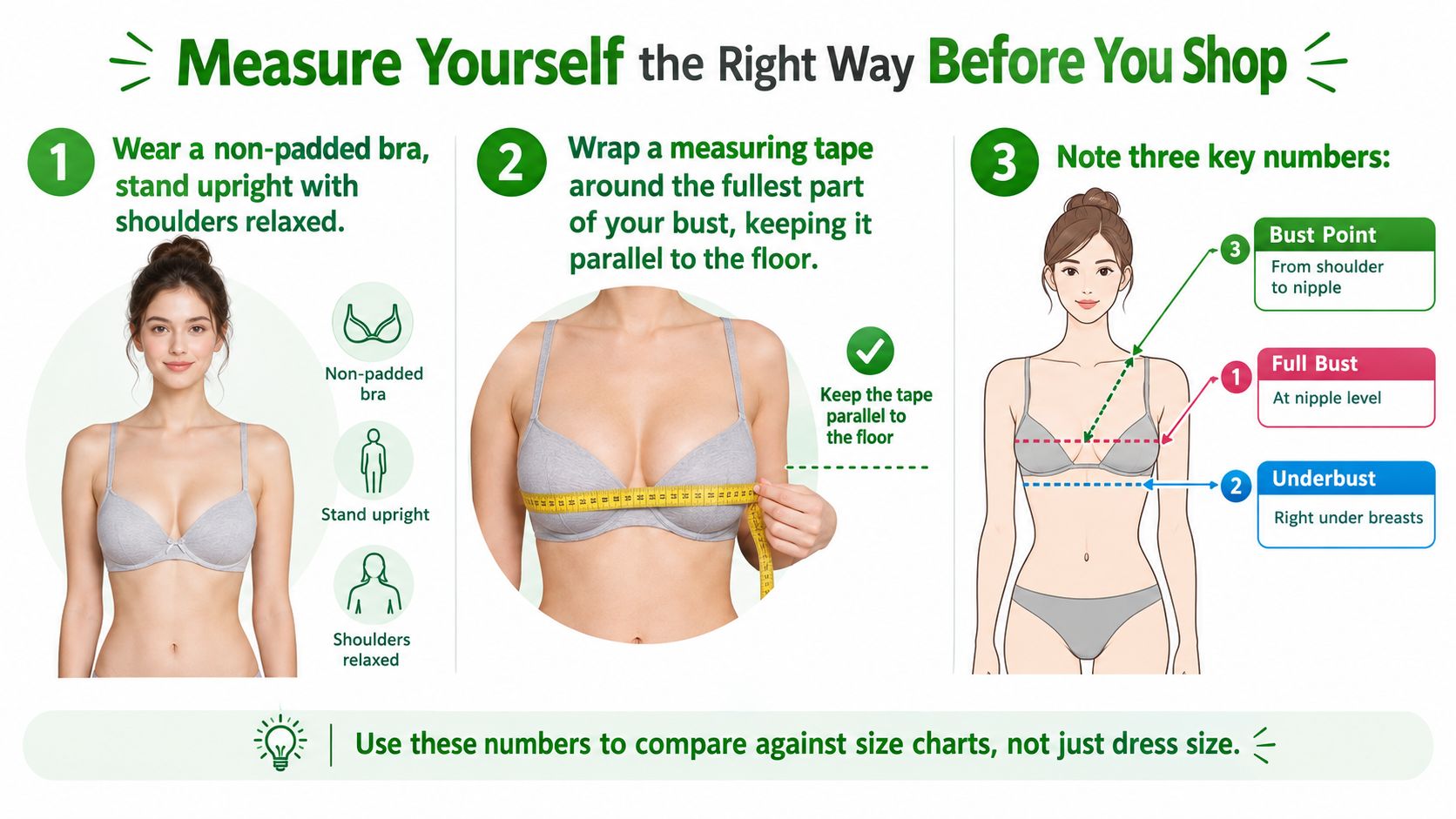
The full bust tells the boutique which garment size has enough room at the most demanding point. The underbust helps establish a bra band that can carry the bust securely. The torso measurement helps identify whether the waist seam will land at the natural waist or climb toward the ribcage.
Why bust-first sizing wins
Dress sizing treats the body as if each measurement grows in a neat proportion. Real bodies don't work that way. The USDA study Women's Measurements for Garment and Pattern Construction demonstrated that bust size couldn't reliably predict height or other vertical measurements. Researchers noted that women with bust measurements of 46 or 47 inches weren't taller on average than women with a 32-inch bust, and women 5 feet 9 inches tall didn't have larger busts on average than women 5 feet tall. The historical garment-measurement study helped establish why a dress can't be accurately sized from bust alone.
For shopping, that means the dress should fit the bust first. The waist and hips can often be refined later, but a bodice that's too small across the chest creates strain, gaping, and unwanted movement.
Record the three numbers in a phone note, along with the date they were taken. The shopper can bring that note to Cedar & Lily Clothier instead of guessing from memory or choosing the size she usually buys. The boutique's dress size chart can then be used as a reference rather than treated as an absolute answer.
Necklines and Silhouettes That Actually Flatter
A fuller bust needs a neckline that creates a stable path for the fabric. The most flattering option is usually the one that directs the eye vertically while giving the bodice enough structure to stay in place.
The strongest choices
V-necks rank first for versatility. A moderate V creates a vertical line through the upper body and leaves room for a supportive bra. Pair it with an A-line or fit-and-flare skirt, which gives the lower half enough movement to balance a fuller top.
Surplice and wrap necklines come close behind. The overlapping fabric follows the body instead of forcing the bust into one fixed width. A wrap dress can be especially useful when the waist needs definition without compressing the chest. The trade-off is clear: wrap fronts can gap at the apex, so the garment may need a discreet pin, an extra interior snap, or a camisole. More guidance appears in this wrap dress styling guide.
Sweetheart and scoop necklines work when the bodice has substance. These shapes can frame the bust beautifully, but they need boning, stable lining, or carefully placed seams. Without that internal support, the neckline may fall outward or expose more than intended.
Square necklines are excellent when the straps and bodice are wide enough. A square neckline offers clear edges and coverage, but narrow straps or a flimsy upper edge can turn a structured-looking dress into a constant adjustment.
Strapless styles rank last for reliability. They can work when the bodice has substantial boning, a secure inner layer, and a long-line bra, but the fitting standard is unforgiving. If the dress slips during a fitting-room walk, it won't become more secure during dinner and dancing.
Match the neckline to the shape
An empire waist can be graceful, but it needs genuine support in the upper bodice. A structured sheath suits scoop or sweetheart necklines because the close shape depends on accurate bust placement. A-line and fit-and-flare silhouettes are more forgiving with V-neck and wrap fronts because the skirt releases below the waist.
High crew necklines deserve caution. They visually shorten the torso and can make the upper body feel crowded, especially when the dress also has a high waist seam or heavy fabric at the chest.
| Neckline | Support Rating | Best Silhouette | Common Bust-Fit Issue | Tailoring Required |
|---|---|---|---|---|
| V-neck | High | A-line or fit-and-flare | Excessive depth or neckline gape | Sometimes |
| Surplice wrap | High | Wrap, A-line, or soft fit-and-flare | Gaping at the apex | Often modest |
| Sweetheart | Medium to high | Structured sheath | Collapse without boning | Sometimes |
| Scoop | Medium to high | Structured sheath or midi | Stretching across the upper edge | Sometimes |
| Square | Medium to high | Structured A-line or fit-and-flare | Straps or neckline lack stability | Sometimes |
| Strapless | Low unless heavily structured | Structured sheath or column | Slipping and downward pressure | Frequently |
The ranking is practical, not a verdict on personal style. A well-built square-neck dress can outperform a poorly built V-neck. The fitting room decides.
Bras and Undergarments That Do the Real Work
The bra should pass its own fitting test before the dress receives any judgment. If the bra band rides upward, the cups spill or gape, or the center gore floats away from the sternum, the dress is being asked to solve an undergarment problem.
Start with the band
The band should sit level around the ribcage and feel firm on the loosest hook when the bra is new. The band carries most of the bust load, while the straps stabilize the position rather than doing all the lifting. If the band rides up, the usual correction is a smaller band with a larger cup, not tighter straps.
The underwire should enclose the breast tissue fully. A wire that lands on tissue creates pressure and changes how the dress sits over the bra. Cups should contain the bust without spilling, gaping, or creating a second ridge at the top.
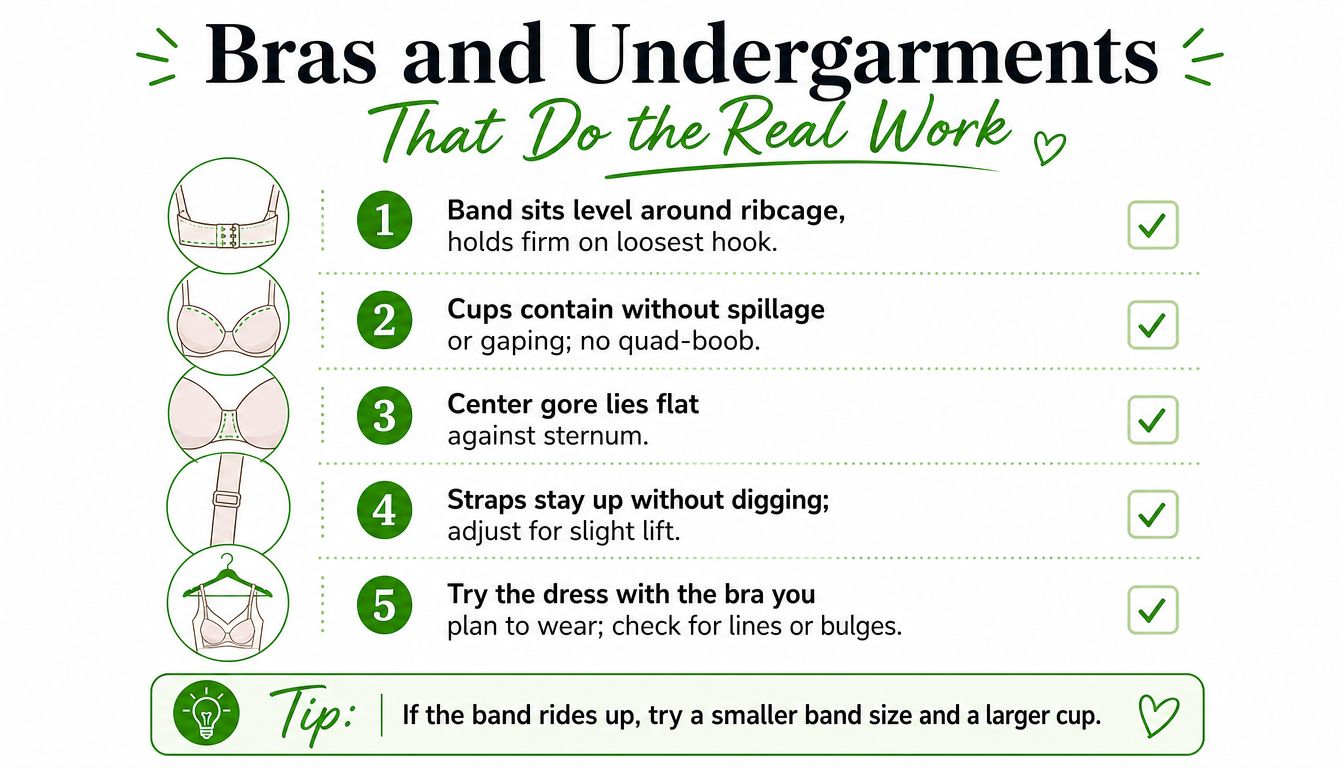
Choose the cup shape for the dress
A molded cup gives a smooth outline under satin or a close-fitting bodice. Seamed cups shape the bust with more precision and can work well under structured dresses, though their lines may show beneath very thin fabric. Balconette styles create an open upper line that can suit square or scoop necklines, provided the dress doesn't cut across the cup edge.
Side support panels can help keep the bust centered, particularly under a fitted bodice. Strap placement matters too. A strap positioned too far toward the arm can slide outward, while one set too close to the neck may interfere with a V-neck or halter shape.
For a fuller bust, strap width deserves attention. One fitting guide recommends straps at least 1 inch wide for DD to DDD cups and 1.5 to 2 inches wide for E cups and above. The supportive dress guide explains why wider straps and structured bodices distribute pressure more effectively.
For additional bra-fitting guidance, the Fashion, Bags & More bra tips offer a useful companion resource.
Match the bra to the back and neckline
Low backs and illusion necklines can make a dependable bra difficult to hide. A convertible option may work if the dress provides enough shoulder coverage, but a backless adhesive solution shouldn't be treated as structural support. A shelf bra or liner can smooth the inside of a dress, yet it won't automatically provide the lift and band stability of a properly fitted bra.
A camisole can solve modesty and neckline movement under some wrap or surplice dresses. Cedar & Lily Clothier's guidance on a camisole for women is relevant when the dress needs an additional layer without forcing the neckline closed.
Fabric and Construction Choices That Hold You Up
Fabric determines how a dress responds after hours of sitting, walking, reaching, and dancing. A fuller bust creates repeated tension at the apex, neckline, side seam, and waist seam, so a fabric that looks beautiful on a hanger may not recover well once worn.
Compare the fabric behavior
Stretch jersey feels comfortable, but thin jersey can cling and lose its clean line at the bust. Crepe usually offers more body and a smoother drape, making it a dependable choice for a polished occasion dress. Mikado and substantial satin hold a sculptural shape, though they expose pulling quickly because the surface has limited forgiveness.
Chiffon creates movement but shouldn't be expected to support the bust by itself. It needs a stable lining or an internal bodice. Lace varies widely. A lined lace dress with firm structure can work beautifully, while unlined or loosely backed lace may stretch at the neckline and reveal every tension point.
| Fabric | Support Behavior | Opacity Risk | Common Failure Points |
|---|---|---|---|
| Stretch jersey | Comfortable, but depends on recovery | Can cling or show bra lines | Sagging neckline, bust drag |
| Crepe | Stable drape with moderate structure | Usually controlled when lined | Pulling at darts or side seams |
| Mikado | Firm and sculptural | Generally opaque | Visible strain and rigid waist |
| Satin | Smooth with varying body | Can reveal shadows and seams | Water marks, horizontal pulling |
| Chiffon | Light and fluid, needs support underneath | Often requires lining | Collapsing neckline, transparency |
| Lace | Depends on backing and lining | Openwork can expose layers | Stretching, uneven neckline |
| Structured stretch | Moves with the body while retaining shape | Usually manageable with lining | Recovery loss at bust and waist |
Inspect the inside, not just the surface
Boning channels keep a strapless or structured bodice from folding. Bust darts provide direct shaping, while princess seams give a tailor more control from bust to waist. Multiple layers and firm interfacing at the neckline help prevent horizontal gape.
A hidden elastic or powermesh panel at the back can anchor the dress, but it should feel supportive rather than constricting. On the hanger, look for diagonal lines from the apex, a neckline that already falls open, or a waistband that rolls. Those signs suggest a pattern-grading issue that tailoring may not solve cleanly.
Construction check: Hold the bodice by the shoulders. If the neckline collapses immediately, it probably needs internal support before it can support the wearer.
Season and venue matter too. Light chiffon suits warm outdoor celebrations when a lined bodice carries the structure. Crepe and satin feel more substantial for evening interiors, while a firmly lined lace dress can bridge ceremony and reception without relying on a heavy outer layer. For more warm-weather guidance, the boutique's article on the best fabrics for summer dresses helps connect fabric choice to climate.
Tailoring the Dress So It Fits Like It Was Made for You
A good dress may need tailoring. A wrong dress needs exchanging. The difference becomes clear when a tailor can adjust the garment's shaping without fighting the original pattern.
Most wedding guest dress alterations need two to three fittings and at least three weeks, so shopping early is part of the fit strategy. The final appointment shouldn't be the first time the dress meets the bra and shoes intended for the wedding.
Prioritize the bust corrections
At the first fitting, the tailor should assess the dress while the wearer stands naturally and moves normally. The most useful adjustments often include:
- Princess-seam shaping: Taking in or letting out through a princess seam can refine the bust-to-waist transition without flattening the chest.
- Dart reshaping: A dart can be moved or refined when the bust apex sits in the wrong place or the fabric tents above it.
- Strap adjustment: Shortening or lengthening straps changes bust placement and neckline stability.
- Back-dart correction: Small back-dart adjustments can remove excess fabric and reduce neckline gape without pulling the front bodice tighter.
- Modesty and support additions: A tailor may add an interior panel, lining, or discreet closure when the neckline needs more security.
Aggressive waist tapering is rarely the answer to a bust problem. It can distort the side seams, pull the front upward, and make the proportions look less balanced. The waist should be refined after the bust and torso length are correct.
Bring the actual bra and shoes to the fitting, not substitutes. The bra changes bust projection, while the shoes affect posture, hem placement, and the way the waist seam settles.
Ask the tailor:
- Where is the dress pulling, and what seam can release it?
- Can the neckline be secured without changing its intended shape?
- Does the bodice need a dart, princess-seam adjustment, or added length?
- Will the alteration affect the waist seam or hem?
- How many fittings are needed before the final appointment?
The tailoring guidance for women can help shoppers prepare for that conversation.
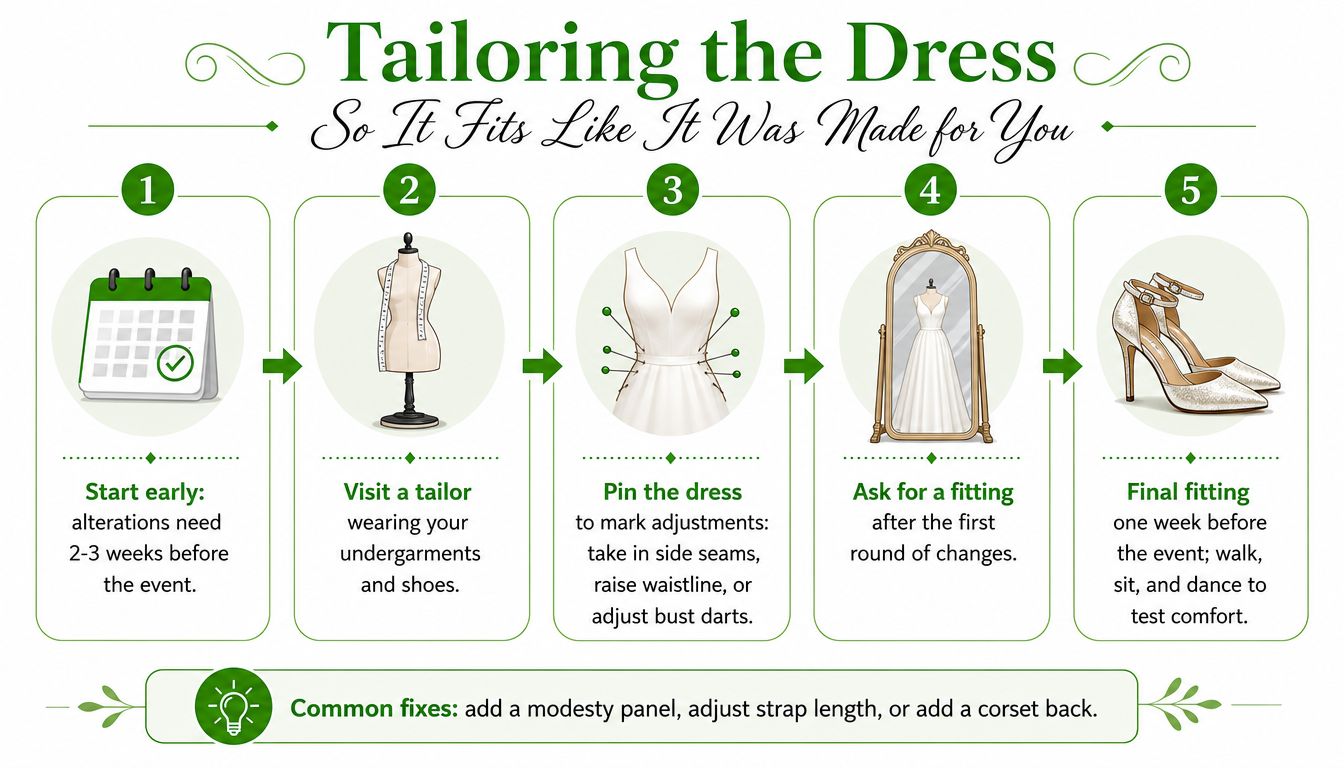
Exchange the dress when the shoulder seams sit too far outward, the bust remains compressed after choosing the bust-fitting size, the armholes restrict movement, or the neckline shape is incompatible with the intended bra. Alterations can refine a strong starting point. They can't redesign a weak bodice economically or invisibly.
Your Next Step and Quick Answers to Last-Minute Questions
The most efficient appointment starts with information. A shopper should request a boutique fitting with a stylist, bring the bust, underbust, and torso measurements, and ask to see three silhouettes in the size that fits the bust first. The planned bra and shoes should come along, because a dress that works over one foundation may fail over another.
At Cedar & Lily Clothier, shoppers can review curated contemporary and designer dresses, including options from Vanessa Mooney and Lace the Label, then assess the fabric, neckline, and internal fit in person. The collection can be tried at the Utica Square location in Tulsa or the downtown Jenks storefront, where the team can help create a practical alteration timeline.
Questions that come up at the register
Should a shopper size up or down?
The bust-fitting size usually comes first. If the waist or hip is loose afterward, those areas can often be taken in. Sizing down to preserve a fitted waist is risky when the bodice already pulls or the neckline gaps.
How far in advance should the dress be purchased?
The dress should be purchased early enough to allow the planned fittings and any construction changes. A dress that arrives immediately before the event leaves no room to correct a riding waist, strained seam, or unstable neckline.
What if the dress code requires strapless?
Choose a dress with genuine internal structure, including boning or a stable lined bodice, and test it by walking, sitting, reaching, and turning. If the bodice slides during those movements, it isn't ready for a full celebration.
Does shapewear help or hurt?
Shapewear can smooth the waist and hips, but it can't create bust support. If it compresses the ribcage enough to change the bra band or pushes the bust upward into the neckline, it may make the dress fit worse.
How can gaping be handled without body tape?
First check the bra, then try a dress with a higher or more stable neckline, an interior snap, a modesty panel, or a small alteration at the neckline edge. A wrap dress may need controlled fastening rather than repeated tightening.
A successful wedding guest dress for a large bust doesn't require constant checking in reflective windows. It should stay anchored while the wearer eats, hugs, sits, and dances. The right dress supports the bust, not one that has to be supported by hand all night.
Cedar & Lily Clothier offers curated occasion dresses, in-person fit guidance, and styling appointments for shoppers who need a dress to work with a fuller bust rather than against it. Visit Cedar & Lily Clothier online, at Utica Square in Tulsa, or in downtown Jenks to try the collection and leave with a clear plan for fit and tailoring.