

The car is cold enough to make a wool dress feel optimistic, the office is warm enough to punish a heavy sweater, and dinner still requires a collar, clean lines, and something more considered than a puffer. That Tuesday-to-evening stretch is why the best work jackets for cold weather aren't necessarily the thickest ones. They're the jackets that keep a woman comfortable on the commute, composed at her desk, and polished when the reservation begins.
For most working wardrobes, the answer lives in three categories: a refined blazer with warmth built in, a packable insulated shell for real exposure, or a knit-blend topcoat that looks intentional over everything. Cedar & Lily Clothier's edit of blazers, jackets, and outerwear gives that decision a fashion context, while cold-weather standards add the practical filter: wind protection, breathability, mobility, and enough room for the layers that make the jacket useful.
Table of Contents
- When the Workday Starts at Twenty Degrees
- What Counts as a Cold-Weather Work Jacket
- Comparing Fabrics for Warmth, Polish, and Care
- Fit and Tailoring Details That Change Everything
- Layering Formulas for Light, Deep, and Wet Cold
- From Desk to Dinner Without a Wardrobe Change
- Matching Jackets to the Way You Actually Work
- Care, Sizing Help, and Your Next Step
When the Workday Starts at Twenty Degrees
At seven in the morning, the thermometer reads 20 degrees, the steering wheel is icy, and the first meeting begins in an office set to 72 degrees. By evening, a client dinner calls for a blouse or dress with a proper collar. A jacket that succeeds in only one of those settings earns very little space in a working wardrobe.
The most successful solution is a jacket with a clear point of view and enough flexibility to move through the day. A thermal-lined blazer works for a client-facing office because its shoulder structure reads as tailoring, not outdoor gear. A packable insulated shell wins the exposed commute, especially when wind or wet weather turns a short walk into the hardest part of the morning. A wool or knit-blend topcoat handles the widest range of outfits, from trousers and loafers to a dinner dress.
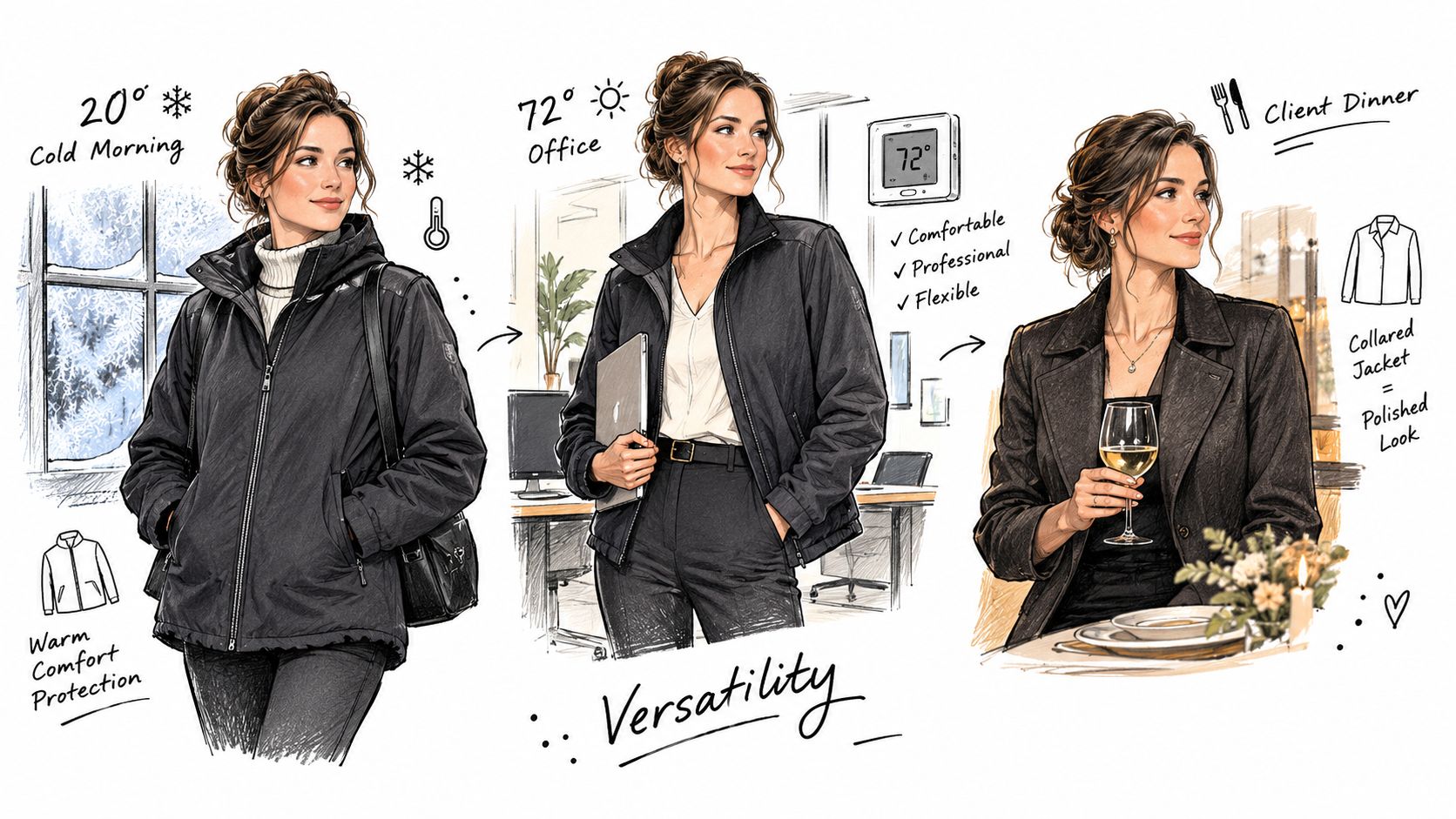
A working woman shouldn't have to choose between warmth and authority. The jacket should be slim enough to sit neatly on a conference-room chair, comfortable enough for a long drive, and refined enough to remain on indoors when the restaurant is cool. The latest winter coat styling ideas offer useful inspiration, but the sharper question is practical: which jacket can carry the entire day without looking like a compromise?
The answer depends on the commute, the office dress code, and the evening plan. For a mostly indoor schedule, the blazer is the smartest hanger investment. For a long outdoor walk, the technical shell earns priority. For a woman who moves from office to dinner several times a week, the topcoat is the dependable middle ground.
What Counts as a Cold-Weather Work Jacket
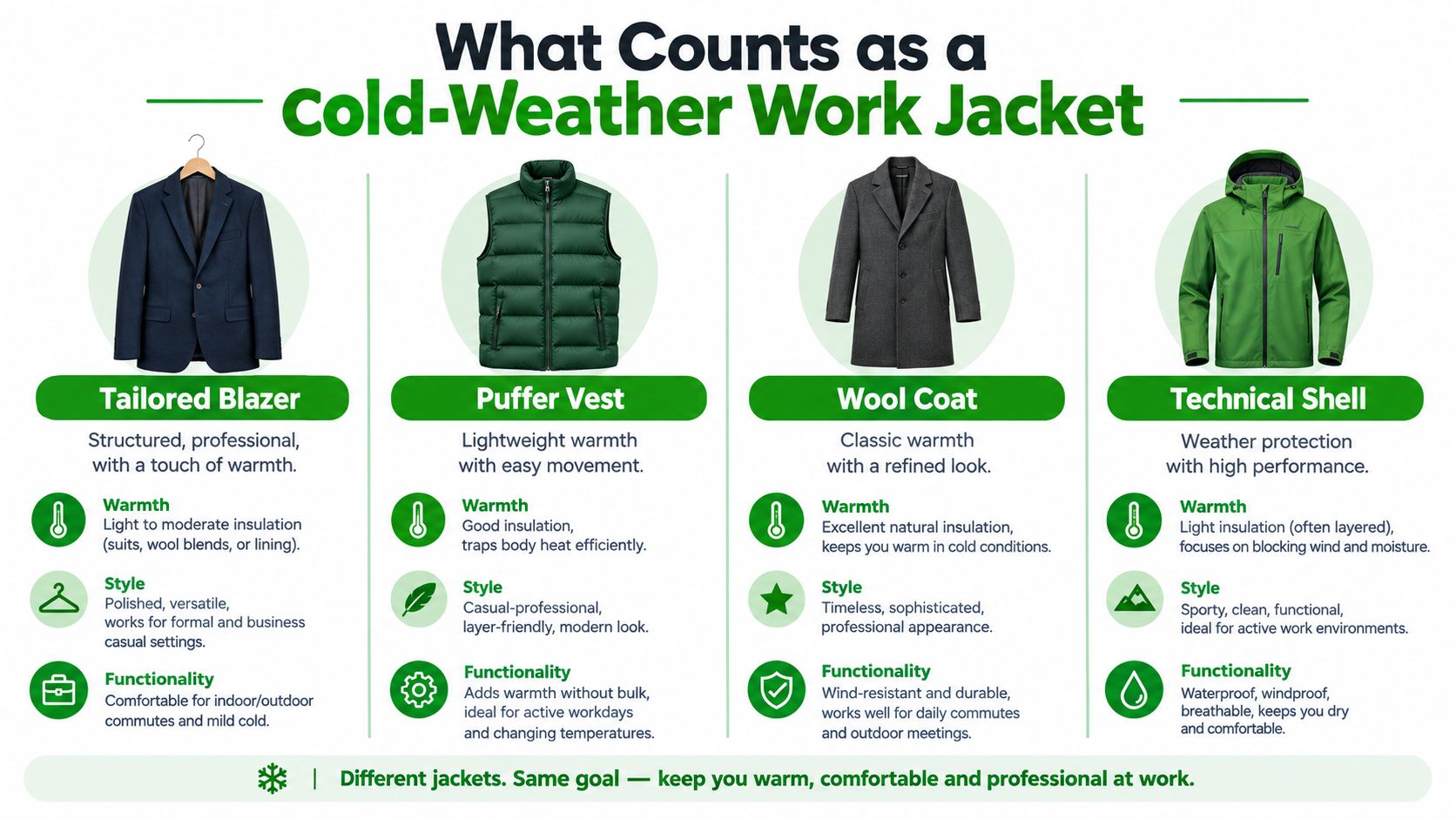
A cold-weather work jacket earns its place when it handles the full day, from a dark commute to a heated office, an after-work dinner, and the weekend that follows. It should protect you outdoors, leave room for a practical layer, and look intentional once you take off your scarf and gloves.
Four useful jacket families
The fitted blazer suits a client-facing office or any workplace where tailoring is part of the dress code. Choose quilted construction, a concealed thermal lining, or enough ease for a fine merino knit underneath. It works best in light cold, roughly 35 to 50 degrees, depending on the fabric and your layers. Wear it for a short commute, desk-heavy days, and dinners where a casual coat would look too relaxed.
The wool topcoat is the strongest all-day choice for a city commuter. A wool or wool-blend coat that grazes the knee can handle roughly 25 to 55 degrees over a sweater, with the upper end depending on wind and activity. Its length protects more of the outfit, while the clean line works for presentations, lunches, dinners, and weekend errands. It is the jacket to choose when one piece must move between settings without a wardrobe change.
The structured bomber or shirt-jacket belongs in a casual office, creative workplace, or hybrid schedule. Its shorter length makes driving easier, and its relaxed shape feels less formal than a topcoat. Select quilted construction, substantial cotton twill, or a compact knit body for days built around movement. It looks especially right with straight-leg trousers, dark denim, and a neat ankle boot.
The technical insulated shell handles an exposed commute, walking meetings, or weather that changes by the hour. A slim matte shell over merino gives you protection without making the outfit look like outdoor gear. Choose an outer layer that blocks wind, allows ventilation, and leaves enough room for movement, following the practical principles in this guide to choosing winter work jackets.
Stylist's rule: If the jacket cannot pass at the restaurant after work, it is not solving the whole workday. It may be excellent outdoor gear, but your wardrobe needs more range.
Outerwear deserves this attention because a winter jacket often becomes the foundation of daily dressing. It protects the commute, sets the tone of the outfit, and determines whether the same clothes feel office-ready or weekend-only. Industry discussion also treats coats and jackets as a major part of winter apparel demand, as described in this winter wear market overview. For a working woman, the practical test is simple: choose the jacket that supports the coldest part of the day while still looking right at the desk and over dinner.
Comparing Fabrics for Warmth, Polish, and Care
Fabric determines how a jacket feels at eight in the morning, how it photographs under office lighting, and whether it survives a week of travel without looking tired. The right choice depends on whether warmth, softness, water resistance, or easy care matters most.
Cold-weather work jacket fabrics at a glance
| Fabric | Warmth | Weight | Polish | Care |
|---|---|---|---|---|
| Wool | Warm | Mid-weight | Dressy | Dry-clean friendly, steam between wears |
| Cashmere and wool-cashmere blend | Very warm for its weight | Light to mid-weight | Soft, refined drape | Handle with care, rest between wears |
| Technical nylon and recycled polyester shell | Moderate to high, depending on insulation | Light | Matte, athletic polish | Often machine-washable, follow label |
| Cotton twill with flannel lining | Moderate | Mid to heavy | Casual | Generally easy care |
| Ponte or double-knit | Light to moderate | Mid-weight | Structured and office-ready | Often machine-washable, follow label |
Wool earns the premium when the jacket needs to appear authoritative. It holds a clean line, resists the visual collapse that can make a casual coat feel sloppy, and works beautifully over fine knits. Wool doesn't need constant dry cleaning. Steaming and careful airing usually preserve its finish between professional cleanings.
Cashmere and wool-cashmere blends offer the most warmth for the least visual weight. The drape is softer, the hand feels more luxurious, and the silhouette can remain elegant instead of bulky. This is the fabric to reserve for a topcoat or refined jacket that will be worn often but not abused. The guide to wool coats with fur collars offers additional direction for shoppers considering a more expressive outerwear finish.
Technical nylon and recycled polyester shells make sense for travel-heavy weeks. They're light, resist moisture, and tolerate the repeated movement between car, airport, office, and sidewalk. Their polish is athletic rather than formal, so the styling should stay clean: tonal knitwear, well-fitted trousers, and minimal hardware.
Cotton twill with flannel lining is the choice for relaxed offices and weekends. It breathes better than a sealed shell and brings a practical texture to denim, corduroy, or casual trousers. It won't replace a long wool coat in sharp wind, but it feels natural for coffee runs and school pickups.
Ponte or double-knit deserves more attention than it receives. It has the structure of a blazer with the comfort of knitwear, which makes it excellent for desk work, driving, and travel. Cedar & Lily Clothier's curated blazers and jackets category is a useful place to look for this kind of polished flexibility without committing to a rigid structured layer.
Fit and Tailoring Details That Change Everything
A jacket can have beautiful fabric and still fail by lunchtime. The problem usually appears at the shoulder, sleeve, collar, or upper back, where poor proportion becomes uncomfortable before it becomes obvious in a mirror.
The shoulder sets the standard
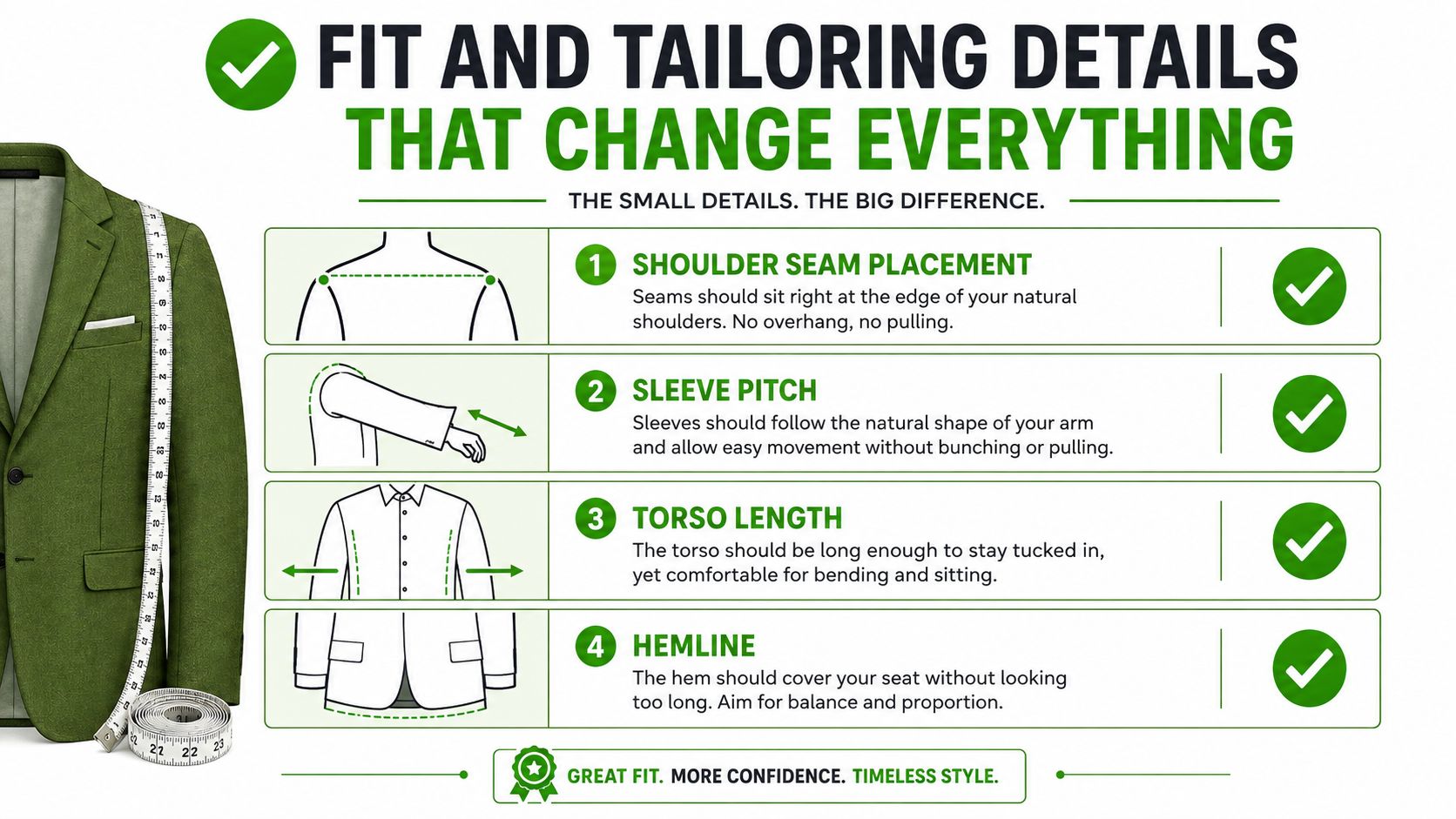
The shoulder seam should sit close to the natural shoulder point, not fall halfway down the arm and not pull inward toward the neck. Buying up for a thick sweater often solves the torso problem while ruining the shoulder line. Buying down for a sharper silhouette creates button pull, restricted reach, and bunching across the chest.
Sleeve pitch matters just as much. When the arm hangs naturally, the sleeve should fall without twisting around the forearm. A sleeve that rotates or gathers at the elbow may look acceptable while standing still but becomes distracting at a keyboard or behind the wheel.
A fitting-room checklist
- Button pull: Close the jacket over the intended base layer. The front should lie flat without diagonal tension.
- Collar gap: The collar should sit against the neck and remain close when the wearer moves.
- Chest drape: The fabric should skim, not cling, across the bust and upper back.
- Cuff exposure: A fine-gauge knit can show slightly beyond the sleeve, but the cuff shouldn't disappear into the hand.
- Hem length: A blazer should cover the waistband and sit comfortably over the seat. A topcoat should create a long, uninterrupted line.
- Scarf compatibility: The collar should accommodate a scarf without forcing the lapels open or pushing the neckline backward.
The fitted construction wins for city commutes, presentations, and dinners because it keeps the outfit visually controlled. A relaxed cut earns its place for suburban driving, walking meetings, and hybrid workdays when the jacket must move with the body.
The work blazer collection is best approached with a tailor's eye rather than a rack-size mindset. The right size is the one that preserves the shoulder, allows the desired layer, and leaves enough ease for a full day of movement.
Layering Formulas for Light, Deep, and Wet Cold
A woman's cold-weather workday rarely stays in one setting. She may walk from the station to the office, sit in a warm meeting room, step outside for lunch, then head to dinner. Build the outfit so each layer has one clear job: the base manages moisture, the middle holds warmth, and the jacket blocks wind or rain. The right combination keeps a lighter jacket comfortable without making the office outfit bulky.
Layering formulas by temperature and condition
| Layer | Light Cold (35 to 45°F) | Deep Cold (15 to 30°F) | Wet Cold (25 to 40°F, precipitation) |
|---|---|---|---|
| Base | Merino, light weight | Merino turtleneck, mid-weight | Moisture-wicking base |
| Middle | Fine-gauge sweater, light weight | Cashmere, mid-weight, plus quilted liner vest | Bonded merino, mid-weight |
| Outer | Unstructured wool or boucle blazer | Structured topcoat or long insulated coat | Technical shell with sealed seams |
| Optional support | Scarf, gloves | Hat, gloves, warm socks | Packable insulated liner |
Light cold
For a dry morning between 35 and 45°F, wear a merino base, a fine-gauge sweater, and an unstructured wool or boucle blazer. The blazer goes outside the sweater, so it remains the polished layer once you reach the office. Choose this formula for a city commute, a heated workplace, and an evening that does not involve prolonged time outdoors.
A scarf and gloves finish the outfit without changing its shape. Keep the knit slim enough that the blazer still closes comfortably.
Deep cold
Between 15 and 30°F, keep the merino turtleneck closest to the skin, add mid-weight cashmere, and use a quilted liner vest when you will spend more than a short stretch outside. Finish with a structured topcoat or long insulated coat. A blazer can sit underneath only when its shoulders stay smooth and the coat closes without compression lines.
For a woman moving between buildings, the calendar matters as much as the forecast. Wear the lighter version for a car-to-office commute. Choose the vest and long coat for a train platform, walking meeting, or outdoor wait. Higher insulation supports warmth, while lower moisture resistance helps heat and perspiration escape during movement. That balance matters more than a technical label when the same outfit must work at a desk afterward.
Wet cold
Rain changes the priority. Start with a moisture-wicking base, add bonded merino, and use a packable insulated liner beneath a technical shell with taped or sealed seams. The shell belongs outside every layer, preserving an uninterrupted barrier against rain. A water-resistant finish handles light precipitation, while sustained rain or wet snow calls for a waterproof membrane and sealed seams.
For exposed travel, body warmers for muscle recovery can provide separate comfort without adding bulk beneath a fitted jacket. Place them according to the product directions, and keep the visible work outfit unchanged.
A long shell over fitted trousers and a fine knit looks more polished than a thick jacket over several loose layers. Use a two-way zipper when sitting, driving, or walking quickly, and open it slightly for controlled ventilation. The winter layering guide offers another practical reference for combining warmth, movement, and a finished everyday wardrobe.
From Desk to Dinner Without a Wardrobe Change
The right jacket can perform the wardrobe change without requiring one. The trick is to begin with a clean base outfit and use the outer layer, shoe, scarf, or jewelry to shift the mood after work.
The charcoal blazer route
A charcoal flannel blazer over a silk shell and fitted trouser is the most reliable client-day formula. The fabric feels warm enough for the commute, while the silhouette keeps the outfit appropriate for meetings. At dinner, add a fine-gauge merino wrap and change into a low heel. The jacket stays on because the charcoal reads as intentional rather than strictly corporate.
A well-fitted blazer earns its closet space. It works with trousers during the day, denim on Friday, and a slim skirt or dark dress in the evening. A gently shaped waist creates polish, but excessive suppression makes layering difficult, so the best version follows the body without trapping it.
The camel topcoat route
A long camel topcoat over a column of black is the most elegant answer for a day that includes a presentation and a restaurant. During business hours, the coat gives the outfit vertical authority over a black knit and trouser or dress. At dinner, remove the coat, add a statement earring, and let the black column do the evening work.
The topcoat category is especially useful for women who don't want to carry a second layer. A simple black base keeps the coat visible outside and prevents the outfit from feeling overstyled once the coat comes off.
The quilted layer route
A matte-finish quilted jacket over a merino dress handles the woman whose workday includes movement between buildings, errands, or a casual office. The jacket brings function, while the dress keeps the outfit feminine and complete. Indoors, soften the look with a tactile scarf rather than stripping away every warm layer.
This route works best when the quilting is restrained, the hardware is quiet, and the hem doesn't fight the dress. The Cleobella Asher Leather Jacket offers a polished leather interpretation of the short-jacket idea, particularly over knit dresses, tonal trousers, or a silk blouse. It's a fashion-led layer rather than a technical shell, so it suits dry commutes and indoor-heavy schedules.
The decision is simple. Choose the blazer for authority, the topcoat for elegance, and the quilted or leather layer for movement and personality.
Matching Jackets to the Way You Actually Work
The best jacket depends less on a job title than on the physical rhythm of the day. A woman who spends ten minutes outdoors between a car and an office needs a different construction from someone who walks between buildings, travels with one carry-on, or works mostly from home.
Workday profile to jacket match
| Workday Profile | Primary Jacket | Backup Jacket | Sizing Note |
|---|---|---|---|
| Corporate commuter | Structured wool blazer with a warm interior | Long wool or wool-blend topcoat | Size for the shoulder, then tailor the waist if needed |
| Creative director | Structured bomber or shirt-jacket | Relaxed leather jacket | Preserve arm movement and avoid a restrictive sleeve |
| Lawyer | Tailored wool blazer | Knee-grazing topcoat | Size down only when the blazer still allows the planned knit |
| Remote professional | Ponte jacket or quilted short jacket | Cotton twill shirt-jacket | Choose ease for errands, driving, and casual layering |
| Traveling consultant | Packable insulated shell with a clean matte finish | Ponte blazer | Size for a merino layer without creating shoulder collapse |
The corporate commuter should prioritize a structured wool blazer because it carries authority from the train platform to the corner office. The topcoat remains the backup for windy days or a schedule that runs late.
A creative director can take more texture. A structured bomber or shirt-jacket keeps the outfit modern and mobile, while a relaxed leather jacket adds enough edge for a client lunch without looking like protective equipment.
The lawyer needs a jacket that holds its line in courtrooms and chilly conference rooms. A wool blazer comes first, with a knee-grazing topcoat reserved for the commute. The remote professional has more freedom. A ponte jacket or quilted short jacket works for coffee, school runs, and video calls without forcing formal suiting onto an informal day.
The traveling consultant should choose the lightest useful system. A matte insulated shell over merino handles airport movement and outdoor transfers, while a ponte blazer provides polish once the coat comes off.
Decision rule: Choose the jacket that solves the hardest part of the day, then use the base outfit to soften or sharpen it.
Sizing needs honesty. A structured wool blazer can sometimes be sized down when the purpose is a close skim, provided the shoulders and bust remain comfortable. A quilted lining or down-filled topcoat usually deserves the larger size so a sweater can sit beneath it without compression lines. Cedar & Lily Clothier's team can assess that balance in person at Utica Square in Tulsa or downtown Jenks, where fit and fabric are easier to judge than they are on a screen.
Care, Sizing Help, and Your Next Step
A cold-weather jacket earns its place through repeated wear, and repeated wear requires a care routine. Small habits preserve shape, loft, softness, and water resistance far better than waiting until a favorite layer looks tired.
Care by fabric
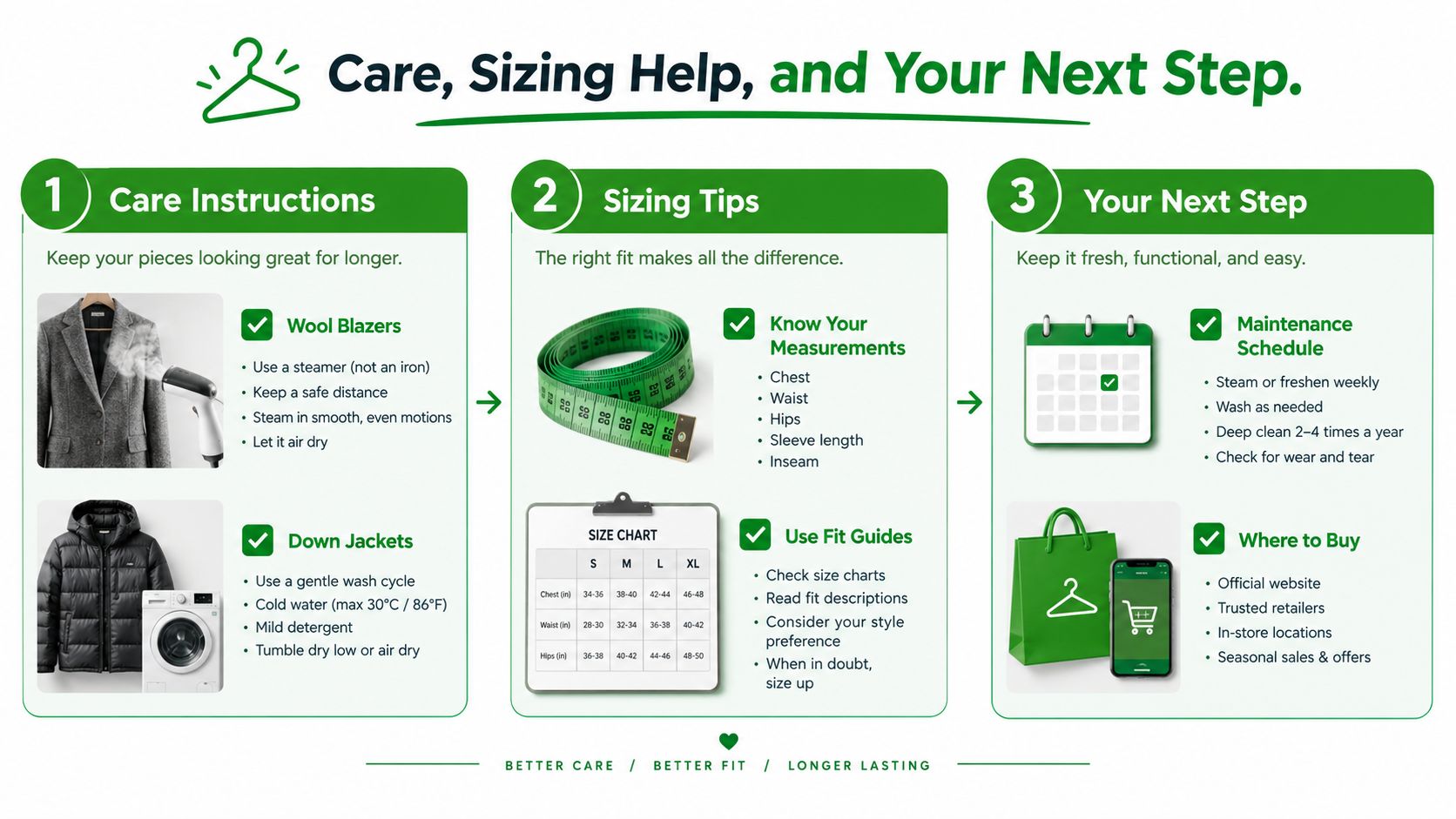
- Wool blazers: Steam rather than dry-cleaning after every wear. Let the jacket air, then store it on a broad hanger.
- Down and insulated coats: Fluff them regularly and use a gentle tumble-dry routine with clean tennis balls when the care label permits, helping restore loft.
- Technical shells: Use a technical wash and re-proofing cycle when the finish begins to stop shedding moisture.
- Cashmere blends: Let them rest between wears so the fibers can recover their shape. The cashmere care guide offers a useful reference for preserving softer fibers.
- Ponte and double-knit: Follow the garment label, avoid unnecessary heat, and reshape while damp if the fabric allows it.
Three fitting questions
How often should a work jacket be dry-cleaned? Only when it needs professional cleaning. Steaming, airing, and spot treatment can handle much of the in-between maintenance.
How can pilling be reduced? Avoid constant friction from rough bags or heavily textured layers, and remove pills gently with a fabric comb rather than pulling them by hand.
Can a fitted jacket be altered after purchase? Often, yes. Waist suppression, sleeve length, and some hem adjustments may be possible, but shoulder changes are more complex. The shoulder seam should fit correctly before any alteration is considered.
A final fitting should check shoulder seam placement, sleeve break around the thumb joint, and enough hem clearance over the seat. A beautiful jacket that restricts the arms or catches on a chair won't become a favorite just because the fabric is expensive.
Cedar & Lily Clothier curates women's blazers, jackets, leather layers, and outerwear for workdays that continue into dinner, with online shopping and personal fit guidance in person. Visit Cedar & Lily Clothier at Utica Square in Tulsa or downtown Jenks to try the layers over real sweaters, compare fabrics, and get styling help from the team.