


The invitation is open, the wording is short, and the closet doesn't offer an obvious answer. It says white party, cocktail attire, or both, and a white dress already on the rail suddenly raises three questions at once. A white cocktail party dress can be exactly right, subtly wrong at a wedding-adjacent event, or perfect in the mirror and sheer under flash. The order matters. Permission comes first, then silhouette, then fit and opacity.
Table of Contents
- When a White Cocktail Party Dress Is the Right Call
- Choosing the Right Cut for Your Body Type
- Fit Checks That Matter Before You Buy
- Fabric, Lining and Opacity Under Real Light
- Shoes, Bags and Jewelry That Complete the Look
- Layering Outerwear and Styling Across Seasons
- Shopping White Dresses at Cedar & Lily
When a White Cocktail Party Dress Is the Right Call
A plain invitation that says only white party should be read conservatively as an all-white request, not as an invitation to wear a near-white and hope it blends in. That's the safer position, and it spares the awkward moment of arriving in blush while every other guest is in white. The logic is simple. Cocktail describes formality, not permission to wear white, so the garment still has to clear two separate tests, the event's dress code and the host's intent.
For an all-white event, guidance on all-white party dressing holds that the main garment and any jacket, wrap, or cover-up should stay white, while shoes and accessories have more flexibility. Beige, champagne, or blush should be treated as accents rather than substitutes. White, nude, clear, and metallic shoes usually sit inside that flexibility without breaking the look.
Where White Works at Cocktail and Wedding-Adjacent Events
| Event | Safe to Wear White | Ask the Host First | Avoid White |
|---|---|---|---|
| Designated all-white party | Yes, it's the request | ||
| General cocktail party, gala, birthday dinner | Yes, if the cut isn't bridal | ||
| Engagement party or bridal shower | Yes, white may be reserved | ||
| Rehearsal dinner or wedding welcome event | Yes, check the wording first | ||
| Wedding as a guest | Yes, unless white is explicitly requested |
The wedding-adjacent row is where most mistakes happen. A solid white midi in lace, with volume through the skirt or a neckline that echoes bridalwear, can visually compete with the bride even at a shower or rehearsal dinner where no rule was printed on the invitation. Removing one bridal cue helps, but it doesn't settle the question if the event exists to celebrate someone else.
When white is ambiguous, a short message to the host settles it faster than any styling trick.
Shoppers sorting out the formality side can start with what cocktail attire means for women, then apply the permission check above. A dress can be technically correct for cocktail hour and still be the wrong social choice.
Choosing the Right Cut for Your Body Type
At a fitting appointment, start with the lines you want the dress to create, then compare how each cut sits on your frame. The shoulder, waist, and skirt shape will narrow the options faster than a size label, which can vary between brands.
Start at the shoulders. A strapless or one-shoulder neckline leaves the shoulders open and creates a clean upper line, provided the bodice stays secure as you move. If you prefer coverage or want less emphasis on the shoulders, consider sleeves, a square neckline, or a more defined shoulder. Each changes the balance of the outfit.
Check where the waist seam falls. A seam at the natural waist gives the torso a clear point of definition. A higher seam can lengthen the leg line, though it may feel crowded across a fuller bust. A lower seam can suit a straighter frame by keeping the middle line simple.
Matching the Skirt to the Hip
The skirt determines how much shape the dress follows or adds. An A-line opens over the hip, defining the waist without clinging below it. A sheath follows the body in a vertical line and works well on a balanced or straighter frame. A fit-and-flare adds movement and can create a more curved outline on a straighter frame. In white, extra skirt volume can read as bridal, so consider the event before choosing a fuller shape.
The L'Agence- Caprice Strapless Midi Dress is one option for a shopper who wants open shoulders and an uninterrupted line. A more structured dress with a defined bodice and sleeves offers greater coverage through the top. The right choice depends on your proportions, comfort, and how much structure you want, rather than an abstract idea of what is flattering.
Hemline matters, too. Cocktail dressing generally calls for a polished knee-to-midi dress or dressy separates in chiffon, satin, lace, or crepe, rather than a casual sundress or full-length gown, as outlined in the cocktail formality range for women. A hem at or just above the knee can keep the leg line open on a petite frame. A midi that ends at the widest part of the calf may shorten the line, while a taller frame has more room for a true midi length.
For a broader guide to choosing shapes, see how to dress for a specific body type. Cedar & Lily associates at Utica Square in Tulsa and in downtown Jenks can help assess proportions in person, since a dress that looks balanced on a hanger can sit differently once worn.
Fit Checks That Matter Before You Buy
A size label is the weakest tool in the fitting room. White shows drag lines, gaping, and a waist seam sitting in the wrong place more clearly than a dark color does, so the process has to start with measurements, not a number on a tag.
The image below sets out the five measurements worth recording before any comparison with a size chart.
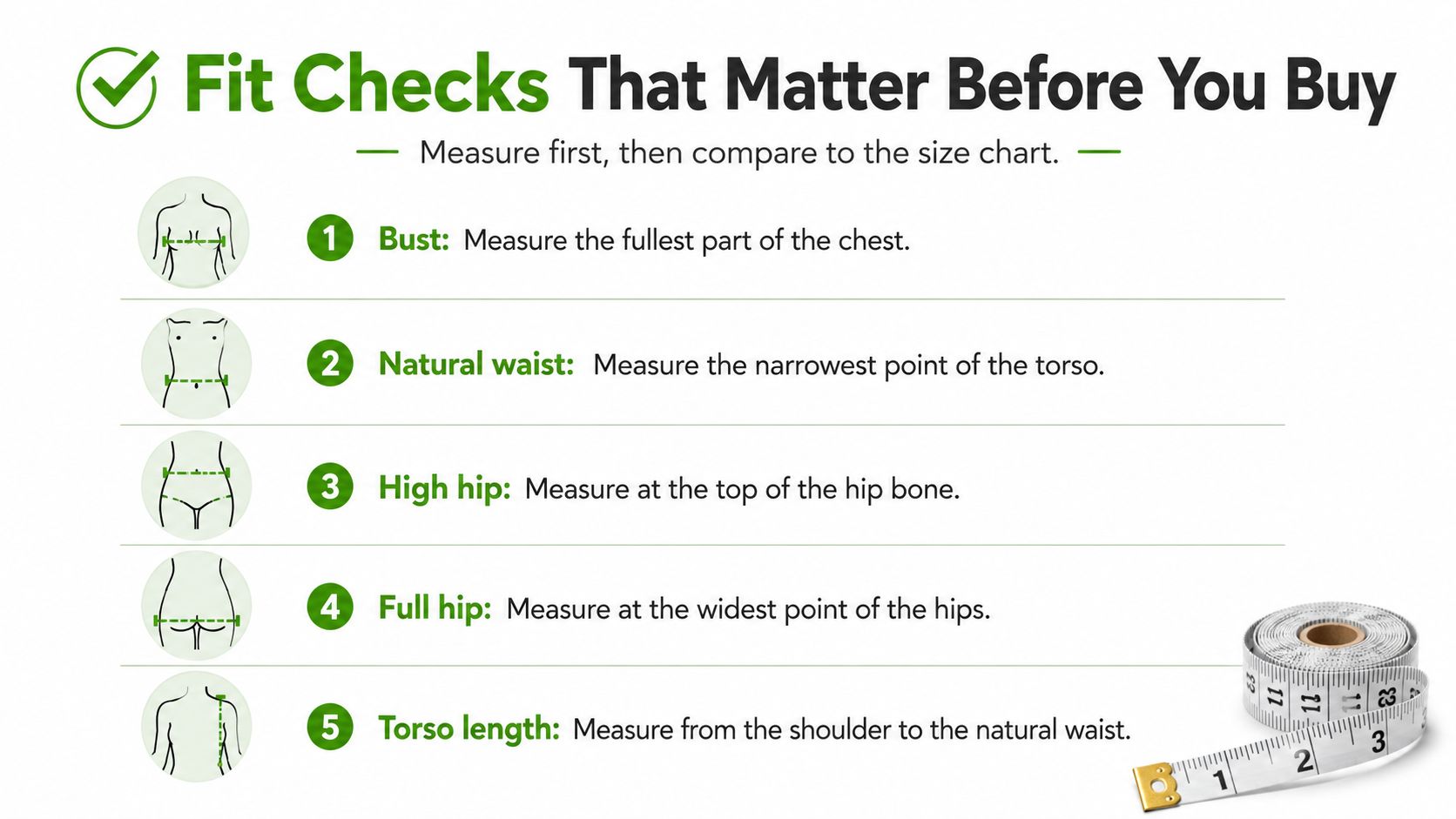
A measurement-first protocol records bust, natural waist, high hip, full hip, and torso length, then compares each one with the garment's actual size chart. Research summarized in a measurement-first approach to dress fit notes that a study of 30 women found body-shape variation materially influenced how people judged dress fit, which is why two shoppers in the same labeled size can assess the same dress very differently.
Five Criteria in Plain Language
Professional fit assessment uses five terms, and each one translates into something visible.
- Ease: the room between body and fabric, enough to sit and breathe, not so much that the dress shifts
- Balance: the dress hangs level front to back rather than hiking or dipping
- Set: seams and closures sit smoothly without puckering or strain
- Grain: the fabric's threads run straight, so the skirt doesn't twist around the leg
- Line: the overall silhouette reads as intended from neckline to hem
The Try-On Sequence
Order matters because early faults explain later ones. Start with shoulder and neckline stability, since a bodice that slides will distort everything below it. Then look for horizontal drag lines at the bust and hip, which signal that the fabric is being pulled across a curve it wasn't cut for. Walk a short distance and check whether the waist seam stays level. Finish with sitting, raising both arms, and turning, in the intended undergarments and shoes, because heel height changes posture and posture changes fit.
Three mistakes account for most returns. Choosing by bust alone ignores the hip and waist. Overlooking torso length leaves a waist seam stranded above or below the natural waist. Assuming a labeled size fits the same across brands turns a second purchase into a guess. A saved measurement record makes an exchange more useful, since a stylist can tell whether the fault is circumference, length, or construction instead of recommending the nearest size and hoping.
Shoppers comparing measurements against a chart can use the dress size chart guide as a starting reference. The benchmark is clear. A dress passes when it holds through every movement check without persistent pulling, gaping, riding up, or visible undergarment lines.
Fabric, Lining and Opacity Under Real Light
Fit answers whether a dress is the right shape. Fabric answers whether it behaves once the lights change. The four fabrics most common in cocktail dressing do different jobs, and white exposes the trade-offs faster than any other color.
The comparison below shows how each one presents on the body.
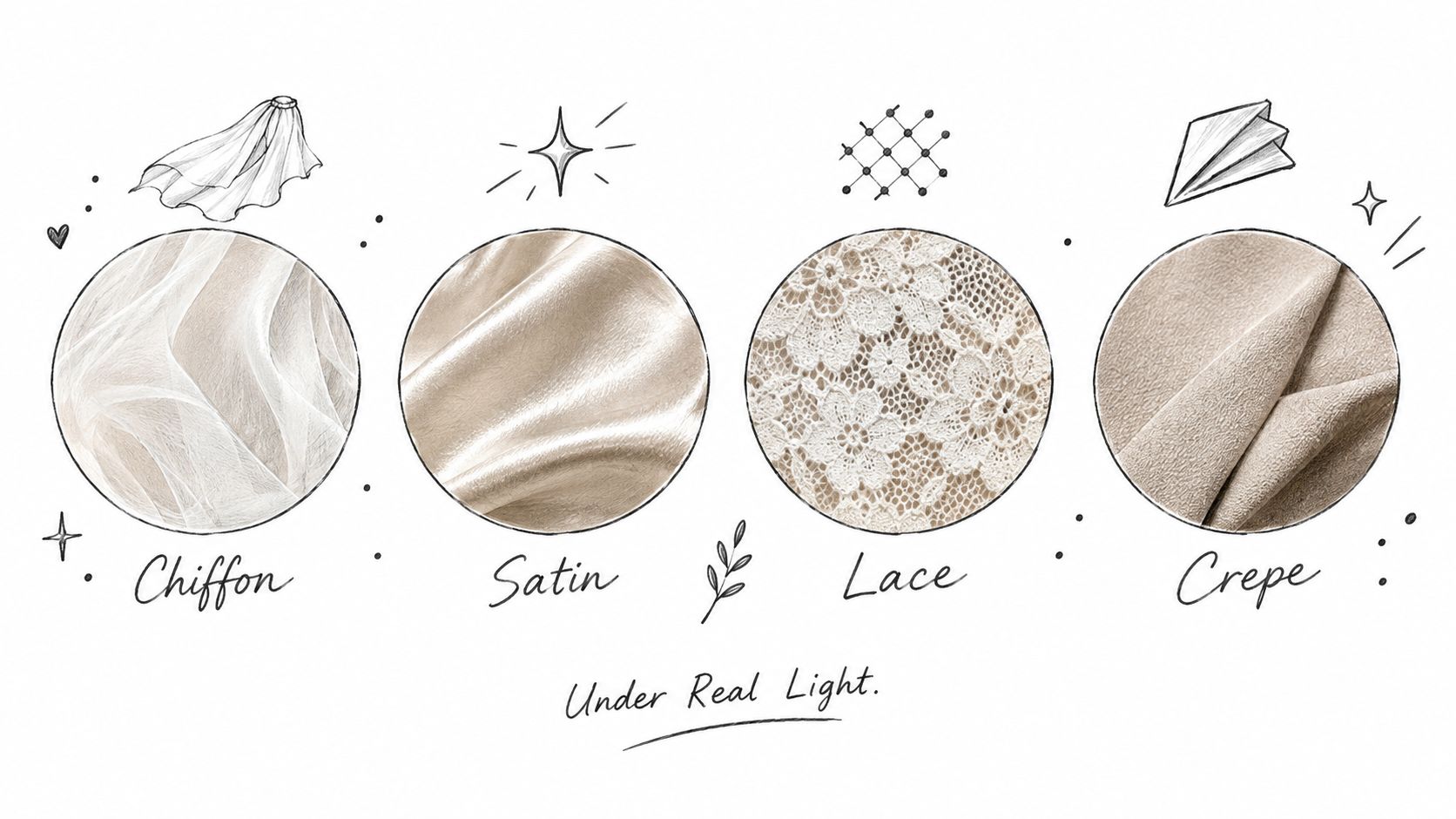
Crepe gives structure and a matte, clean silhouette, which makes it the most reliable choice for a shopper who wants coverage and a controlled line. Chiffon moves well and softens a shape, but it's the most likely to need a full lining under it. Satin brings a polished evening sheen and reflects light, which flatters in person and can flatten detail in a photograph. Lace adds texture that reads well on camera, though it almost always needs a slip or lining beneath the openwork.
Testing Opacity in the Store
Research on garment evaluation notes that white fabrics can reveal lining edges, seam allowances, adhesive cups, and shadowing differently across light sources, and the case for structured garment assessment supports checking opacity under daylight, warm indoor light, and camera flash rather than relying on one impression. The test should happen while seated, bending forward, and walking, with a neutral undergarment in place.
Two traps catch careful shoppers. The first is judging opacity from a product photo, which is lit and exposed to flatter the garment. The second is trusting a flash photograph taken during the fitting, since camera exposure can make a fabric look more opaque than it appears to the eye standing in the room. A lined bodice also guarantees nothing about the skirt or the side seams, where coverage often thins out first.
Pass or fail, by zone: bust, waist and hip, skirt, and closure area each get checked under every light. Any visible undergarment or construction detail counts as a fail and calls for layering, different styling, or a different dress.
Shoppers weighing lighter fabrics can read more about styling sheer fabric dresses with proper layering before committing. Boutique staff can check the back view and closure area during a fitting, two angles a shopper can't assess alone in a mirror.
Shoes, Bags and Jewelry That Complete the Look
One white midi can carry three different events in a single month, and accessories decide which one it appears to be dressed for.
The image below contrasts a daytime set with an evening one built around the same kind of dress.
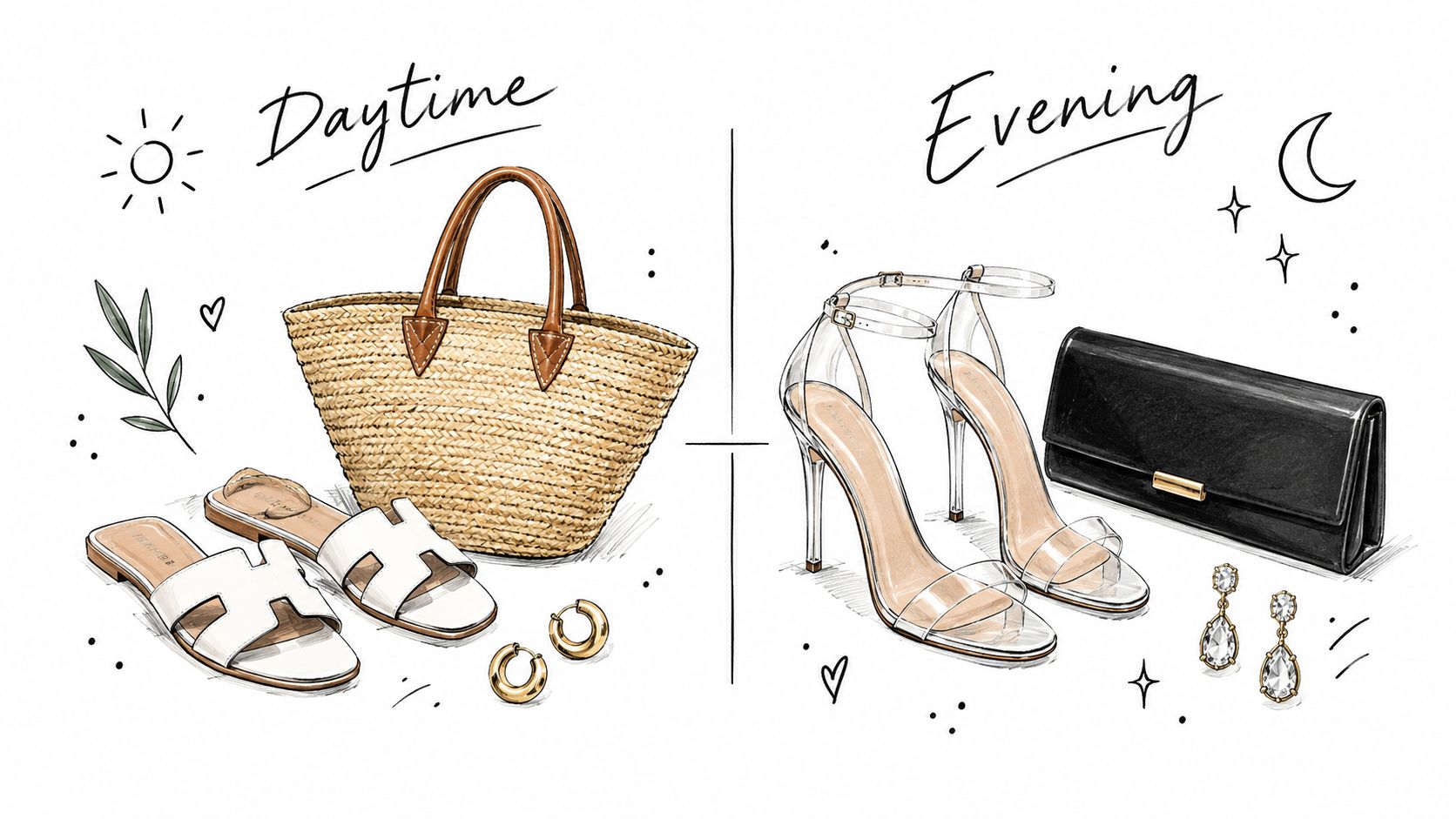
At a daytime lunch, the dress reads fresh with a flat or low-heeled sandal, a structured bag with enough room for the day's essentials, and small gold hoops. Nothing sparkles, and that's the point. The same midi at an evening dinner takes a heeled sandal, a small clutch, and a single piece of jewelry with more presence. At a summer gala, metallic shoes and a sculptural earring lift it again without adding a second statement anywhere else.
Choosing the Shoe Finish
White shoes extend the monochrome line and suit a designated all-white event, though they can push a lacy dress toward bridal. Nude lengthens the leg and stays neutral against any shade of white. Clear straps disappear almost entirely and work when the dress has enough detail of its own. Metallic finishes add evening shine and are the easiest way to move a plain crepe dress from afternoon to night.
Handbags follow the occasion rather than the dress. A structured bag suits a lunch or an office-to-dinner transition, where the bag has already done a full day's work. A clutch suits a reception, where it only needs to hold a phone, a card, and a lipstick. Oversized totes pull a cocktail look off course regardless of how polished the dress is.
Pick either a statement neckline or statement earrings, not both. White fabric is already the brightest thing in the outfit, and two competing focal points dilute it.
Metal choice follows the undertone of the white. Gold sits comfortably against ivory and warmer whites. Silver reads crisper against a bright optic white. Shoppers who want a method rather than a list can work through how to accessorize an outfit with intention. Cedar & Lily carries handbags, jewelry, hats, and belts alongside dresses, so the full combination can be judged together in the boutique rather than guessed at home.
Layering Outerwear and Styling Across Seasons
A white cocktail dress doesn't need to be a summer-only purchase. Season, fabric weight, and outerwear work together, and adjusting two of the three usually carries the same dress into a different part of the year.
In spring and summer, lighter-weight and more breathable fabrics do the work, and sleeveless or strapless cuts make sense outdoors. The gap is indoors. Air-conditioned venues and evening breezes call for a light blazer or wrap that can come off without disturbing the dress underneath. A layer that has to be wrestled over a strapless bodice rarely gets worn twice.
In fall and winter, the order reverses. A heavier crepe or a lined silhouette becomes the base, and the layer carries more of the outfit's warmth and structure. A well-fitted blazer, a cropped jacket, or a substantial wrap in white or cream keeps the look reading as one intentional outfit rather than a summer dress with a coat over it.
The Coat Color Question
Coat color changes the message more than shoppers expect. A dark or neutral coat frames a white dress and reads as contrast, which suits a winter evening event. A light coat over a white dress creates an unbroken pale column, and at a wedding-adjacent event that column can look bridal even when the dress alone didn't. The test is the full outfit in a full-length mirror, coat included, not the dress on its own.
- Desk to dinner: a fitted blazer over a white midi reads as workwear during the day and comes off at the table
- Outdoor evening: a wrap handles a temperature drop without covering the neckline
- Cold-weather formal: a cropped jacket preserves the waist definition a long coat would hide
Cedar & Lily's blazers and outerwear sit in the same assortment as its dresses, which makes it practical to test the combination rather than assume a coat already in the closet will cooperate. Proportion is the deciding factor. A layer that ends at the natural waist preserves the dress's shape, while one that ends mid-hip can cut the silhouette in an unflattering place.
Shopping White Dresses at Cedar & Lily
A white cocktail dress can look polished in a fitting room and still disappoint at the event. Before buying, check whether the invitation permits white, whether the dress reads as bridal at a wedding-adjacent gathering, and whether its fit and opacity hold up under flash. Those decisions matter as much as the cut.
A 2025 wardrobe study on least-worn dresses found that fit was the most cited problem for least-worn dresses, reported by 32% of participants. The study also estimated the global resale market at $289 billion in 2025, forecasting it to reach $393 billion by 2030. A good fit supports regular wear, and a dress that remains wearable has a better chance of finding a second owner later.
Fit, Tailoring, and Repeat Wear
Factor tailoring into the decision. A hem that falls awkwardly on the calf or a strap that needs shortening can often be adjusted while preserving the dress's proportions. Pulling across the hip or gaping at the bust points to a shape mismatch, which alterations may not solve.
A knee-to-midi white dress in substantial fabric can work for brunch, dinner, and a gallery evening with changes to accessories. That flexibility makes it a high-consideration wardrobe piece with uses beyond one event. Consider the cost of any needed alterations alongside how often the dress is likely to leave the closet.
Shopping In Person or Online
At Utica Square in Tulsa and in downtown Jenks, shoppers can examine fabric weight, lining, and opacity in person and see how a dress moves when seated. This is especially useful for white fabric, which can look opaque in a product photograph but show more under bright flash. The stylist can also help assess whether the dress feels appropriate for the invitation, including the bridal-adjacent risk at a wedding-related event.
Online shopping at cedarandlilyclothier.com suits shoppers who know their measurements and preferred silhouettes. The site has weekly new arrivals and free shipping on orders of $250 or more. Fit can change between brands, so a saved measurement record is a useful starting point, not a guarantee of the same size. Settle the invitation, measurements, fabric, and flash-opacity questions before the event is close, so there is time to choose carefully or ask Cedar & Lily's local team for styling help.
Shop white cocktail dresses, blazers, and finishing accessories with personal styling help at Cedar & Lily Clothier, online or in person at Utica Square in Tulsa and in downtown Jenks. Bring the invitation and your measurements to help narrow the options to dresses suited to the event and its lighting.