

The invitation is settled, but the dress still isn't. A sequin mini looks promising for the party ahead, yet the question is whether it will feel comfortable through dinner and earn another outing afterward. The best purchase balances the right amount of sparkle, a dependable fit and manageable care, rather than looking striking on a hanger.
Sequin mini dresses can work well beyond a holiday celebration. Choosing one thoughtfully means considering the whole evening, including sitting, walking, outerwear and the trip home, before committing to the shine.
Table of Contents
- Sequin Mini Dresses by Occasion at a Glance
- Choosing Sequin Density and Silhouette
- Checking Construction Before You Buy
- Finding Your Size in a Mini Dress
- Styling a Sequin Mini Beyond One Night
- Caring for and Packing Your Sequin Mini
- Shop Your Sequin Mini in Tulsa or Jenks
Sequin Mini Dresses by Occasion at a Glance
A cocktail invitation and a night on the dance floor call for different levels of shine. Start with the occasion and dress code, then use silhouette and sequin coverage to narrow the options. This makes it easier to judge whether a dress can earn repeat wear rather than serving a single event.
Cocktail attire can suit a polished mini, provided the styling remains refined. A sequin dress can work for cocktail dressing when the overall look does not feel casual. For a broader guide to what to wear to a formal event, check the invitation's wording before choosing by sparkle alone.
Sequin level, silhouette and dress-code fit by occasion
| Occasion | Sequin level | Silhouette to choose | Dress-code fit |
|---|---|---|---|
| Cocktail party | Medium coverage or tonal sequins | Fitted bodycon or A-line mini | Polished; fits cocktail dress codes |
| Holiday or New Year's party | Full high-shine | Column or structured mini | Statement night; keep accessories simple |
| Cocktail-coded wedding | Low-density or tonal sequins | A-line or shift mini | Elegant without competing with the couple |
| Date night or dinner out | Low to medium coverage | Wrap or slip mini | Easy to dress up or down |
| Desk-to-dinner | Tonal or low-density sequins | Tailored shift mini | Works with a blazer; not for formal office dress codes |
| Nightlife or club | Full high-shine | Bodycon mini | Bold and minimal; the dress carries the look |
When the invitation needs another look
A holiday date alone does not settle the dress code. If the invitation calls for formal eveningwear rather than cocktail attire, a mini may not be the right choice. For weddings, follow the couple's stated dress code, since the venue's appearance does not necessarily indicate how formal the celebration will be.
Starting point: Choose for the actual invitation, not the most glamorous interpretation of the occasion.
Consider how often the dress could work beyond the event. A versatile silhouette and a finish that suits more than one setting can make a higher initial cost easier to justify. Keep accessories and fragrance in proportion to the outfit; a restrained scent can suit close seating. For ideas, find your signature lavender scent.
Use the table as a shopping filter; density, construction, proportions and care decide whether a dress is worth buying. Before paying, check the fit and care label, then consider whether the dress code and likely repeat occasions justify the purchase.
Choosing Sequin Density and Silhouette
A photograph can make sparse embellishment look dense and a sheer base look opaque. Before assessing the cut, a shopper should establish how much fabric is embellished, what sits beneath the sequins and how the surface behaves under pressure.
Low-density designs leave visible space between embellishments. Medium coverage offers a more continuous reflective effect without necessarily covering every part of the dress. Full high-shine designs create the strongest surface statement, but tonal sequins can still be densely applied, so color and density shouldn't be treated as interchangeable.
Look beyond the front-facing photograph
The base fabric deserves its own inspection. A sheer ground may need a separate slip or depend on strategically placed lining; neither should be assumed from a styled image. Holding the garment against the light, with an associate's help, reveals areas that need closer attention.
Seated comfort is another useful discriminator. Dense embellishment at the hip can press, catch or pull during dinner, especially when the underlying fabric has limited give. For a calendar dominated by restaurant evenings, medium-coverage panels with comfortable seating areas may be more practical than uninterrupted embellishment.
These questions narrow the choice:
- Coverage: Does the dress provide the intended opacity at the neckline, sides and skirt?
- Contact: Will the embellished surface sit beneath the arms or against the chair for much of the evening?
- Duration: Does the weight remain comfortable after standing in the fitting room rather than briefly slipping it on?
Choose the shape around the evening
A bodycon or column silhouette creates a close, uninterrupted line through the hip. The trade-off is less room for movement, particularly when the sequin layer doesn't flex with the base fabric.
An A-line or shift offers more ease through the hips, although an oversized shift can look disconnected from the shoulders. A wrap can offer adjustment at the waist, but its overlap needs checking while seated. A slip silhouette may feel fluid without being forgiving if it's cut narrowly.
For comparison with a non-sequin option, the Especia Majorelle Mini Dress is described as an elegant, versatile style with a flattering silhouette. Its description doesn't establish sequin construction, so it belongs in a broader mini-dress comparison rather than being assumed to have embellishment.
The final decision comes down to the destination, time spent standing and realistic repeat wear. Comparing contrasting silhouettes in the same length at Utica Square or downtown Jenks helps separate a preference for sparkle from a preference for fit.
Checking Construction Before You Buy
A beautiful surface doesn't excuse an uncomfortable interior. The Ice Fabrics guide to sequin fabric explains the importance of consistent sequin direction, cleared seam allowances and lining, all useful checkpoints when evaluating a finished dress.
A fitting-room inspection
The checklist below works best with the garment laid flat first, followed by a movement test.
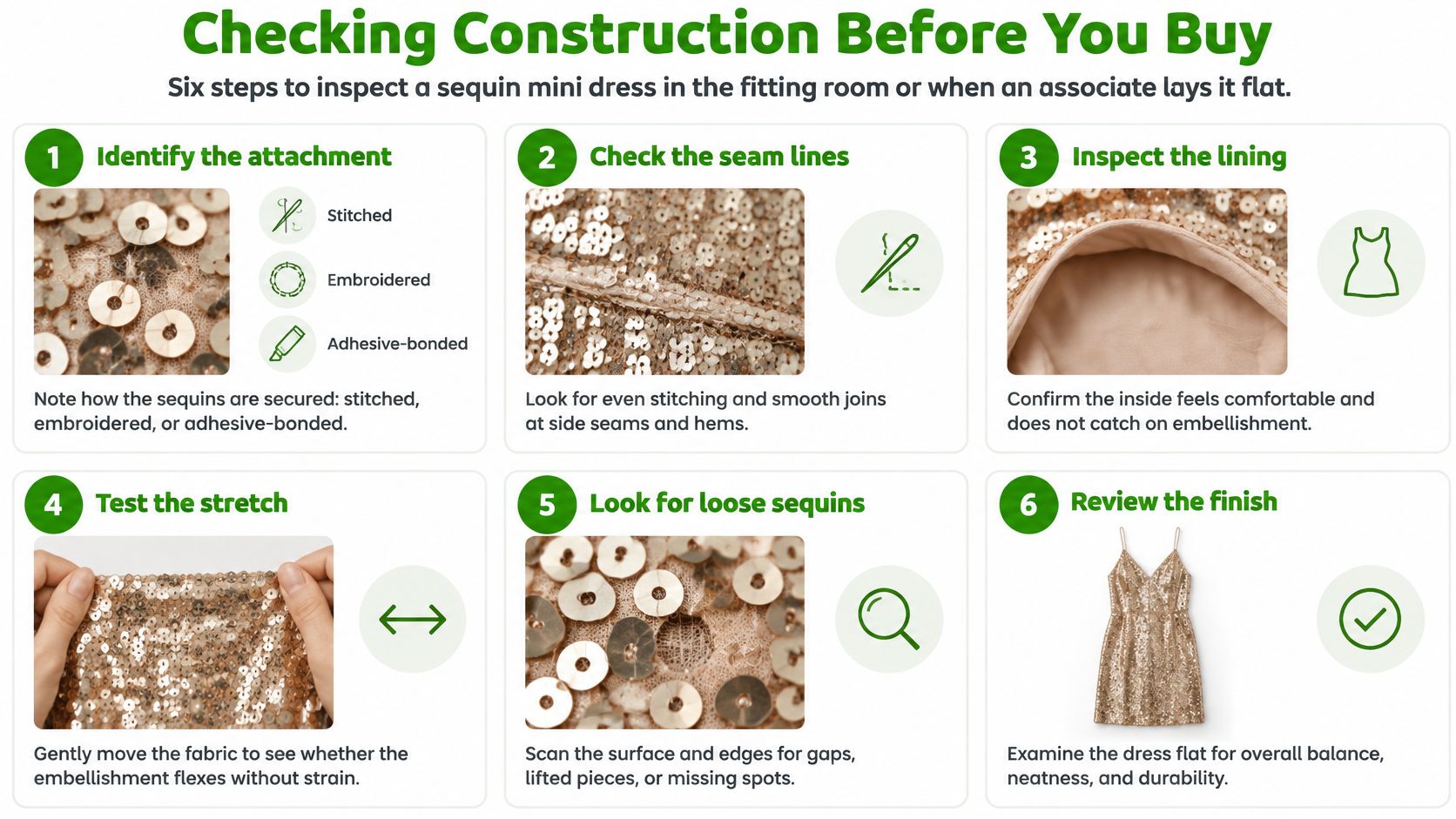
- Identify the attachment. Look inside for threads securing stitched or embroidered sequins, and ask an associate when the attachment isn't clear. Adhesive-bonded decoration deserves particular attention because cleaning compatibility can differ from sewn embellishment.
- Check the lining. Run fingertips gently along the inside, especially at the underarm, neckline and hem. A full lining should shield skin from sequin edges without twisting, bunching or hanging below the outer skirt.
- Look at panel alignment. Tilt the dress under the same light rather than judging each panel separately. Sequin rows running in conflicting directions can make adjoining sections appear mismatched even when their colors are identical.
- Inspect the seams. Side seams and joins should lie reasonably flat, without hard clusters of sequins trapped inside. Clearing embellishment from seam allowances helps prevent bulk and reduces the risk of needle damage during construction or alteration.
- Test a concealed area gently. With permission, lightly brush a hidden patch and apply slight tension beside a seam, not directly to individual sequins. Scratching, rattling loose pieces or opening stitches are reasons to investigate, not reasons to pull harder.
- Try the dress seated and walking. Check smooth zipper operation, comfortable armholes, a stable hem and a lining that moves without tension. Raising the arms and taking ordinary steps can reveal problems a still mirror pose conceals.
Decide whether the problem is fixable
Sequins can restrict fabric recovery and catch on accessories. Even a dress with a stretchy base should be evaluated as an embellished, structured garment rather than treated like a forgiving jersey mini.
A slightly loose waist may be manageable, while strained embellishment across the hip can require disruptive panel work. Cedar & Lily's guide to quality women's clothing brands provides additional context for judging clothing beyond its surface appearance.
A dress that passes the construction checks is worth considering for repeat wear. A failed check calls for a clear fit-or-skip decision, not hope that the problem will disappear during the event.
Finding Your Size in a Mini Dress
A familiar numerical size can't establish where a mini will land or whether its embellished panels will move comfortably. Height, torso length and horizontal proportions all affect the result, and the lining may fit more closely than the outer fabric suggests.
A historical U.S. Department of Agriculture garment-measurement study found that accurately predicting women's measurements requires combining vertical and horizontal measurements, identifying height as the most practical vertical measure. That finding supports a simple shopping habit: record proportions rather than relying on a size label alone.
Take measurements without adding guesswork
A flexible dressmaker's tape works better than a rigid measuring tool. Measurements should be taken over the undergarments intended for the dress, with the tape resting against the body rather than compressing it.
- Record barefoot height. Stand against a wall with an upright posture and mark the top of the head. Height helps an associate assess whether a photographed hemline is likely to translate to a particular frame.
- Measure the fullest bust. Keep the tape level across the back and check that it hasn't slipped beneath the shoulder blades. A relaxed breath gives a more useful measurement than holding the chest tightly.
- Find the natural waist. Measure at the torso's natural narrowest point without drawing the stomach inward. A tie loosely placed around the waist can help locate the position consistently.
- Measure the fullest hip. Move the tape until it includes the fullest part of the seat, commonly around 20 cm below the waist, while allowing for individual proportions. Measuring at a fixed distance alone can miss the actual fullest point.
- Compare body and garment measurements correctly. A body size chart describes the intended wearer; finished garment measurements describe the dress itself. When a flat width is supplied, establish whether it must be doubled before comparing it with a circumference, and allow for the intended ease.
- Resolve between-size choices through fit. Prioritize comfortable bust and armhole placement, then confirm that the hip also fits without strain. Sizing down to remove waist looseness isn't useful if the embellished skirt pulls.
Check length as a separate decision
A good circumference match doesn't guarantee a comfortable hemline. The dress should provide the intended coverage when seated, bending slightly and stepping onto a raised surface.
Cedar & Lily's dress size chart guide can help organize the comparison. At the Utica Square or downtown Jenks boutique, shoppers can try adjacent sizes and ask the team for finished measurements before deciding whether alterations are sensible.
Styling a Sequin Mini Beyond One Night
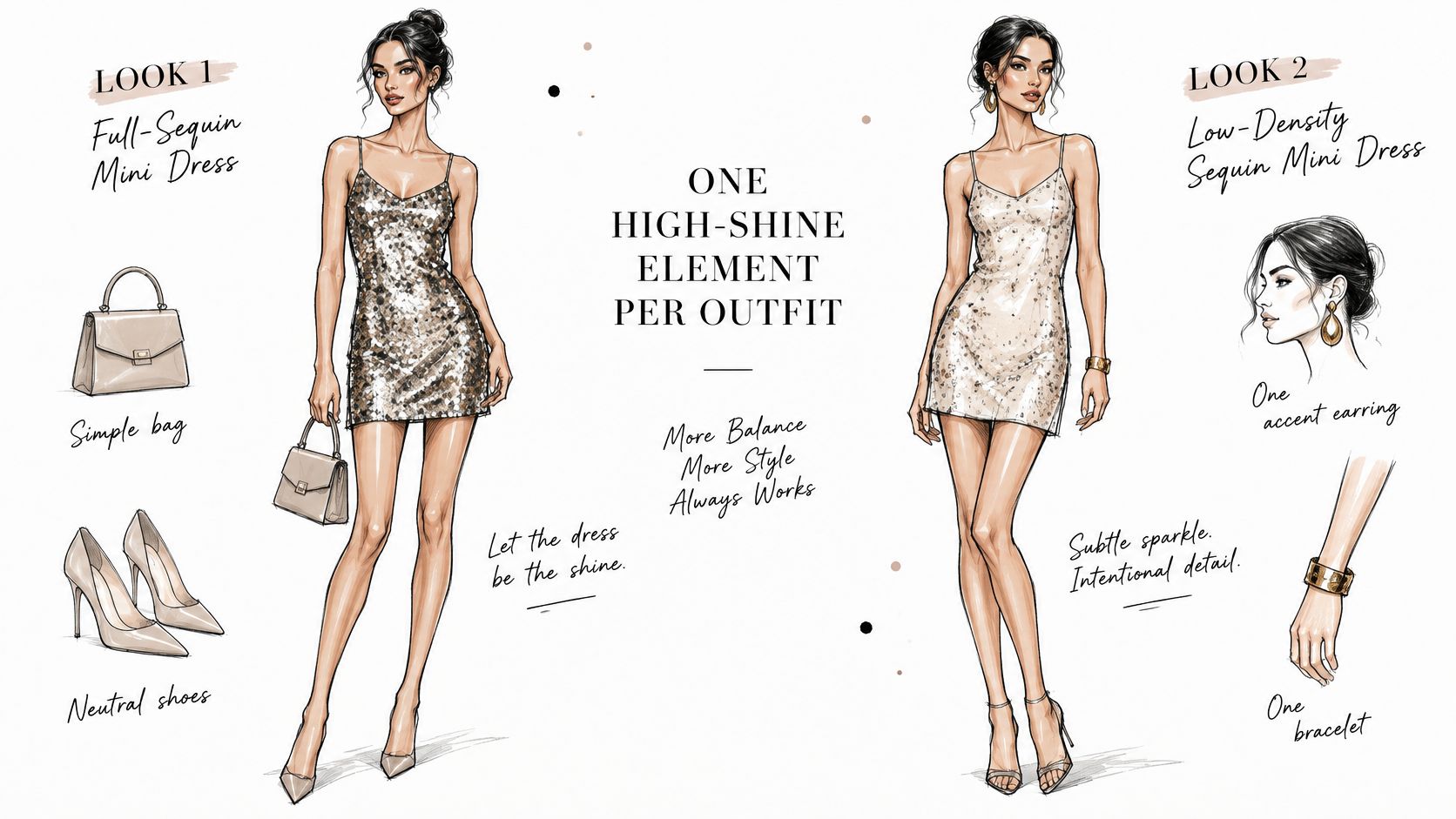
A sequin mini earns repeat wear when its sparkle, cut and styling work across plans you can realistically see yourself attending. Start with the dress's shine level: a fully sequined style usually pairs best with neutral shoes and a simple bag, while sparse embellishment leaves room for a jewelry accent.
Repeat wear is a practical purchasing priority. Drapers reports that womenswear purchased for party occasions fell 16.3% year over year in the 12 weeks ending November 9, 2025, alongside a preference for pieces that could be mixed and matched rather than reserved for a single night.
Outfit combinations that change the mood
- Desk-to-dinner: Wear a tonal, low-density shift beneath a fitted blazer, with opaque tights in cooler weather and stable block or ankle-strap heels. Check the workplace dress code first: a blazer cannot make every mini length or level of embellishment appropriate.
- Dinner or a date: Frame a medium-coverage mini with a camel or black wool coat. A small leather bag and uncomplicated footwear help the dress feel suited to the setting outside the festive season.
- Cocktail wedding: Pale heels, a structured clutch and statement earrings can soften the outfit. Choose earrings for their shape or color, rather than adding another broad area of reflection.
- Nightlife: A leather or cropped jacket makes the arrival outfit feel intentional while leaving the dress visible. Choose a smooth lining; exposed hardware inside the jacket can catch on sequins.
For a color-accent reference, browse sapphire stud earrings to see how blue can sit beside your chosen dress. The useful principle is controlled contrast: one added accent, not another large reflective surface.
Cedar & Lily's guide to how to accessorize an outfit offers ways to balance jewelry scale with a neckline and other finishing details.
Calculate the wear before the purchase
Cost per wear equals purchase price divided by actual wears. For example, a dress costing $150 and worn three times comes to $50 per wear; worn once, it comes to $150 per wear. These amounts illustrate the calculation, not product prices.
Counting possible occasions gives a starting estimate; it doesn't prove every outing will happen. List real plans and accessories already in your wardrobe, then consider whether the dress can work with those combinations.
Buying filter: A quieter dress with several believable outings can offer better value than a dramatic bargain with nowhere else to go.
Include outerwear and accessories in the cost-per-wear check. Tights and footwear from your existing wardrobe can complete different outfits, and the Cedar & Lily team can help assess proportions without assuming those items are stocked.
Caring for and Packing Your Sequin Mini
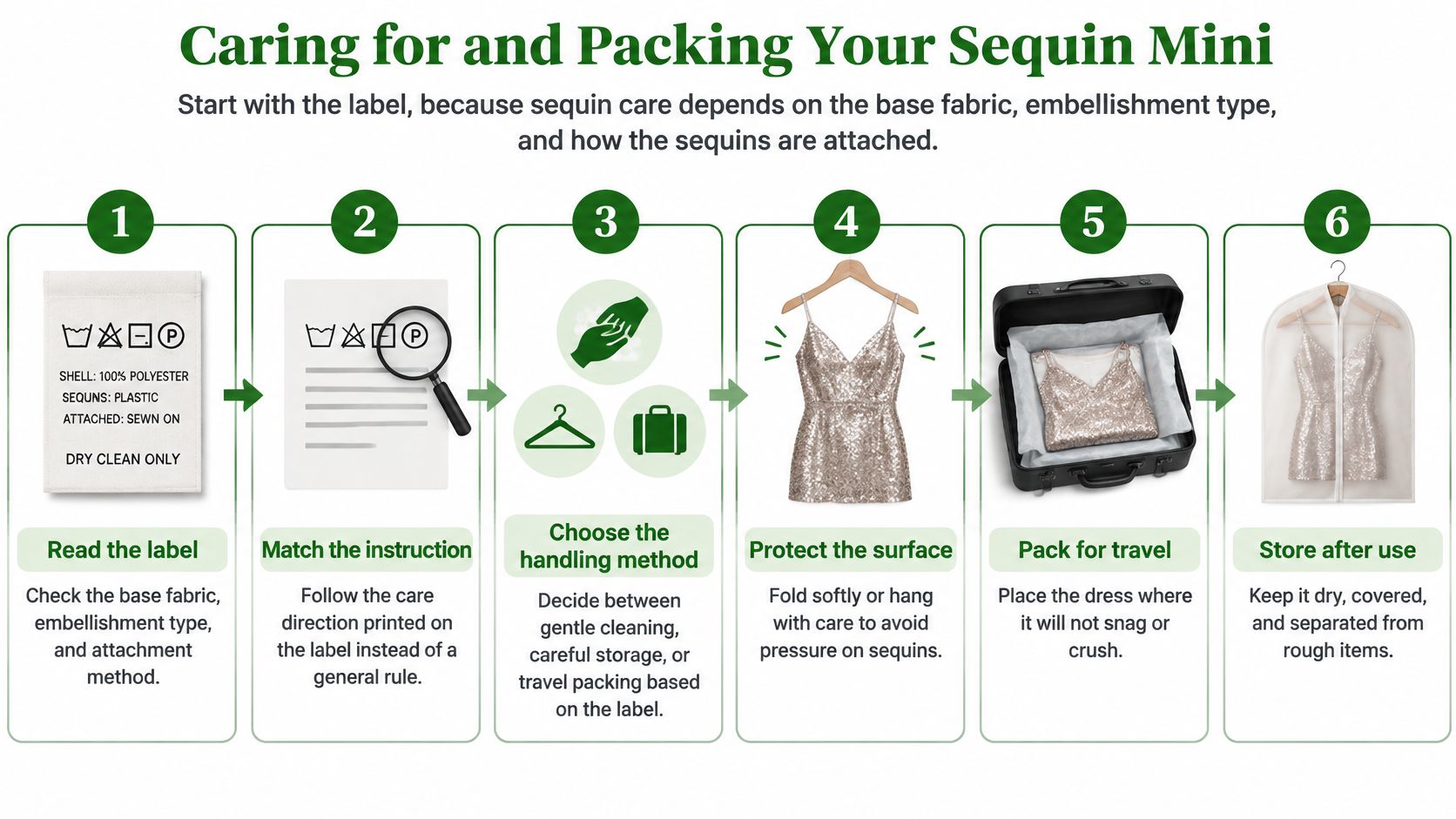
A dress that looks ready for another outing may still need careful handling after wear. Follow the garment label first: the base fabric, sequin material and attachment method determine which cleaning methods are safe. Glued embellishments can be particularly sensitive, so do not assume that a wash method suitable for one sequined dress will suit another.
Care label wording and the method to use
| Label says | Method | Temperature | Limits |
|---|---|---|---|
| Hand wash | Use hand-warm water and gentle detergent, move the dress as little as possible, rinse cool, then dry flat | Hand-warm, no warmer than 30°C | Do not wring; lay flat to dry |
| Machine wash, gentle | Turn inside out, place in a mesh bag, and choose a very gentle cycle with the lowest spin speed | Maximum 30°C | Never tumble dry |
| Dry clean only | Use a professional cleaner and mention any glued sequins | Follow the cleaner's process | Solvents may affect glued decoration |
| No label or unclear label | Test a hidden area before minimal spot cleaning with cool water | Cool water only for the test | Do not rub; seek advice before broader cleaning |
The temperatures in the table apply only when the label permits that washing method. An unclear label is not permission to immerse the dress.
A handling routine between outings
- Read the label before wearing. Check the permitted cleaning method and note any glued decorations. Knowing the care requirements before the first event helps you decide whether the dress suits your repeat-wear plans.
- Dab small marks gently. If the label allows it, test a concealed spot with a barely damp, clean cloth. Avoid rubbing or soaking an unidentified stain, since either can spread the mark or disturb the embellishment.
- Use only the permitted wash route. Follow the label, and use the table as a practical guide rather than a substitute for its instructions. Avoid twisting the dress, and support its weight while wet.
- Air and store with support. Let the dress air after wearing before covering it. A padded hanger can suit a lighter garment; heavier embellishment may need supported flat storage to limit stretching.
- Keep snags away. Store the dress apart from exposed zips and hook-and-loop closures. A clean fabric cover can prevent contact with neighboring garments.
- Keep heat away from the surface. If the label permits steaming, turn the dress inside out and use a low setting, keeping the steamer at a distance. Never press an iron directly onto sequins.
- Pack without crushing the embellishment. Cushion soft folds with tissue, or roll gently only if the dress's construction allows it. Keep embellished rows aligned and place the dress away from shoes and sharp closures. Pack it last so other items do not compress it.
For general luggage organization, travel packing advice from Urban Totes can help separate belongings, but avoid compressing a decorated dress. Cedar & Lily's guide to packing dresses without wrinkles offers further advice for preparing a dress for travel.
Care is part of the repeat-wear calculation. A mini that requires professional cleaning after every outing may not suit someone looking for a low-upkeep purchase. Choose a care route you can realistically maintain.
Shop Your Sequin Mini in Tulsa or Jenks
Choosing a sequin mini for repeat wear starts with a practical question: can you see and assess the garment before buying, and can the boutique answer product-specific questions? Cedar & Lily Clothier sells dresses in Mini, Midi and Maxi lengths, alongside tops, bottoms, denim, jumpsuits, outerwear and accessories. Its designer selection includes LoveShackFancy, Spanx and FRAME, among other brands.
Shop online or visit a boutique
Online, use the product description to check what is stated about the dress, then contact the store if a detail you need is missing. For a sequin style, that could include the lining, how the embellishment is attached, or the care instructions. Designer sizing and construction vary, so avoid assuming that a mini has stretch or is lined.
In person, Cedar & Lily has boutiques at Utica Square in Tulsa and in downtown Jenks. Seeing the dress directly lets you judge its sparkle and fabric in person, while a fitting-room try-on can show how it feels and moves. An associate can offer fit guidance and help check local availability.
Make the visit useful beyond one purchase
The boutique holds trunk shows and events that bring women together, offering a way to explore styles beyond a single shopping trip. New styles arrive each week, so shoppers can check the current selection when planning a visit. If you are buying a sequin mini, ask about the specific garment rather than relying on general expectations about a designer's pieces.
A repeat-wear purchase should suit more than one event. Compare the dress with the occasions you expect to wear it for, and consider whether its styling can work with pieces you already own. The goal is a mini that earns its place in your wardrobe, not just one that looks right under fitting-room lights.
Visit Cedar & Lily Clothier to browse the current dress selection, or stop by the Tulsa or Jenks boutique for help with fit and local availability.