


Prom night is getting close, and the dress search has narrowed to one question: can a short dress look formal enough without creating a problem at the door? The answer is yes, but the right choice depends on proportion, fabric, support, shoes, and the school's written policy, not the word “short” on a product page.
A polished short prom dress should look deliberate from every angle. That means checking the shortest hem point, testing how the bodice behaves while moving, and choosing evening-level details that make the outfit read as prom rather than a night-out look. Cedar & Lily Clothier carries curated designer and contemporary clothing, including Vanessa Mooney and Lace the Label, with online shopping and Oklahoma storefronts at Utica Square in Tulsa and downtown Jenks.
Table of Contents
- What Counts as a Short Prom Dress
- How Short Is Too Short for Prom
- Silhouettes That Work on a Short Hem
- Fabric, Structure, and Stretch
- Fit, Support, and Alteration Risk
- Styling a Short Dress for Prom
- Shopping Smart, Caring Well, and Coming In
What Counts as a Short Prom Dress
A short dress can absolutely be formal enough for prom. The strongest options usually combine an intentional hemline with structured fabric, a precise fit, refined accessories, and enough coverage for the venue. A very abbreviated dress in casual jersey may read like going-out clothing, while a knee-skimming satin, embellished mini, polished crepe, or elegant high-low design can look unmistakably occasion-ready.
The word “short” has never represented one fixed measurement. Western women's everyday skirts moved from floor length or ankle length toward the knee within roughly fifteen years, with hemlines rising significantly in the mid-1910s, reaching mid-calf around 1920, returning closer to the ankle by 1923, and reaching the kneecap or higher by 1927 during the flapper era. Later prom and occasionwear continued to shift. Tea-length dresses, approximately mid-calf, were common in the 1950s, while late-1950s bubble hems, shorter 1960s silhouettes, late-1980s pouf dresses, and the short and high-low styles visible by the 2010s kept redefining what formal dressing could look like. The history of changing hemlines shows why “short” should be treated as a relative fashion category, not a single universal length.
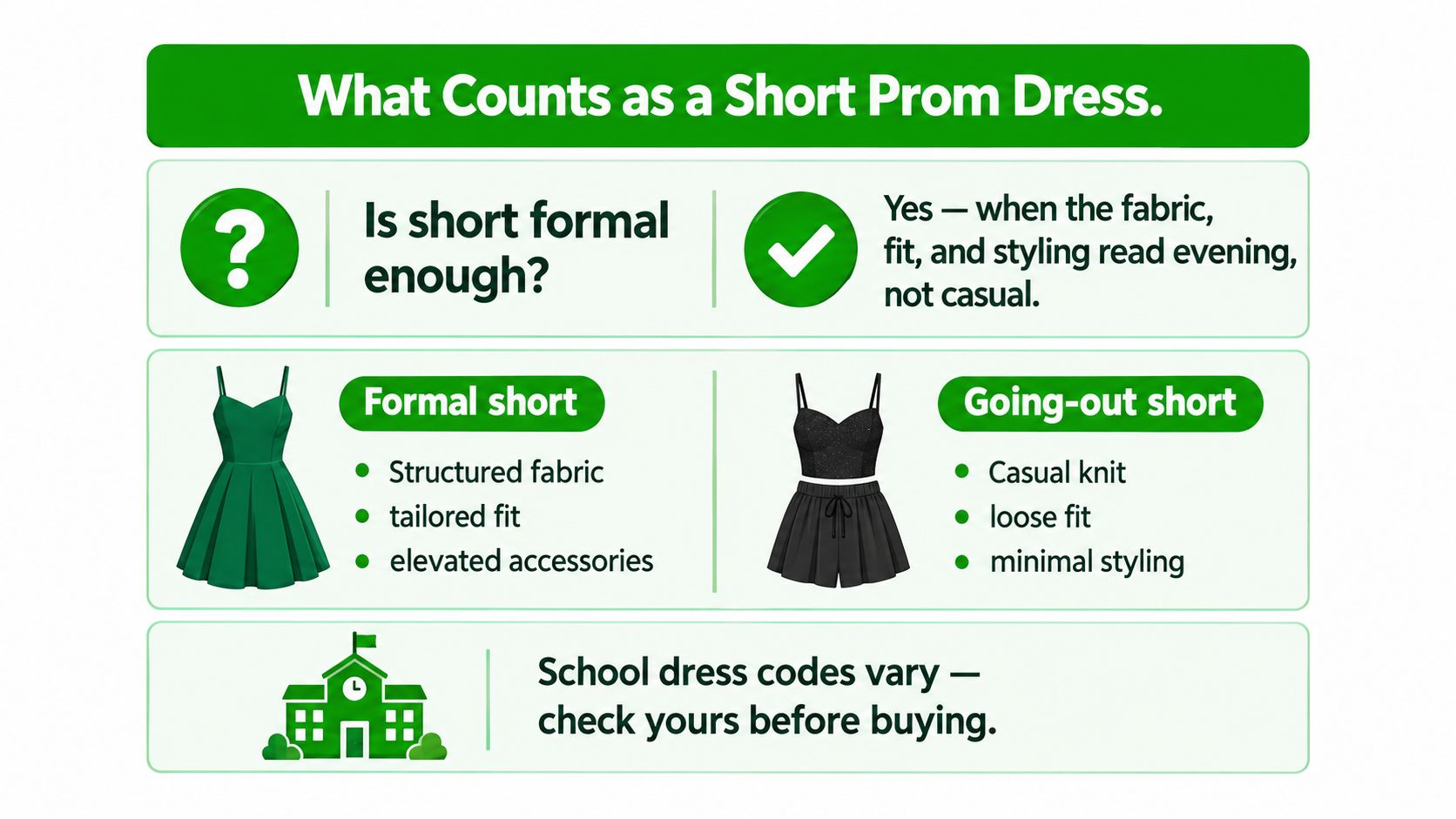
Start with the policy
Before browsing colors or necklines, a shopper should answer three questions:
- What is the minimum hemline? Some schools require the dress to cover the knee, while others permit shorter proportions.
- How does the venue affect the choice? A ballroom, school gym, religious venue, and outdoor event may each create a different expectation of formality.
- Are high-lows and slits addressed separately? A dress can look modest from the front but fail a rule at its shortest point.
A shopper should request the school's written guidelines before ordering. Then the fitting process becomes much easier. A stylist can focus on the silhouettes that meet the policy instead of trying to rescue a dress that was never eligible.
Stylist's rule: Short is formal when every visible detail looks intentional. The hem, fabric, fit, shoe, and accessories have to agree.
A mini, an above-knee fit-and-flare, or a polished high-low can all work, but the final proportion matters more than the label. For a useful reference before trying on dresses, the skirt length guide can help shoppers name the hemline they want. If sleeves need refinement after the right dress is found, a practical sleeve alteration guide offers useful background on the adjustment process.
How Short Is Too Short for Prom
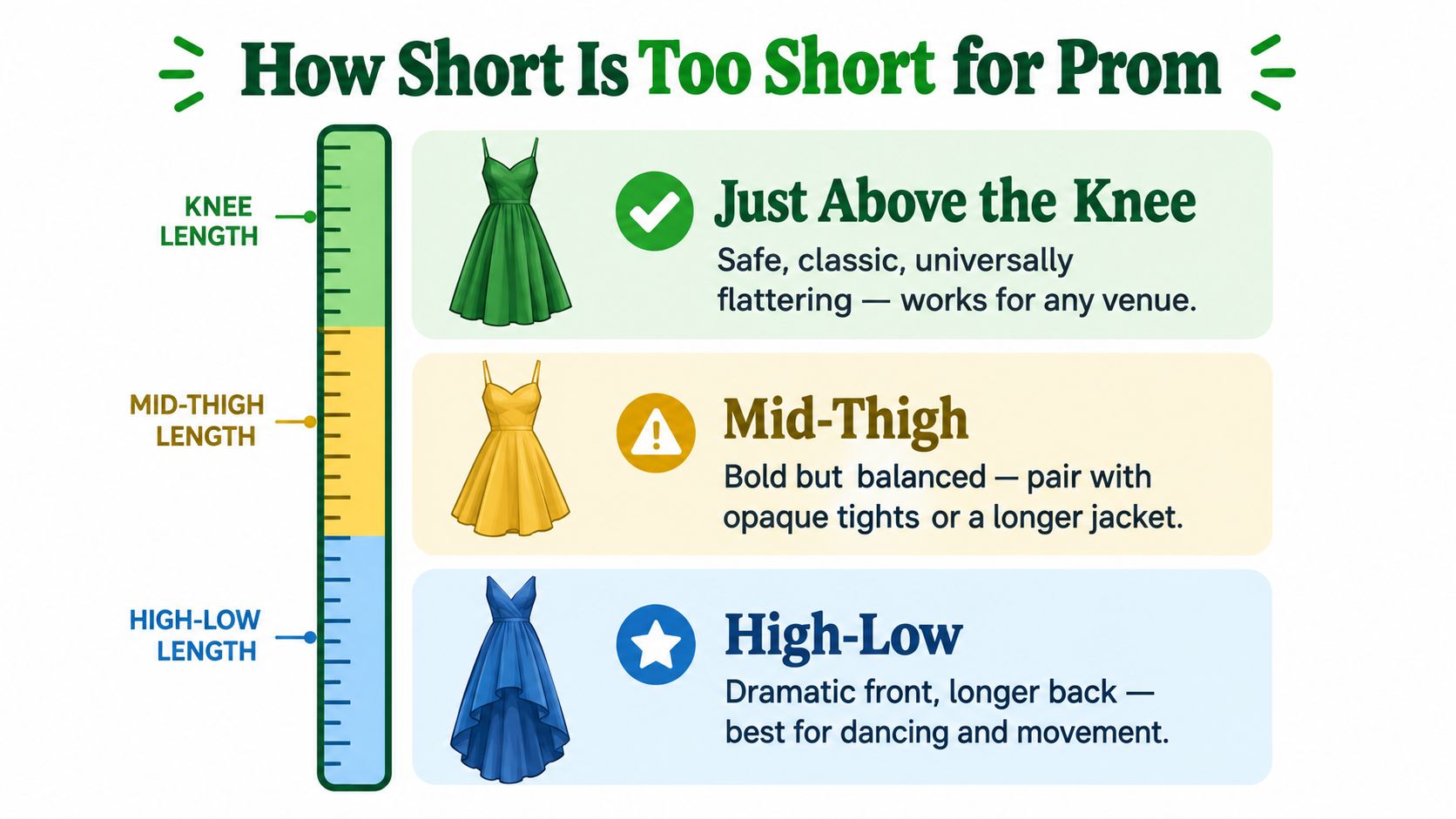
The safest way to judge a short prom dress is to separate the choices into three workable zones. Each zone creates a different impression, and each should be tested with the actual shoes planned for the event.
Just above the knee
This is the most adaptable short length. It feels current without fighting the visual language of formalwear, and it generally works for a school dance, ballroom setting, or venue with a more conservative dress expectation. A structured A-line, sleek sheath, or refined fit-and-flare at this length can look polished with minimal styling because the proportion already carries the occasion.
Mid-thigh
Mid-thigh is bolder and requires more discipline. The fabric should look polished, the fit should stay secure while moving, and the accessories should finish the look rather than make it feel like evening nightlife. An opaque tight or longer jacket can add coverage, but those additions should complement the dress instead of looking improvised.
This length deserves a full movement test. Sit in a chair, walk up steps, dance, and check the hem from the front and back. A dress that feels fine standing still may become uncomfortable once the skirt shifts.
High-low
A high-low dress creates drama through contrast. The front shows the leg and shoe, while the longer back adds movement and a more formal sweep. It can be a strong option for dancing, especially when the back falls gracefully instead of forming a stiff or bulky train.
The shortest point still has to meet the dress code. One published school policy requires dresses to cover the knee, mid-calf, or longer and applies the same standard to high-low designs, meaning every portion of the fabric must meet the stated coverage requirement. That policy also limits slits to the back or side and prohibits them from extending above the top of the kneecap. School requirements vary, so the prom dress guide should be treated as styling inspiration, not a substitute for the school's own written rules.
The mini question
A mini can be beautiful, but an extremely abbreviated hem is more likely to resemble a night-out dress than promwear. The shorter the skirt becomes, the more important the material, finish, and event policy become. A mini in polished satin with structured tailoring and intentional accessories may look formal, while a loose casual knit usually won't.
Heel height changes the result, too. The dress on the hanger isn't necessarily the dress on the body once the shopper adds shoes, adjusts the waist position, and accounts for torso length. The practical order is simple: read the policy, put on the intended shoes, assess the shortest point, then judge the overall formality.
Silhouettes That Work on a Short Hem
A short hem reveals more of the leg line, so the silhouette has to create balance above it. The best choice depends on where the dress defines the waist, how much movement the skirt allows, and whether the shopper wants a playful or refined result.
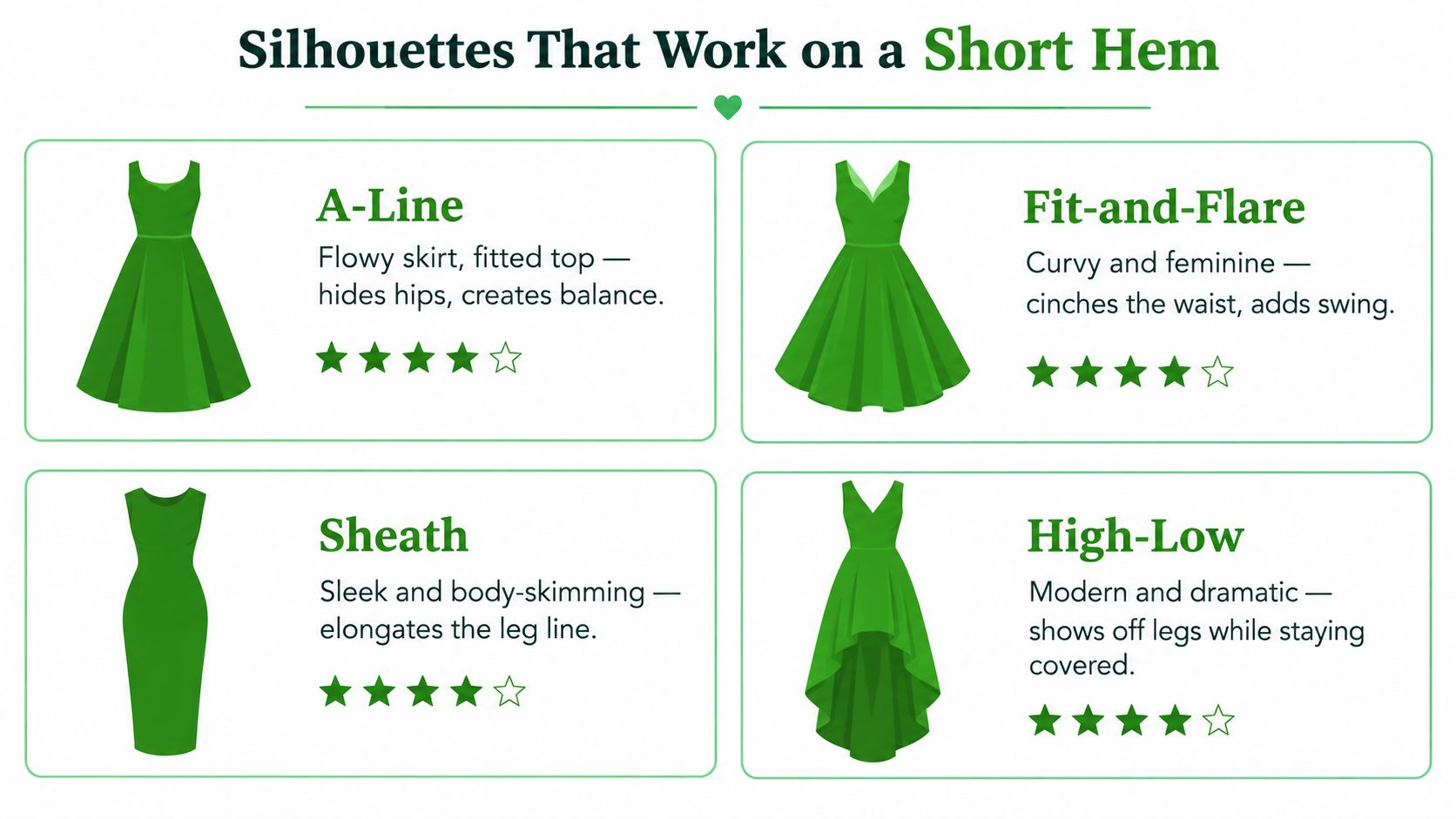
A-line
An A-line fitted through the top and gradually flared through the skirt gives the body room without adding visual weight at the hip. On a short hem, it feels youthful and easy to move in, especially for a shopper who wants to dance or create a gentle twirl. It also balances a fuller hip line and can make the waist look more defined without tight compression.
Lightweight chiffon, layered mesh, or a softly structured woven fabric can support the shape. The skirt shouldn't collapse into a casual shape, so a little construction at the waist or lining makes a noticeable difference.
Fit-and-flare
Fit-and-flare designs emphasize the waist before opening into movement. This cut suits shoppers who want a more sculpted silhouette while keeping the freedom of a shorter skirt. The flare can balance the bust and hip line, while the fitted bodice gives the outfit a more deliberate formal shape.
A fit-and-flare is especially effective in satin, crepe, or an embellished fabric that holds the waistline. Shoppers comparing the cut with other dress types can use this fit-and-flare dress guide to see how the flare changes the overall proportion.
Sheath
A sheath is the most grown-up short option. Its body-skimming line pairs naturally with strappy heels, a clean clutch, and restrained jewelry. The style works well for a shopper who wants a polished cocktail effect rather than a full, youthful skirt.
The fit must be exact. A sheath that pulls at the bust, waist, or hip won't look sleek, and a fabric with weak recovery may ripple after sitting or dancing. A lined crepe, structured satin, or carefully embellished mesh can keep the look refined.
High-low
High-low provides a compromise between visible movement and extra coverage. The shorter front highlights the shoes, while the longer back adds a sweeping, event-ready element. It suits a shopper who wants drama without committing to a traditional floor-length gown.
Regional preferences also show why a boutique should offer more than one shape. A Teen Vogue survey reported that 31% of Northeast shoppers selected column dresses, while 30% of Southern respondents and 38% of Midwestern respondents preferred princess silhouettes. The Northeast also reported an average prom-dress spend of $699.56, and the South reported the highest attendance rate at 76%. These figures don't isolate short dresses, but they support a clear merchandising conclusion: shoppers need multiple silhouettes and lengths rather than one national definition of formalwear. The regional figures and survey context appear in Teen Vogue's prom-style coverage.
For an in-person appointment at Utica Square in Tulsa or downtown Jenks, a shopper should begin with two contrasting options, such as an A-line and a sheath, then add a fit-and-flare or high-low if the first try-on reveals a preference for more movement.
Fabric, Structure, and Stretch
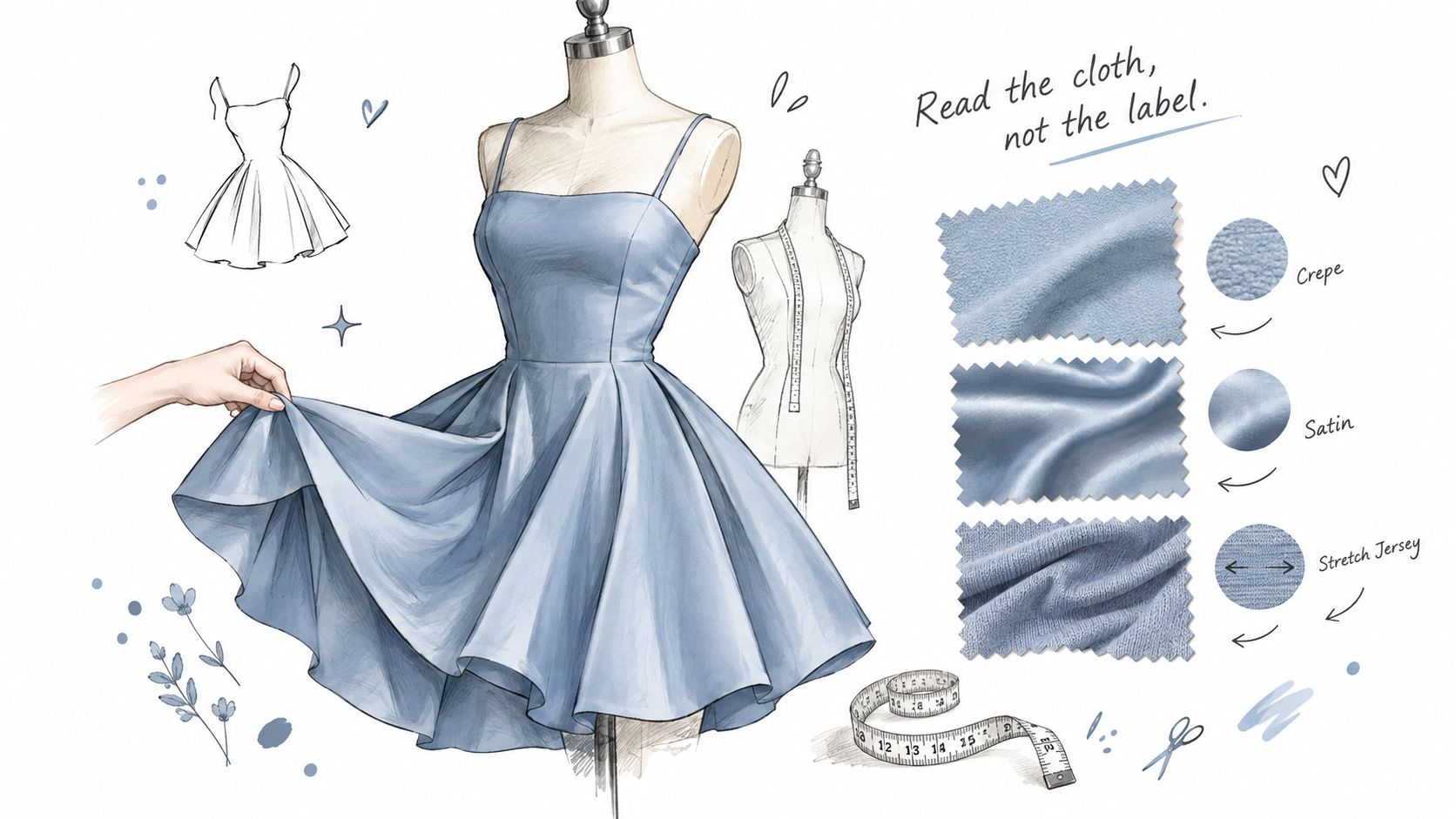
Fabric determines whether a short dress reads as formal, comfortable, and secure. Fiber labels alone don't answer those questions. Porosity, thickness, density, and construction influence how a garment handles heat, movement, and shape, so a shopper should touch and test the fabric rather than choosing by fiber name alone.
A densely constructed satin or structured woven fabric can hold a crisp outline and photograph with polish, but it may feel warmer during extended dancing. A lighter, more porous construction can improve ventilation while offering less sculptural support. The technical textile review on fabric comfort and thermal behavior recommends considering air permeability, vapor transfer, thickness, and thermal resistance together because no single property predicts comfort in every setting.
Reading the main fabric families
Structured satin holds a defined waist, reflects light, and gives a short sheath or fit-and-flare a formal finish. It can feel warmer, so it suits shoppers who value shape and shine over maximum breathability.
Crepe creates a quieter, refined surface. It usually looks more polished than casual jersey and works well for a clean sheath or fitted A-line. The hand should feel substantial enough to avoid cling and rippling.
Featherweight chiffon moves beautifully and keeps an A-line or high-low light on the body. It needs a reliable lining and thoughtful construction because the fabric itself won't provide much support.
Beaded mesh or embellished cloth can make a short hem feel unmistakably evening-ready. The shopper should inspect the backing, seams, and areas where beadwork may rub against the arm or catch on a bag.
A fabric's performance also depends on stretch recovery. Textile testing measures how far a fabric extends under a specified load and how closely it returns toward its original dimensions afterward. Performance fabrics are generally expected to recover to within approximately 3% of their original extension, as outlined in the fabric stretch-recovery testing reference. Recovery matters more than stretch alone. A very stretchy dress can still lose its shape if the fabric or elastic structure doesn't rebound.
The fitting-room test
Press the fabric at the bust, waist, armhole, and hip. Look for recovery rather than only asking whether the garment stretches. One-way stretch may make sitting easier, while two-way or four-way stretch changes how the dress responds during dancing and torso rotation.
A shopper should also test the dress in the conditions prom will create. Sit, raise the arms, walk, rotate, and check whether the hem stays controlled, the neckline remains secure, and the seams stay smooth. A useful fabric guide for summer dresses offers additional context for matching construction to warm-weather comfort.
Fit, Support, and Alteration Risk
Short dresses expose proportion problems quickly. Torso length, bust placement, rise, skirt volume, waist position, and heel height all affect where the hem finally lands. A dress that appears knee-skimming on a model may sit higher or lower on a shopper with a different torso length, even when both select the same labeled size.
The bodice deserves more attention than the skirt. A short hem is easy to shorten, but a bodice that is too small can create pulling, neckline movement, and uncomfortable pressure. Letting a dress out is often limited to roughly one to two inches, depending on the available seam allowance, so the safer choice is a dress that fits comfortably through the bust and waist before any length adjustment.
A practical try-on sequence
- Wear the intended undergarments. Seam placement and bust support change when the planned bra, shapewear, or other foundation garment is in place.
- Bring the prom shoes. Heel height can change the finished hem by several inches, and the shoe affects posture and the apparent length of the legs.
- Sit fully. Check whether the skirt rides excessively, the slit opens, or the bodice shifts.
- Raise both arms. Watch the armholes, neckline, waist seam, and hem. A short dress shouldn't become unwearable when the arms move.
- Walk and rotate. Look for twisting seams, neckline slippage, and fabric that bags at the hip or waist.
- Check the lining. The outer skirt may look secure while the lining pulls shorter or clings during movement.
Adjustable straps can improve placement, but they don't replace genuine bust support. Shoppers with a fuller bust should inspect the neckline, underbust seam, lining, and closure rather than assuming strap adjustment will solve every fit issue.
Structural changes require early planning. Reshaping a neckline, adding straps, moving a waist seam, or rebuilding support can become expensive and may not be practical after the dress arrives. Straightforward hemming is usually a more manageable alteration, especially when the dress has a clean finish, but the planned shoes must be present during measuring. The women's tailoring guide can help shoppers understand why fit and alteration decisions should happen before the final purchase.
Practical fitting rule: If the dress only works while standing perfectly still, it isn't ready for prom.
Styling a Short Dress for Prom
A short hem puts the shoes into the composition, so footwear is no longer a hidden detail. The heel should make the length look intentional, support the venue, and remain comfortable enough for an evening of standing and dancing.
A block heel works well for outdoor spaces, uneven ground, or shoppers who want stability. A strappy sandal creates a lighter line and suits a sleek sheath or fitted satin style. A platform can add height with a stronger fashion presence, but it should feel secure when walking and turning. Metallic, satin, or polished patent finishes usually bring more impact to a short dress than casual materials.
Build the accessories around the neckline
A one-shoulder or embellished neckline usually needs only earrings and a clutch. A simple strapless bodice can carry a more visible necklace, while a high neckline often looks best with a strong earring and no competing chain. The accessories should complete the dress, not fight the hemline.
A small clutch keeps the silhouette clean. A tiny shoulder bag can work when hands-free movement matters, but the hardware should look evening-ready. Vanessa Mooney and Lace the Label are among the designer and contemporary brands carried by Cedar & Lily Clothier, so shoppers can ask the team to coordinate jewelry, handbags, and occasion pieces with the dress selection rather than treating accessories as an afterthought.
Hair should follow the neckline and the overall scale of the outfit. A soft updo or sleek ponytail exposes shoulders and earrings, while hair down can soften a structured sheath or minimalist neckline. For a polished color match, a shopper choosing extensions or added hair pieces can use guidance on matching blonde tones naturally before finalizing the beauty appointment.
Three reliable finishing formulas
- A-line plus strappy sandal: Keep the jewelry delicate and let the movement of the skirt create the interest.
- Sheath plus pointed heel: Add a refined earring and a compact clutch for a clean, polished line.
- High-low plus visible statement shoe: Keep the bag sleek and let the asymmetrical hem and footwear carry the drama.
The styling should also respect the dress code. If the hem sits near the policy limit, a polished jacket or elegant wrap can add coverage without hiding the shape. A boutique fitting lets the shopper see the entire look at once, including hem, shoe, bag, jewelry, and outer layer.
Shopping Smart, Caring Well, and Coming In
A short prom dress still needs a real shopping timeline. Start eight to ten weeks before prom so you can compare proportions, order when needed, schedule alterations, and keep a backup option without rushing the final week.
Work backward from the event
- Eight to ten weeks out: Confirm the school and venue rules, identify acceptable hem zones, and try on several silhouettes.
- Several weeks before prom: Choose the dress, planned shoes, undergarments, and accessories. Compare bust, natural-waist, and fullest-hip measurements with the retailer's size chart.
- Before alterations: Bring the exact shoes and foundation garments for the event. Check the hem, straps, waist position, and lining while wearing the complete base outfit.
- The final week: Steam or press the dress according to its care label, test every closure, pack the clutch and shoes, and avoid structural changes.
Short and midi styles may need little alteration, yet a fitting still matters. Strap length, bust placement, waist position, and the final hem can change the dress's proportion on your body. Shopping early gives you time to correct an unexpected fit issue.
Beaded, feathered, and heavily embellished dresses need gentle care after the event. Hang the dress in a breathable garment bag, keep it away from rough jewelry and sharp hardware, and follow the care label before storing it. Careful storage can keep the piece ready for another formal occasion or make it easier to pass along in good condition.
Cedar & Lily Clothier offers online shopping, along with in-person service at Utica Square in Tulsa and downtown Jenks. In-store service can include pulling complementary shoes and clutches, checking the shortest hem point under store lighting, and reviewing the full outfit before alterations. Online shoppers can review the collection and request styling guidance before ordering.
Visit Cedar & Lily Clothier to shop polished short prom dresses, embellished minis, elegant midis, and fit-and-flare options from curated designer and contemporary brands. The team can compare proportions, check support and movement, and complete the look in person or provide styling guidance online.