

You're standing in front of the mirror on a Monday morning, pulling at a blouse that's either a little too crisp or a little too relaxed, and the annoying part is you can't tell which. The outfit is fine on its own, but fine is exactly what makes the decision hard. In a modern office, the professional dress code for women isn't confusing because the standards vanished, it's confusing because the signals got softer and the consequences for getting them wrong got more personal.
That hesitation is rational. Only 3% of U.S. workers say they wear business professional clothing such as suits or suit separates most days, while 51% of women report business casual as their usual work attire and 30% say they wear street clothes (Gallup survey summary). That means most workplaces have moved away from rigid suiting, but they haven't replaced it with one clear rulebook. A woman can look polished and still miss the mark if the fabric reads cheap, the fit looks accidental, or the outfit ignores the setting.
The fix is to stop thinking in outfit lists and start thinking in judgment calls. Setting, seniority, calendar, and fabric quality decide whether a look reads intentional or sloppy. If you get those four things right, you don't need a closet full of “office outfits.” You need a few strong formulas and the discipline to edit them correctly.
Why the Professional Dress Code for Women Feels Harder Than It Should
The hardest part is that women get judged on nuance men can often ignore. A blazer that looks sharp on one team can feel overdressed on another, and a blouse that passes in a creative office can look careless in finance. Add in mixed signals from leadership, vague onboarding notes, and the fact that dress codes are often interpreted differently by every manager, and you get a lot of women second-guessing perfectly decent outfits.
There's also the problem of ambiguity. 67% of employees say dress codes have relaxed, but only 56% say their workplace has a clearly defined dress code, so plenty of people are dressing by feel instead of policy (IWG Workwear Reimagined report 2025). That gap is why generic “wear business casual” advice fails. It tells you the category, not the judgment call.
What actually decides the outfit
If you want a clean answer, use these four variables in order.
- Setting: A client meeting, internal brainstorm, and executive presentation are not the same dress code, even if they happen on the same day.
- Seniority: The more visible your role, the more your clothes need to look deliberate instead of casual by accident.
- Calendar: A normal Tuesday gives you more flexibility than an interview, board meeting, or off-site dinner.
- Fabric quality: Wrinkled, shiny, thin, or clingy fabric can sink a look that was otherwise right.
Practical rule: If you're unsure, dress one notch sharper than the room, but keep the silhouette clean. That reads as respect, not insecurity.
The rest comes down to repeatable standards. Once you know what each dress code level looks like, you can choose faster and stop treating every outfit like a fresh exam.
The Four Levels Every Working Woman Should Know
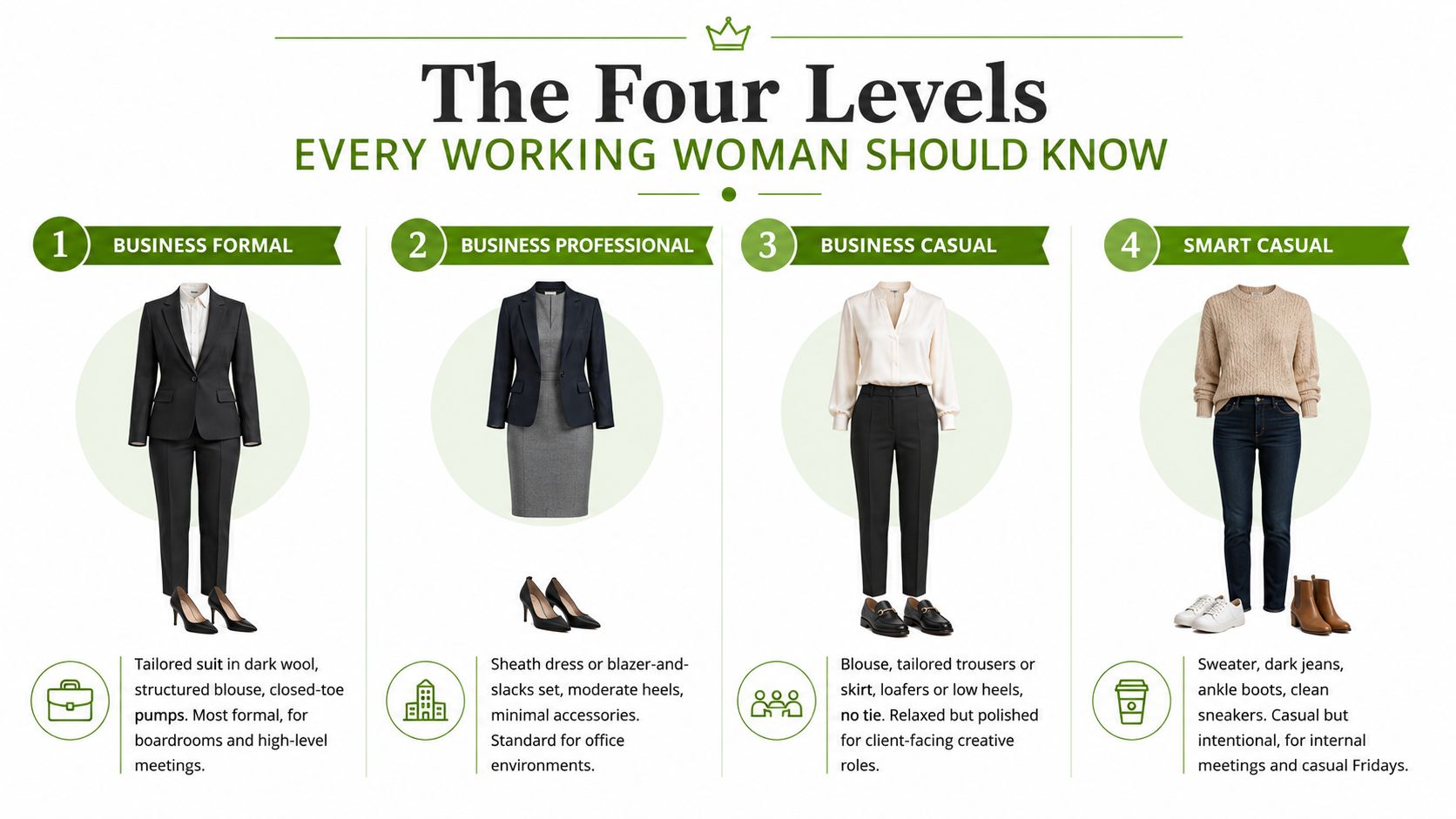
The spectrum works best when you picture it as structure that fades gradually rather than a wall that drops suddenly. Most modern offices sit in the middle, which is why women get stuck on pieces that are allowed on paper but still read wrong in the room.
The four levels in plain English
| Level | What it means | Example |
|---|---|---|
| Business formal | The most structured level, usually for conservative or high-stakes settings. | Tailored suit in dark wool, structured blouse, closed-toe pumps. |
| Business professional | Still polished and serious, but slightly more flexible than formal suiting. | Sheath dress or trouser suit in a solid neutral with minimal accessories. |
| Business casual | Relaxed, but still polished enough to face clients or leadership. | Chinos or dark denim with a blazer and loafers. |
| Smart casual | Intentional and neat, but clearly less structured than office suiting. | Knit top, tailored trouser, low heel, clean lines. |
Business formal belongs in conservative rooms and high-stakes meetings. Business professional is the default in many offices that still expect polish without a full suit every day. Business casual is where a lot of women live now, especially in hybrid settings. Smart casual still needs to look chosen, not improvised.
The blur usually shows up between business professional and business casual. A blazer can pull dark denim up into business casual, while a flimsy tee can drag well-cut trousers down into weekend territory. The item matters less than the whole outfit. If the pieces look like they were chosen with intent, the look reads as deliberate.
For a practical example of how to build the more relaxed end of that spectrum, this guide to business casual outfit ideas for women is useful because it focuses on combinations, not just categories.
One clean rule covers most situations. The more formal the room, the more structure your clothes need, and the more conservative your shoes should be.
How Dress Codes Shift by Industry and Role
The same blazer can feel right in one office and too stiff in another, which is why industry context matters more than fashion trends. A woman in finance needs a different baseline than a woman in tech, and a front-office role needs a sharper wardrobe than someone who rarely leaves an internal meeting pod. The clothes change because the audience changes.
Industry signals you should respect
| Industry | Default Tier | What to Wear | Common Mistake |
|---|---|---|---|
| Finance | Business formal or business professional | Structured blazer, tailored trousers, closed-toe pumps, conservative blouse | Too much texture, too much trend, or shoes that look casual |
| Law | Business formal | Suiting, polished dress, minimal jewelry, sharp tailoring | Anything that reads soft, busy, or overly decorative |
| Tech | Business casual to smart casual | Refined denim, knit tops, blazers, clean sneakers | Looking like you're trying too hard to “dress up” the room |
| Creative agency | Smart casual to business casual | Strong color, interesting texture, tailored separates | Treating expressive dressing as an excuse to skip tailoring |
| Healthcare | Business casual, depending on role | Covered shoulders, simple layers, low-profile jewelry | Fussy accessories or anything that gets in the way of movement |
| Retail | Business casual to smart casual | Polished separates, practical shoes, clean lines | Dressing either too corporate or too sloppy for a customer-facing floor |
Role matters as much as industry. If you're client-facing, your clothes should lean more precise because you represent the company, not just yourself. If you're back office, you can often relax the silhouette, but you still need crispness. Tenure matters too, because a new manager usually benefits from more structure than someone who has already established authority.
Direct line: In a room where you're still being evaluated, dress like you respect the hierarchy.
Many women overcorrect. They either show up overdressed and feel costume-y, or they underdress and look tentative. The middle path is to borrow the room's usual level, then sharpen it with fit and fabric.
Four Outfit Formulas That Cover Most Workdays
The smartest wardrobe is built on four repeatable formulas, not a pile of one-off outfits. Once you choose pieces that fit cleanly, the mirror stops being a daily negotiation. You look prepared because the clothes do the same job every time.
The formulas that actually work
| Formula | Core Pieces | Best For | Skip It When |
|---|---|---|---|
| Blazer and trouser | Neutral blazer, fitted trouser, shell or blouse, closed-toe shoe | Interviews, presentations, leadership meetings | The trousers bunch at the ankle or the blazer pulls across the back |
| Sheath dress | One fitted dress, structured layer, pumps or low heel, compact bag | High-stakes days, client meetings, long work dinners | You need a look that layers easily or feels relaxed |
| Polished denim | Dark denim, blazer, refined knit or blouse, loafers or ankle boots | Business casual offices and creative settings | The denim is faded, ripped, or too stretchy |
| Event-ready | Dress or sharp separates, elevated shoe, sleek outer layer, better bag | Client dinners, after-work functions, networking events | You will be moving a lot and need maximum comfort |
The blazer-and-trouser formula gives you the most authority, but it also demands the most precision. Pants that sit wrong at the waist or ankle throw off the whole look. The sheath dress is easier because it is one piece, yet it is harder to dress down if your office stays casual. Polished denim is the cleanest business-casual move, as long as the wash stays dark and the rest of the outfit stays sharp.
For bags, a structured work tote makes every one of these formulas easier to live with. If you want a practical reference point, the guide to 2026 work totes is useful because it treats compartments and function as part of the outfit, which is exactly how a work bag should be judged. A good comparison point for outfit ideas is this business casual outfit ideas for women guide, especially if your office sits between polished and relaxed.
A couple of trade-offs are worth saying out loud. Trousers are less forgiving but more authoritative. Sheath dresses are easy on busy mornings but less flexible across settings. Pick the formula that matches your day, not the one that sounds fashionable.
Fit and Tailoring Rules That Make Any Outfit Look Expensive
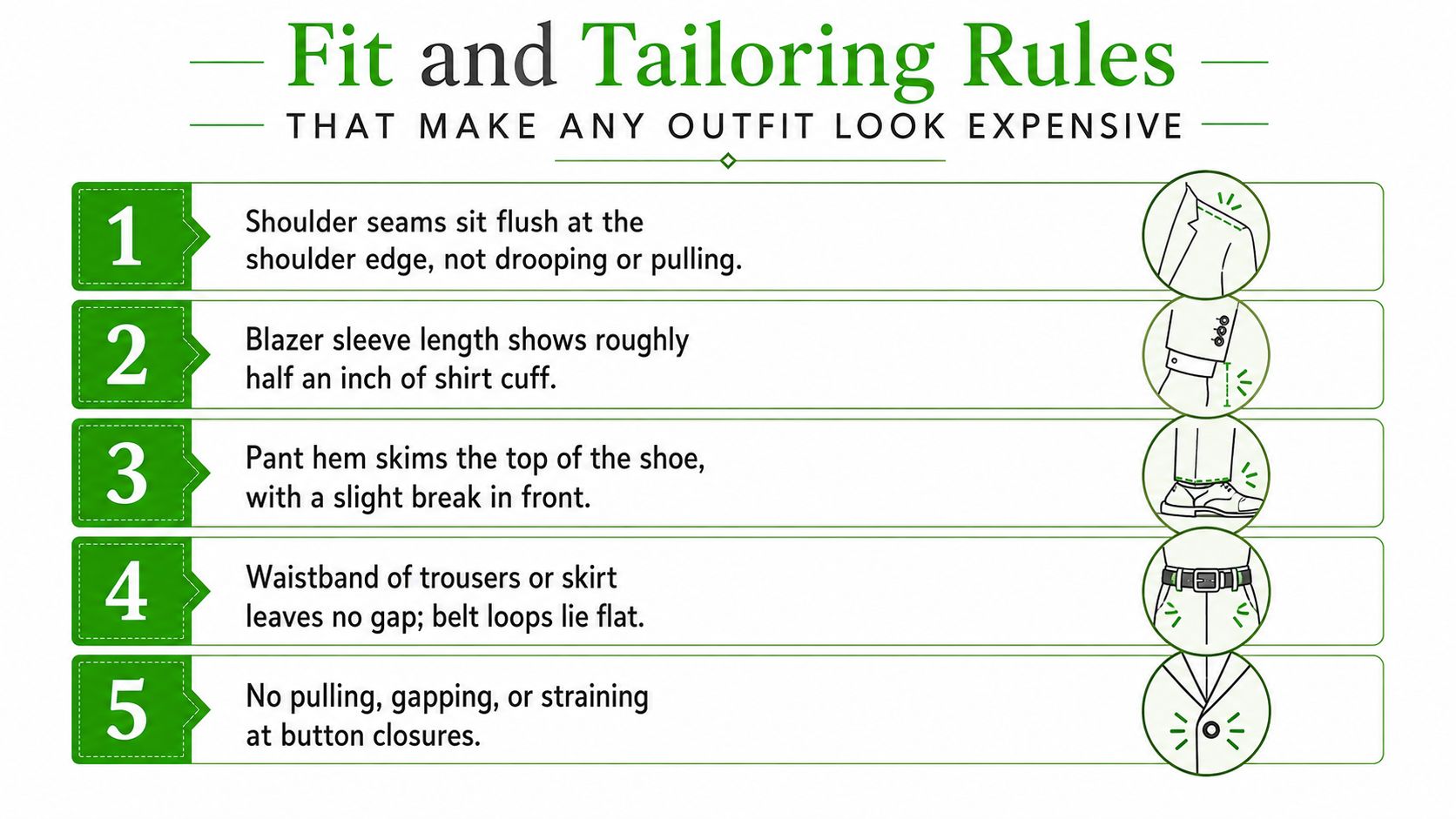
Fit is what turns clothes into a professional wardrobe. A mediocre blazer that fits correctly beats a designer blazer that wrinkles, pulls, or hangs wrong. That's not a style opinion, it's how people read competence.
The fitting-room checklist
- Shoulders: The seam should sit flush at the edge of your shoulder. If it droops, the jacket looks borrowed. If it pulls, the size is wrong.
- Sleeves: A blazer sleeve should show a little shirt cuff, roughly half an inch. If the sleeve swallows your wrist, the jacket looks unfinished.
- Jacket length: The hem should hit around mid-seat. If it's too short, the jacket looks cropped in the wrong way. If it's too long, it starts to read sloppy.
- Trousers: The hem should skim the top of the shoe with a clean break. If the fabric puddles, the pants need hemming.
- Waist and closures: Buttons shouldn't strain, ggap, or warp the front of the garment. If they do, size up or choose a different cut.
Skirt hems should land at or just above the knee, and dress waist seams should hit your natural waist. Those are the lines that make the garment feel deliberate instead of fussy. Small hems and sleeve tweaks are usually tailor work, while shoulder problems and major pulling usually mean the whole piece was wrong from the start.
Real rule: A fifty-dollar blazer tailored correctly will outwork an expensive blazer that fits badly.
If you want help sorting what needs a hem versus what needs replacing, this tailoring for women guide gives a useful framework for spotting the difference. The point isn't perfection. It's eliminating the details that make other people notice the clothes before they notice you.
Accessories and Grooming That Finish the Look
Accessories should support the outfit, not compete with it. One statement piece is enough. If your blouse has a strong neckline, keep the necklace simple. If the outfit is very clean and minimal, a better watch or earring can do the work instead.
Keep the finishing details disciplined
- Jewelry scale: Smaller pieces work best in formal settings. Go a little bolder only when the rest of the outfit is quiet.
- Bag choice: A structured tote or satchel reads more intentional than a slouchy carryall in business professional settings.
- Shoes: Closed-toe pumps, loafers, pointed flats, and sleek ankle-strap styles are the safest professional choices. Open-toe heels belong in looser settings, not business formal.
- Grooming: Clean nails, controlled hair, and restrained fragrance matter more than trendier accessories.
- Watch and belt: These should look like part of the outfit, not an afterthought.
Stacked bangles can get noisy fast, especially in more conservative offices. So can oversized logos, scratchy costume jewelry, and bags that look like gym carryalls. The goal is calm polish, not sparkle for its own sake.
For one more practical reference point on finishing touches, this how to accessorize an outfit guide is useful because it treats accessories as a deliberate layer, not decoration. That's the right mindset for work.
If you only have five minutes, choose the shoes first, then the bag, then one piece of jewelry. The rest should already be doing the heavy lifting.
Seasonal Adjustments That Keep Your Wardrobe Working Year-Round
Seasonal dressing gets easier when you stop rebuilding outfits and start swapping materials. The same blazer-and-trouser formula can work in spring and winter if you change the fabric weight, the layer underneath, and the color temperature. That's how you keep a work wardrobe looking fresh without buying a new identity every quarter.
Spring and summer
Spring is the time for lighter structure. Breathable suiting, ivory, soft pastels, and lighter trenches keep the outfit polished without looking heavy. A sleeveless vest under a blazer can make a warm day feel more manageable while still reading office-appropriate. If your office leans business casual, a crisp blouse under a light blazer does the job without visual weight.
Summer needs more fabric judgment, not less professionalism. Linen-blend trousers, short-sleeve shells, and closed-toe sandals can work if the rest of the silhouette stays clean. Tropical wool is a smart suiting swap because it keeps structure without the bulk. The mistake is trying to dress like it's the weekend just because it's hot.
Fall and winter
Fall is where texture starts earning its keep. Camel, oxblood, knit blazers, and ankle boots create depth without requiring new outfit formulas. You can keep the same trousers or sheath dress and just shift the outer layer to something richer. That's also the season where wool and suede start reading deliberate instead of heavy.
Winter calls for heavier wool, merino base layers, and tights under sheath dresses. Flannel trousers and longer coats help the whole outfit feel grounded. A turtleneck under a blazer can look sharp in colder offices, especially when the rest of the silhouette stays clean.
Myths worth dropping
- No pants is a myth: Well-cut trousers carry equal authority in nearly every modern office.
- No color is a myth: A saturated blouse or jewel-toned blazer looks polished when the rest of the outfit stays neutral.
- Flats are unprofessional is a myth: Pointed loafers, structured ballet flats, and sleek ankle-strap styles absolutely work.
- Denim is forbidden is a myth: Dark, unworn indigo with a blazer is standard business casual in many workplaces outside finance and law.
Change the weight, not the principle. If the core outfit is right, the season should only change how warm, light, or textured it feels.
Building a Core Work Wardrobe and When to Ask for Help
Start with five pieces: a neutral blazer, well-fitted trousers, a sheath or wrap dress, dark polished denim, and a crisp button-down. Those pieces cover most office situations if the fit is right and the fabric doesn't fight the room. Buy the blazer and trousers first, because they show up in the most combinations, then fill in with tops and accessories that can rotate across seasons.
The fastest way to find gaps is to watch your own hesitation. If you avoid a piece because it wrinkles, pulls, gaps, or feels wrong for meetings, that's not a style preference, it's a closet problem. Keep the items that get worn often and make the rest earn their place.
A styling service can save time when the dress code is unfamiliar, the closet feels fragmented, or your job has shifted into a more formal lane. Cedar & Lily Clothier, for example, offers curated women's apparel, accessories, and fit guidance that can support a more polished work wardrobe without forcing you to start from zero. The value is in editing, not overbuying.
A stylist can audit what you already own, point out what needs tailoring, and add seasonal pieces that extend your core wardrobe instead of duplicating it. That matters if you're returning to work after a break or stepping into a new role where the standards are higher than what you're used to. If you want a cleaner wardrobe and fewer morning decisions, book a styling consultation and build the outfit system around your actual week.
Cedar & Lily Clothier helps women build polished wardrobes that move from desk to dinner without guesswork. If you want help choosing workwear that fits your industry, your body, and your calendar, visit Cedar & Lily Clothier and start with a styling conversation that makes your next outfit decision easier.