


You're standing in front of a full wardrobe and still have nothing convincing to wear to Monday's meeting, Saturday's lunch, or the wedding on the calendar. A co ord suit solves that problem only when it earns more than one outing. The right set gives a woman a polished complete look, then separates cleanly into pieces that work with denim, knits, dresses, and shoes she already owns.
This guide gives shoppers the vocabulary to identify the right set, the fit checks that matter in a fitting room, and practical formulas for work, weekends, dinners, weddings, and travel. It also takes a firm position on value: a matching suit deserves a place in a wardrobe only when both pieces look strong on their own.
Table of Contents
- What a Co Ord Suit Is
- The Silhouettes Worth Knowing
- How to Choose the Right Fit and Fabric
- Polished for Work and Dressed Up for Events
- Easy Ways to Style Co Ord Suits on the Weekend
- Making the Set Work Twice as Hard
- How Cedar & Lily Curates and Fits These Sets
- Your Next Step Toward the Right Set
What a Co Ord Suit Is
You need one outfit for a meeting, another for dinner, and something polished for an event. A co ord suit can cover all three, provided the pieces look convincing together and useful apart. That makes it a wardrobe investment, not a one-season purchase. Try the set on in a real boutique, where you can judge the fabric, proportions, and separate styling before committing.
A co ord suit is a coordinated two-piece or three-piece outfit made from matching fabric, color, or pattern. Common combinations include a jacket with trousers, a jacket with a skirt, or a top and bottom with a relaxed cut. The matching material gives the outfit its identity.
A blazer and trousers bought separately may share a color and still count as suit separates rather than a co ord. Matching casual sets, such as a shirt with shorts or a knit top with trousers, sit in the same family. A co ord suit sits closer to tailoring because its construction, proportion, and finish create a more polished impression.
Shopping rule: If the pieces look convincing together and useful apart, the set has earned consideration.
Traditional suits usually suggest formality, especially with a structured blazer and fitted trousers or skirt. Co ords cover more ground. Cropped jackets, shirts, draped tops, peplum shapes, fluid trousers, and softly structured skirts can all belong to the category. The right level of polish also fits within business casual for women, depending on fabric, cut, and styling.
A skirt suit needs its own distinction. It is a co ord when the jacket and skirt share the same cloth and were designed as a pair, but the skirt changes the message. A knee-length A-line looks classic and office-ready. A bias-cut or ankle-grazing skirt leans toward evening. A mini skirt, cropped jacket, or bold print makes the set more fashion-led for occasions.
Coordinated dressing has a long history. Fashion historians trace matching bodices and skirts to the 1600s. King Charles II introduced a three-piece suit-like ensemble in September 1666 after the Great Fire of London. Coco Chanel's matching cardigan jackets and patterned jersey skirts marked a major women's milestone in the 1920s, while designers including Mary Quant and Pierre Cardin pushed color-blocking and graphic prints through the 1960s. The category keeps returning because matching separates adapt to changing ideas of polish and proportion.
For shoppers, the vocabulary is simple: look for a matching coordinated set, then test each piece with items already in your wardrobe. In the fitting room, pair the jacket with denim and the trousers or skirt with a blouse, knit, or tee. If both combinations work, shop the set as a repeat-wear investment.
The Silhouettes Worth Knowing
A woman can lose an entire morning trying to decide between a long jacket, a cropped jacket, a skirt, and a wide-leg trouser. The rack becomes easier to read once each silhouette has a job. The most useful starting point is the shape that can move between settings without demanding a complete change of personality.
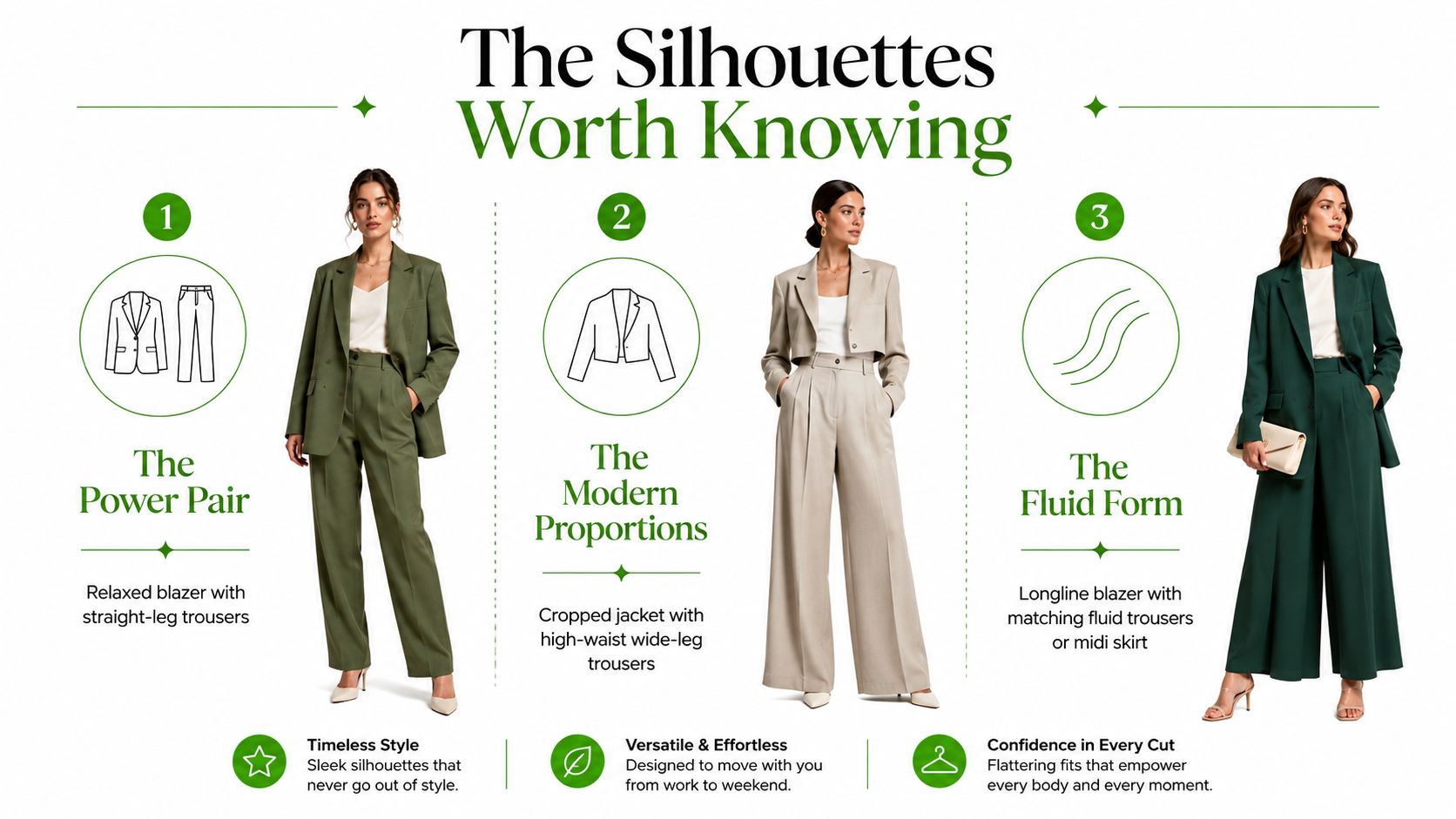
Start with the power pair
A relaxed blazer with straight-leg trousers is the safest first try-on. The jacket gives the shoulder definition, while the straight trouser creates a clean vertical line without overwhelming the frame. This silhouette suits women who want one set for meetings, dinners, and travel days, especially in a matte neutral or restrained pattern.
The cropped jacket with high-waist wide-leg trousers feels more directional. The shorter top defines the waist and lets the trouser carry the length, which can flatter women who like a clear proportion between torso and leg. It reads more fashion-forward than a conventional suit, making it useful for dinners, gallery events, and weddings where a standard office suit might feel too serious.
A long-line vest with slim trousers creates a fluid, elongated column. It's particularly appealing to women who prefer less shoulder structure or who want a third piece that feels lighter than a blazer. In a quiet neutral, it works for polished business casual. In a lustrous fabric, it can move into evening.
Move toward statement proportions
The boxy jacket with an A-line midi skirt balances structure above with movement below. It's flattering on women who like waist definition created through contrast rather than a tightly fitted jacket. The skirt length makes this a strong choice for offices, daytime events, and classic wedding guest dressing.
The short-sleeve jacket with a knee-length skirt has a neat, ladylike quality. It suits women who enjoy a compact silhouette and want an outfit that feels finished without heavy layering. Choose a refined fabric and a simple shoe for daytime; add larger jewelry and a more sculptural heel for a celebration.
A useful blazer styling edit can help shoppers compare jacket lengths before entering a fitting room. The practical recommendation is to begin with the relaxed blazer and straight trouser, then try the cropped wide-leg option if the first shape feels too conventional.
How to Choose the Right Fit and Fabric
A co ord suit can look expensive on a hanger and disappointing once worn. Check the shoulder, closure, waistband, hem, and seat before judging the full outfit. A real boutique fitting room gives you space to test movement, compare sizes, and decide whether the set deserves a place in your wardrobe.
Use the fitting room as a movement test
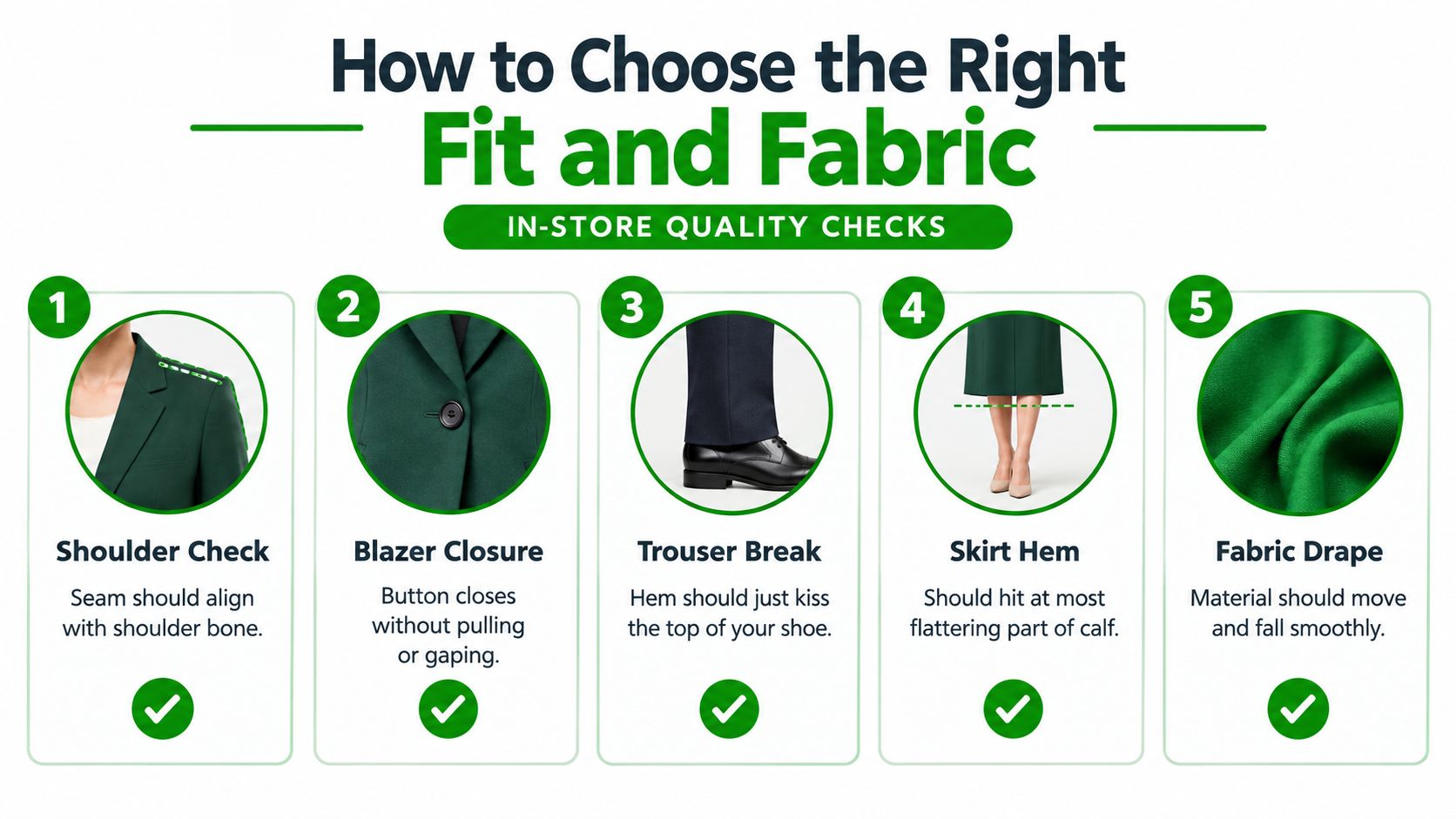
The shoulder seam should finish close to the shoulder bone. If it falls down the arm, the jacket is too large or the cut is too relaxed for you. Button the blazer fully. The closure should lie flat without pulling across the chest or opening at the waist.
Trousers should meet the shoe with a deliberate break. A dragging hem makes polished tailoring look careless, while a hem that floats too high interrupts the line. For skirts, inspect the hem standing and sitting. A knee-length skirt should sit at a flattering point around the knee, not across the widest part of the calf.
Run this checklist in front of the mirror:
- Button the jacket: Check the chest, waist, and lapel for strain.
- Sit down: The waistband should stay flat and the skirt should remain secure.
- Raise both arms: The armhole should allow movement without the jacket riding sharply upward.
- Walk three steps: Watch how the trousers, skirt, and jacket recover after movement.
- Take a photograph: A front and side view can reveal pulling that the mirror hides.
Bring the set into a boutique and test it with the shoes and layers you already wear. That practical check helps you buy a wardrobe investment, not a matching outfit that only works once.
Let the fabric decide the calendar
A wool blend can span seasons and support a structured shape without looking overly formal. Cotton-linen suits suit warm-weather dressing, especially in relaxed cuts where natural texture adds ease. Crepe offers attractive drape and a smooth surface for work, dinners, and occasions. Knits work well for travel because they move comfortably and avoid the stiffness that makes tailoring tiring.
Fabric should move smoothly over the body. Inspect the lining and seams, then check recovery at the elbows and seat. A professional tailoring service for women can make a good set feel custom when the required change is a hem or small waist take-in. Alterations are often the final step between looking dressed and looking precisely fitted.
Choose pieces you can separate later. Wear the jacket with jeans, the trousers with a fine knit, or the skirt with a simple shirt. A boutique can assess those combinations during the fitting, so the set earns repeat wear across workdays, weekends, and events.
Polished for Work and Dressed Up for Events
The same matching idea can read corporate, relaxed, or formal depending on fabric, jacket length, hemline, and styling. For work, the strongest choices are trouser suits and skirt sets in matte materials such as wool blends, gabardine, or crepe. Navy, charcoal, taupe, and camel communicate authority without forcing the outfit to dominate the room.
An office-ready co ord suit usually has a longer jacket, a mid-rise trouser, or a knee-length A-line or bias skirt. Underneath, choose a silk shell, fine knit, or crisp shirt. Structured accessories and a polished pump or loafer keep the look composed. A guide to stylish workwear for women offers a useful reference point for building that wardrobe.
Evening allows more movement and sheen. Velvet, satin-back twill, and metallic accents belong at dinners, cocktail events, and festive occasions rather than conservative offices. A relaxed blazer with fluid trousers looks refined without feeling rigid. A bias-cut skirt creates a softer line for weddings and evening celebrations, especially when paired with a fitted shell and refined jewelry.
| Setting | Best Silhouette | Best Fabric | Top Swap |
|---|---|---|---|
| Corporate office | Longer blazer with straight trousers | Wool blend or gabardine | Crisp shirt |
| Business casual | Long-line vest with slim trousers | Crepe or fine knit | Silk shell |
| Client dinner | Relaxed blazer with fluid trouser | Crepe or satin-back twill | Fine knit with jewelry |
| Wedding guest | Cropped jacket with wide-leg trouser or bias skirt | Satin or refined crepe | Draped camisole |
| Evening event | Boxy jacket with fluid skirt | Velvet or metallic-accented fabric | Minimal shell with statement earrings |
Shoes can shift the entire message. A low heel or loafer keeps a refined set grounded for work. A higher heel lengthens the trouser line for dinner. Jewelry should stay modest in the office and become more sculptural after dark. A tonal top makes the set look sleek, while a contrasting top breaks up the match and makes the outfit feel less uniform.
The most versatile purchase is a matte trouser suit that can accept both treatments. A statement cropped jacket or glossy skirt is more exciting, but it needs a clear occasion in the wardrobe before it deserves the hanger space.
Easy Ways to Style Co Ord Suits on the Weekend
Weekend dressing benefits from a little friction. A formal suit can look too deliberate for coffee, while a soft knit set can look exactly right with almost no effort. The trick is to keep the outfit to three main pieces, then let the shoe and accessory set the tone.
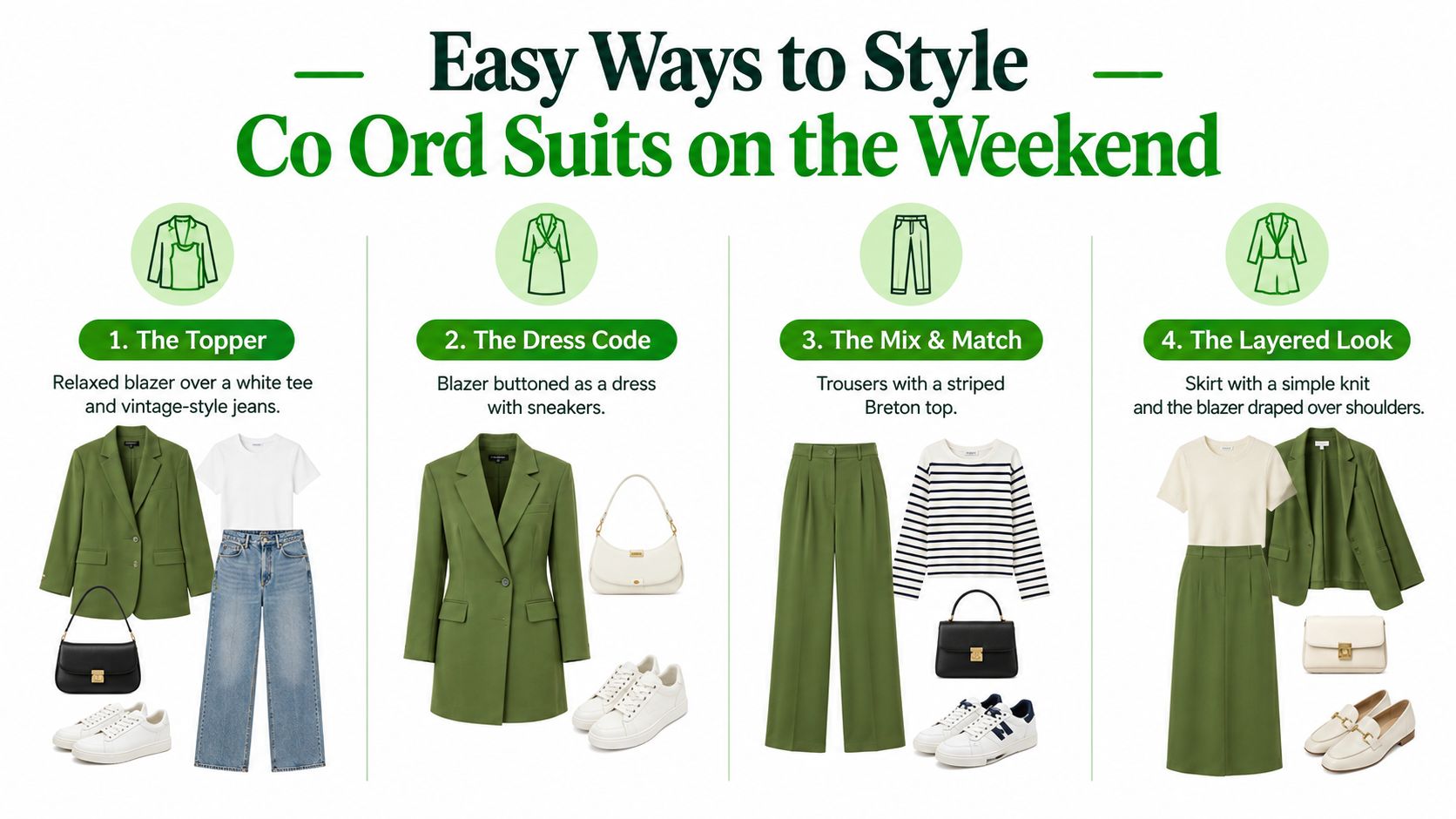
Four formulas that work quickly
Saturday errands: Wear the relaxed blazer over a white tee with vintage-style jeans. Add loafers and a crossbody bag. The denim lowers the formality, while the blazer keeps the outfit from becoming ordinary.
Brunch or coffee: Keep a knit co ord together, then add chunky sneakers and a crossbody bag. The matching texture makes the simple silhouette feel intentional. This is the right choice for travel days and casual appointments when comfort matters but pajamas aren't an option.
Warm-weather lunch: Pair wide-leg co ord trousers with a ribbed tank, sandals, and a woven bag. The tank exposes enough of the neckline to soften the tailoring, while the sandals prevent the wide leg from looking office-bound.
Hot-day outing: Try a shacket-and-shorts co ord with a bandeau and strappy sandals. Keep the accessory small and the hair uncomplicated so the set feels like an easy summer uniform rather than a costume.
Formal sets can also be relaxed without being dismantled. A belt and white sneaker combination is the quickest fix. Belt the jacket or add a belt at the natural waist over a buttoned blazer, then use the sneaker to interrupt the expected office silhouette.
The best weekend test happens in person because color, weight, and stiffness don't translate perfectly on a screen. A set that appears relaxed online may feel rigid in motion, while a structured piece may become easy with the right tee and shoe.
Making the Set Work Twice as Hard
A matching suit earns its place when the pieces solve separate wardrobe problems. The blazer can serve work, weekend day, dinner, and travel. The trouser or skirt should have the same range, even if the styling becomes more casual or more refined.
The blazer rotation
For weekend day, pair the blazer with dark denim and a tee. For evening, wear it over a slip dress, leaving the closure open so the dress remains the focal point. In winter, layer it over a maxi skirt and turtleneck, using boots to ground the longer proportions.
A fourth option uses the blazer as a tunic-style layer over wide-leg trousers. Keep the underlayer slim and let the jacket provide the volume. This works when the jacket is long enough to cover the upper hip without creating awkward bunching.
The trouser rotation
The matching trouser can move into weekend with a band tee and sneakers. For dinner, use a silk blouse and heeled mules. For travel, add a chunky sweater, then finish with a long coat when the outfit needs more structure for the office or a client appointment.
Wardrobe math: If a set is worn four times a month across six months, the price becomes a per-wear figure rather than an abstract sticker price.
That calculation isn't a reason to buy every matching set. It's a test of whether the set has enough life beyond the original styling. A shopper considering a higher-priced suit should list the actual occasions available, then name at least four separate combinations before purchasing.
The principle behind a capsule wardrobe approach is useful here. A co ord suit works hardest when it connects to existing denim, knitwear, dresses, shoes, and coats. A beautiful set that only works with its own matching pieces is an outfit. A set that integrates with the wardrobe is an investment.
How Cedar & Lily Curates and Fits These Sets
Cedar & Lily Clothier treats a co ord suit as a wardrobe system, not a matched hanger display. The buying team evaluates hand feel, lining weight, construction, and the way the pieces behave on a real body. A jacket can look balanced on a rack and still sit poorly once the wearer moves, reaches, or sits.
The in-store checkpoints
The first check is the jacket closure. The button should fasten without pulling across the chest or forcing the lapel to bow. The second is the trouser waistband while seated. It should remain flat rather than rolling, gaping, or pressing into the body.
The third is movement. A shopper walks several steps, turns, and checks how quickly the fabric recovers from creasing. That matters because a co ord suit that looks polished only while standing still won't become a reliable work-to-weekend piece.
The set must also pass the separation test. Stylists look for a trouser that can work with a blouse, sweater, or tee and a jacket that can pair with denim or a dress. If one half has no credible life outside the full set, the garment is less useful and the buyer should think twice.
Why the boutique fitting matters
In person, shoppers can compare two silhouettes side by side, swap sizes immediately, and assess fabric under consistent boutique lighting. They can also bring a familiar shoe or bag into the fitting room, which produces a more honest answer than styling around a mannequin.
Cedar & Lily offers fittings by appointment so each customer has focused time to test the complete set, separate the pieces, and discuss alterations. An in-house tailor understands each label's construction, making a hem or waist adjustment more precise than a generic alteration decision. The result should be a suit that sits securely, moves comfortably, and looks intentional from every angle.
The boutique carries curated designer and contemporary brands, including Vanessa Mooney and Lace the Label, alongside other women's clothing categories suited to work, events, and everyday dressing. Shoppers can examine fit and fabric in person at Utica Square in Tulsa or downtown Jenks, with styling help available from the team.
Your Next Step Toward the Right Set
The right co ord suit solves more than one clothing problem and still feels like the woman wearing it. Before shopping, decide which gap matters most: Monday meetings, Sunday brunch, a wedding, or a combination of those needs. That answer determines whether the first try-on should be a matte trouser suit, a softer knit set, a skirt suit, or a more directional evening silhouette.
A useful appointment starts with something already loved. Bring a heel, a tee, or a leather bag and style the set around it. Then break the suit apart in the fitting room and test each half with existing wardrobe categories such as denim or a cashmere knit. The purpose is to see the garment on a real body in a real context, not to admire a complete look that may never leave the boutique.
The fitting should include more than a quick glance in the mirror:
- Try the full set: Check the overall proportion, closure, hem, and movement.
- Separate the jacket: Pair it with denim, a dress, or a simple skirt.
- Separate the bottom: Test it with a shirt, tee, fine knit, or evening top.
- Compare silhouettes: Put two jacket lengths or trouser shapes side by side.
- Discuss tailoring: Ask whether the waist or hem needs a small adjustment.
Cedar & Lily appointments run about an hour, allowing time to compare silhouettes, work with the in-house tailor, and decide whether the set earns its hanger. Online shoppers can browse the curated collection, while local customers can visit Utica Square in Tulsa or downtown Jenks for personal fit and styling guidance.
Cedar & Lily Clothier offers curated women's clothing from designer and contemporary labels, including Vanessa Mooney and Lace the Label, with online shopping and Oklahoma boutiques in Tulsa and Jenks. Visit Cedar & Lily Clothier to shop the collection, book a fitting, or reach out for styling help choosing a co ord suit that works beyond its first wear.