


A long day is over, the outfit for tomorrow is hanging by the wardrobe, and one small decision can change the entire mood of the room. A woman lights a rose candle before dinner, while getting ready for an evening out, or just reclaiming a quiet corner of the weekend. The right fragrance doesn't feel like background decoration. It becomes part of the occasion.
Rose is especially effective because it carries emotional range. It can feel fresh and dewy, soft and powdery, lush and romantic, or darkened with woods and oud. That flexibility makes scented candles rose an appealing choice for self-care, entertaining, work-to-weekend spaces, and thoughtful gifts. The key is choosing the profile that suits the woman, the room, and the moment rather than buying any candle labeled “rose.”
Table of Contents
- Why Rose Candles Feel Like a Ritual
- Understanding Rose Fragrance Profiles
- Choosing the Right Wax and Wick
- How to Choose a Quality Rose Candle
- Caring for Your Rose Candle
- Rose Candles as Gifts and Keepsakes
- Styling Rose Candles for Every Occasion
Why Rose Candles Feel Like a Ritual
Rose has been associated with luxury, fragrance, and ritual for thousands of years, so a rose-scented candle belongs to a much older tradition than modern home fragrance. Historical accounts identify rosewater production in ancient Persia, while medieval Europeans used rose fragrance medicinally and to mask unpleasant odors. During the 12th and 13th centuries, Crusaders brought Damask roses from the Middle East into Europe, where the petals became important ingredients in perfume-making. Later, commercial rose-oil extraction in Bulgaria's Valley of the Roses and Turkey reinforced rose's place in luxury fragrance. The history is documented in the fragrance history of roses.
The raw material also explains why rose has long suggested refinement. Approximately four tonnes of rose petals may be required to produce one kilogram of rose otto, and some industry accounts estimate that roughly 60,000 roses are needed for a single ounce of oil, according to the same historical account. A rose candle therefore carries more than a sweet floral impression. It evokes perfumery, hospitality, gifting, ceremony, and the pleasure of making an ordinary room feel considered.
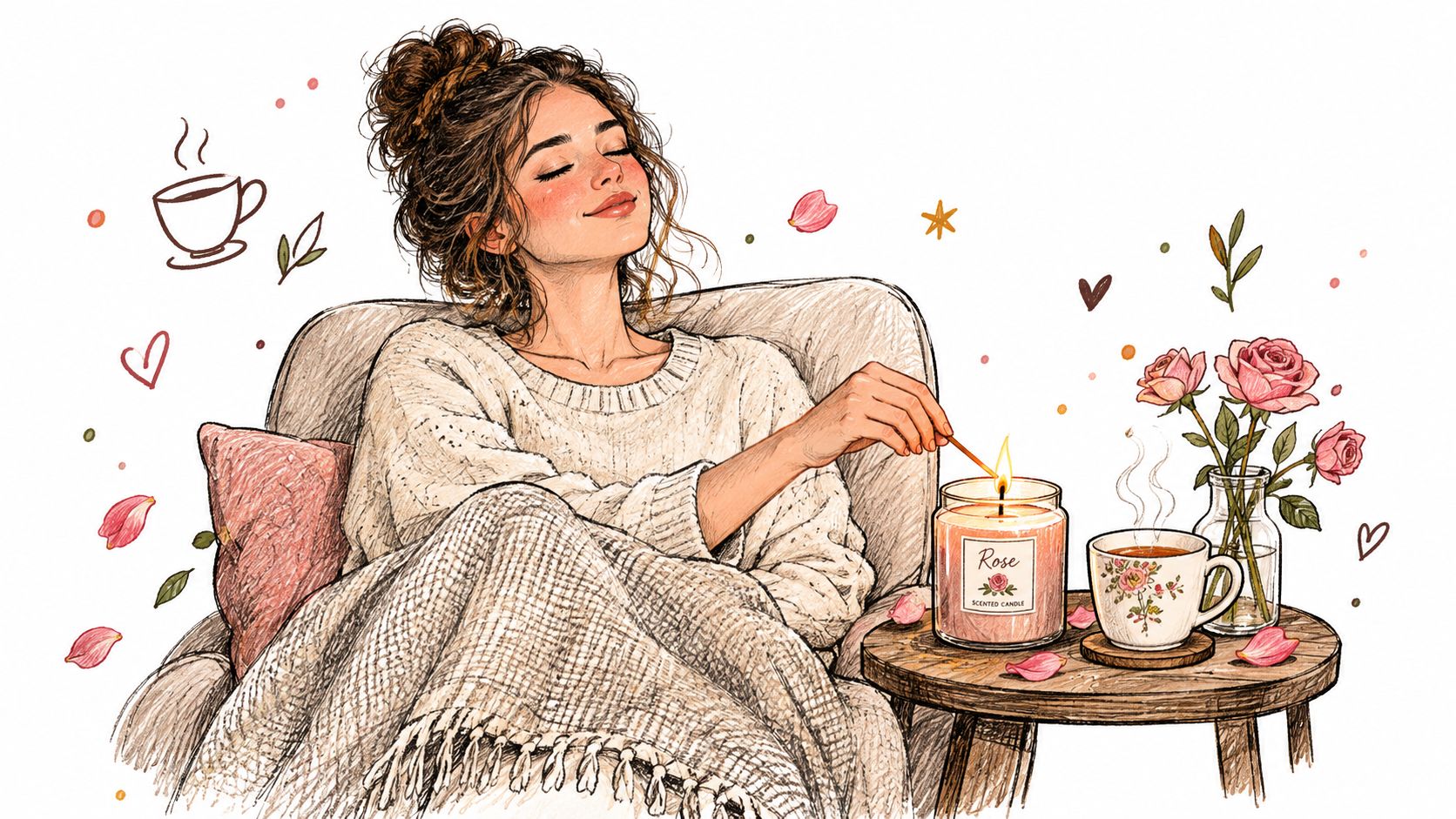
One fragrance, several lives
The same woman might want different rose profiles throughout her week. A fresh green rose suits a dressing room or work-to-weekend transition because it feels polished without becoming theatrical. A powdery rose belongs beside a bath, vanity, or soft knitwear. A deeper rose with musk, woods, or oud has the presence for an evening gathering.
The choice becomes more intuitive when fragrance is treated like personal style. A minimal wardrobe may pair beautifully with a clean, dewy rose. A woman drawn to velvet, dramatic tailoring, or statement accessories may prefer a darker composition with woods. Someone shopping for a hostess gift may need a graceful, widely appealing profile rather than an intense interpretation.
Practical rule: Choose the rose candle for the feeling the recipient wants to create, not simply for the flower she already likes.
That approach also makes gifting more personal. Readers who enjoy exploring fragrance combinations can find further ideas in these fragrance layering tips, then use the same logic to select a candle that supports a room, an outfit, or a ritual. The best choice should feel natural in her life, whether it burns during a quiet evening or waits unlit on a beautifully styled shelf.
Understanding Rose Fragrance Profiles
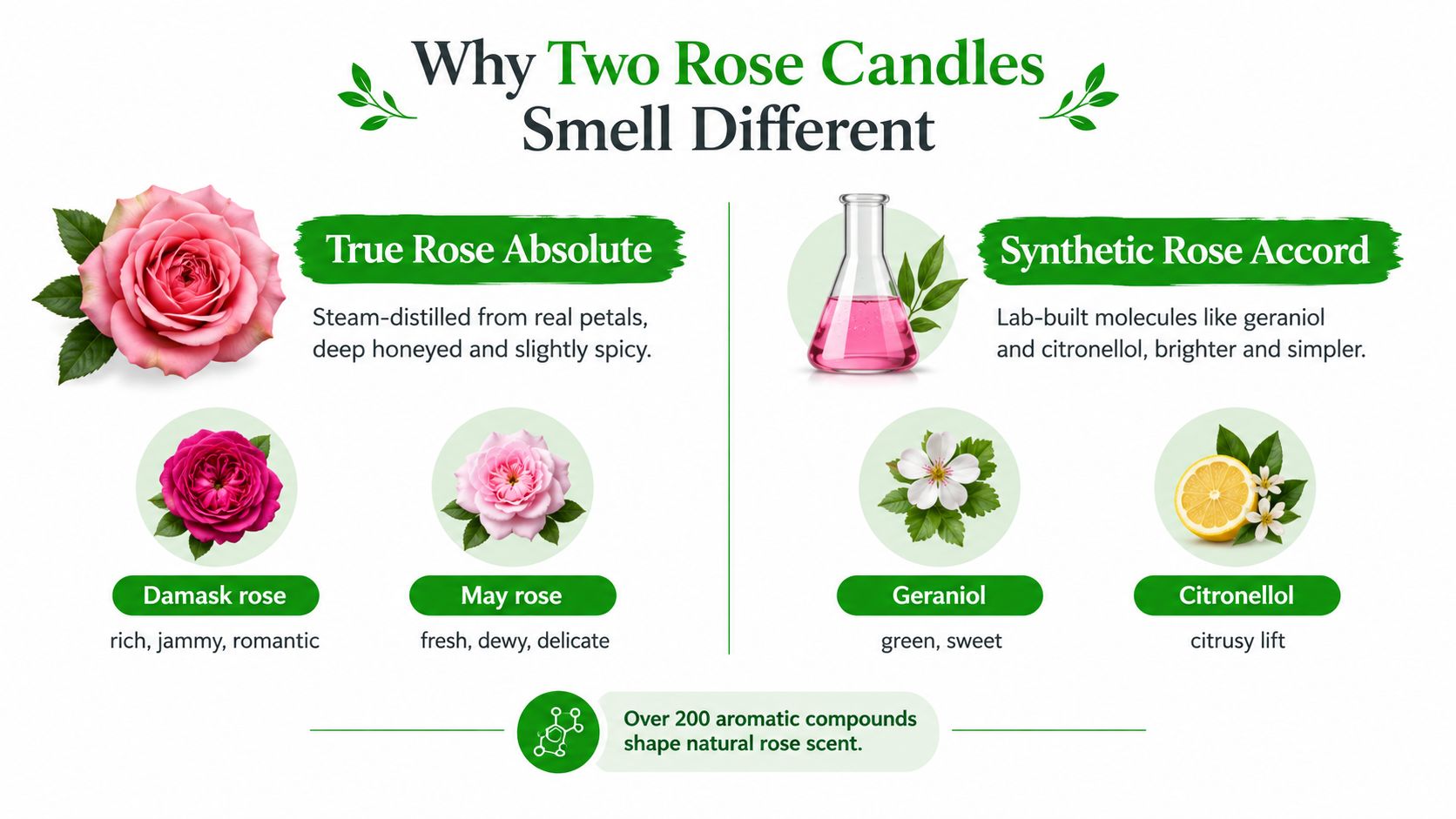
Two candles can both say “rose” and still smell completely different. Rose fragrance isn't one molecule or one fixed formula. Researchers have identified more than 400 volatile compounds in rose fragrance, grouped mainly into terpenoids, phenylpropanoids and benzenoids, and aliphatic or fatty-acid derivatives, as described in this research on rose fragrance chemistry.
Important rose-associated compounds include geraniol, citronellol, nerol, linalool, germacrene-D, and beta-caryophyllene. 2-phenylethanol contributes a characteristic rosy note. A candle formula can emphasize different facets of this complex scent, which is why one rose feels crisp and green while another smells plush, powdery, citrus-like, or woody.
Read the notes beyond floral
The word “floral” tells shoppers very little. A useful profile describes the rose's supporting notes and its overall temperature.
| Profile | Key Notes | Best For |
|---|---|---|
| Fresh green rose | Dewy petals, leafy brightness, delicate citrus | Office, entryway, daytime gifting |
| Powdery rose | Soft petals, cosmetic warmth, gentle musk | Bedroom, vanity, self-care |
| Jammy rose | Rich petals, honeyed depth, ripe fruit | Dinner parties, romantic evenings |
| Rose and vanilla | Creamy sweetness, floral warmth, rounded finish | Cozy weekends, holiday gifting |
| Rosewood | Rose facets, dry woods, subtle spice | Work-to-weekend spaces, polished interiors |
| Rose with citrus, musk, or oud | Bright lift, sensual softness, or smoky depth | Hostess gifts, evening entertaining, statement rooms |
A well-composed fragrance often feels more natural because the supporting notes create balance. Research on rose cultivars links a distinctly rose-like perception with pleasantness and describes the importance of a balanced mixture involving ionones, oxylipins, and 2-phenylethanol derivatives in this study of rose scent perception. The research concerns rose flowers rather than a specific commercial candle, but it offers a useful shopping principle: evaluate the whole composition, not one headline note.
Match character to the recipient
A fresh rose is the safest choice for someone who prefers clean interiors and understated clothing. Powdery rose suits a recipient who loves soft textures, beauty rituals, and feminine details. Jammy or vanilla rose feels more generous and decorative, while rosewood works for someone whose style is custom-made, neutral, and luxuriously understated.
For a moodier gift, shoppers can browse rose and oud perfume options to understand how the pairing shifts rose from delicate floral to richer, more enveloping territory. A candle doesn't need to reproduce perfume exactly, but the comparison helps shoppers identify whether the recipient prefers brightness, softness, sweetness, or depth. More guidance on selecting a personal profile appears in this guide to the best fragrances for women.
Choosing the Right Wax and Wick
A beautiful fragrance can disappoint if the candle's construction can't support it. Wax, wick, fragrance loading, vessel diameter, and burn testing work as one system, so a “natural” label shouldn't be treated as a complete quality assessment.
Soy wax often appeals to shoppers who want a plant-based option and can give a soft, familiar burn character. Paraffin can carry fragrance effectively and produce a strong scent experience, but its performance still depends on formulation and wick design. Coconut wax is valued for a smooth appearance and a creamy presentation, while blends can combine useful characteristics from several waxes. The right choice isn't determined by the wax name alone. It depends on how evenly the candle burns, how consistently it releases scent, and whether the fragrance remains pleasant rather than heavy.
Compare the construction, not just the label
A small rose candle for a bedside table needs a wick suited to its narrower vessel. A wider candle intended for entertaining needs enough heat to create an even melt pool without producing an unstable flame. A properly sized wick supports steadier fragrance release and reduces the chance of soot or excessive mushrooming.
Cotton wicks are familiar and can offer a controlled flame when correctly sized. Wood wicks create a different sensory experience, sometimes with a gentle crackle, but wick construction affects emissions and shouldn't be selected for atmosphere alone. Research summarized by EPFL on candle emissions and indoor air quality reports meaningful variation among candles and notes that tested wood-wick candles produced more phthalate emissions than tested cotton-wick candles, while product-to-product differences remained substantial.
What quality control should look like
Controlled chamber testing has measured carbon monoxide, carbon dioxide, nitrogen oxides, formaldehyde, benzene, polycyclic aromatic hydrocarbons, PM2.5, ultrafine particles, and other volatile organic compounds from burning candles. Scented candles generally generated more VOCs than unscented controls because fragrance ingredients add volatile and semi-volatile compounds to the wax-fuel system. The exact emissions depend on fragrance formulation, wax chemistry, wick behavior, and burn conditions, as detailed in controlled candle-emissions testing.
A quality rose candle should therefore have stable fragrance loading, a wick sized for the vessel, and evidence of burn testing for visible soot, flame instability, and mushrooming. Ventilation matters too. Drafts can destabilize a flame, while incomplete combustion can increase particulate and organic emissions. A curated scented candle set can be useful when shoppers want to compare profiles, but each candle should still be evaluated as a complete construction rather than by wax marketing alone.
How to Choose a Quality Rose Candle
The scented-candle category offers abundant choice. The global scented-candles market was valued at approximately $6.1 billion in 2025 and is projected to reach about $9.3 billion by 2033, with a forecast compound annual growth rate of 5.5% from 2026 to 2033, according to market reporting on scented candles. North America accounted for 32.9% of global revenue in 2025, and the same reporting estimates more than 10,000 candle scents available in the United States. With that much choice, shoppers need a sharper filter than packaging or the word “luxury.”
Start with the fragrance description
A useful product description should reveal more than “romantic rose.” Look for the rose's direction:
- Fresh or green: Best for daytime, work areas, and recipients who dislike heavy sweetness.
- Powdery or musky: A natural fit for bedrooms, dressing spaces, and beauty-focused gifts.
- Vanilla or jammy: Better for cozy rooms, entertaining, and recipients who enjoy noticeable warmth.
- Wooded or oud-based: Choose this for a more dramatic, evening-oriented scent.
Fragrance concentration matters because a candle with too little character may disappear in the room, while an overly forceful blend can feel tiring in a small space. Shoppers should look for clear note information, a vessel that feels stable and well finished, a transparent brand description, and instructions that explain proper burning.
Inspect the vessel and the burn promise
A quality vessel should sit securely, feel substantial, and complement the room after the flame goes out. The label should identify the fragrance clearly and provide safety guidance. Burn time can help with value, but it shouldn't be the only measure. Even burning, a stable flame, clean edges, and a scent that remains balanced during use matter more than a dramatic promise on the box.
A premium candle earns its place twice, first through fragrance, then through reliable performance.
Experience rose in person
Rose is difficult to judge from a screen because powder, citrus, musk, vanilla, and wood can change its entire personality. Visiting a boutique allows shoppers to compare vessels, read the notes, and consider how the fragrance fits a dressing room, office, guest bath, or entertaining space. At Cedar & Lily Clothier, readers can shop in person at Utica Square in Tulsa or downtown Jenks, see fit and fabric across the broader lifestyle assortment, and ask the team for practical guidance.
For gifting, a curated fragrance gift set can solve the uncertainty of choosing one intense scent. A thoughtful set lets the recipient discover whether her ideal rose is green, powdery, creamy, or deep. The result is a purchase made with confidence rather than guesswork.
Caring for Your Rose Candle
Good candle care protects the fragrance, the vessel, and the room. Before lighting a rose candle, the wick should be trimmed so the flame doesn't become unnecessarily tall or unstable. The first burn should allow the top layer of wax to melt evenly rather than leaving a narrow tunnel, and future burns should remain controlled rather than prolonged.
A laboratory study of scented tea lights found that all tested samples emitted formaldehyde and acetaldehyde, with particulate emissions dominated by ultrafine particles in the approximate 0.3 to 0.5 micrometer range. Emissions varied among samples, which reinforces a practical point: construction and conditions matter. Separate environmental-condition research found that PAH emissions changed nonlinearly with relative humidity and ventilation, with some emission factors highest at 0.5 air changes per hour compared with 1.0 and 2.0 air changes per hour, as reported in the laboratory research on scented tea lights and ventilation.
Use a simple routine
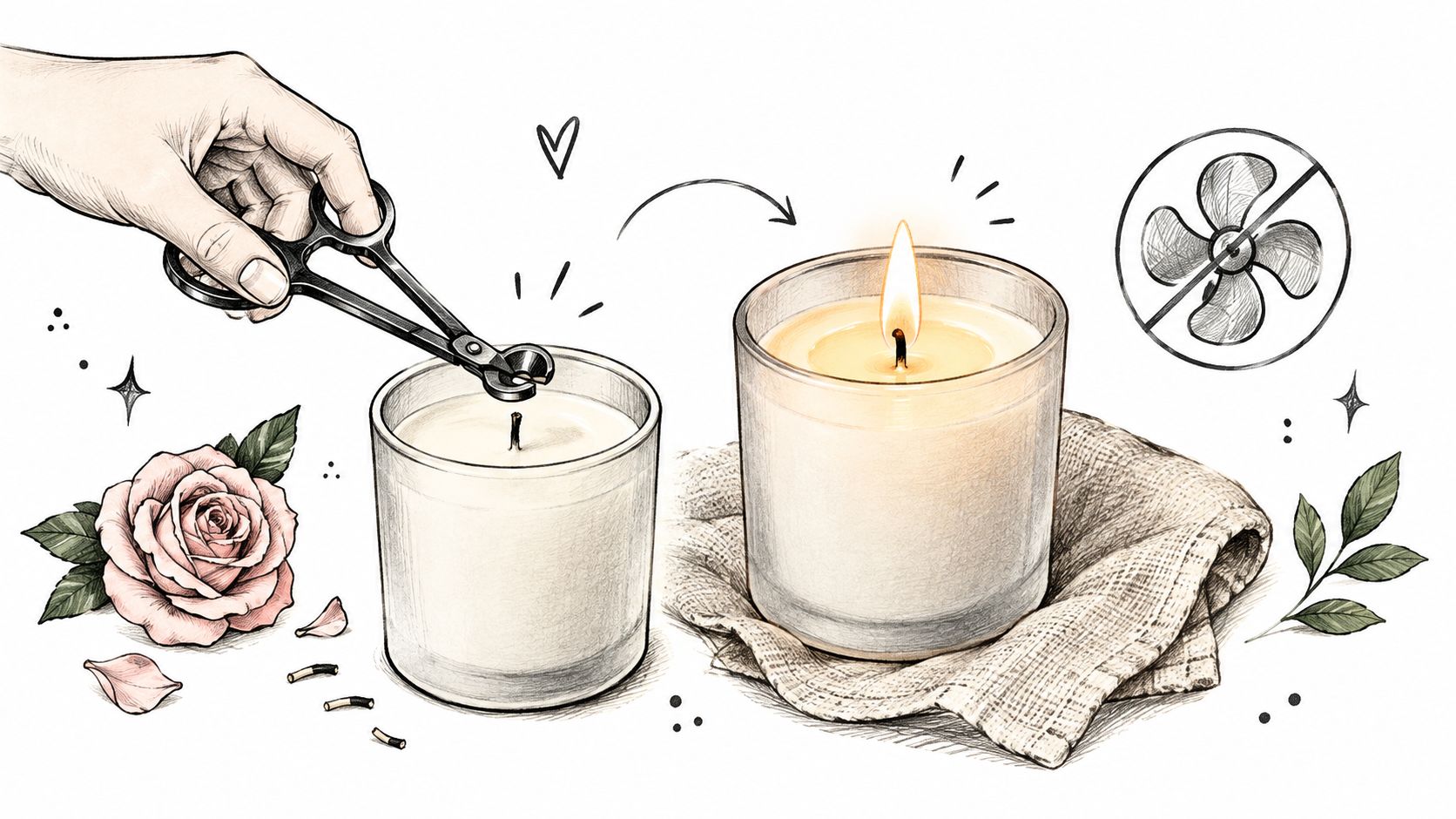
- Trim before lighting: Remove the loose, mushroomed portion of the wick so the flame stays steadier.
- Choose the room carefully: Use short burns in an appropriately sized, ventilated room rather than prolonged burning in a small enclosed space.
- Avoid drafts: Keep the candle away from open windows, fans, doorways, and moving air that can create an uneven flame.
- Watch the vessel: Stop using the candle if the vessel becomes excessively hot, soot appears, or the flame becomes unstable.
- Never burn while sleeping: Bedrooms, wardrobes, and dressing areas contain textiles that can ignite if placed too close.
Fire safety deserves direct attention. The National Fire Protection Association reports an estimated annual average of 5,894 home structure fires started by candles in the United States, causing averages of 63 civilian deaths, 532 civilian injuries, and $286 million in direct property damage. More than half began when a flammable item was too close, 21% involved a candle left unattended, discarded, or otherwise misused, and 36% began in bedrooms, according to NFPA candle safety guidance.
Keep rose candles away from clothing, bedding, curtains, paper, decorations, and furniture. A well-cared-for candle preserves its atmosphere without asking the room to take unnecessary risks, which makes it a better gift and a more enjoyable part of a personal ritual.
Rose Candles as Gifts and Keepsakes
A rose candle makes a strong gift because it carries both beauty and flexibility. For a bridal shower, a soft powdery profile feels feminine without being childish. For a housewarming, a fresh green rose can suit a new kitchen, entryway, or sitting room. For a birthday, a rose with vanilla or musk feels more personal, while a deeper rose with woods suits someone who prefers evening fragrance and personal style.
The recipient's wardrobe can provide a useful clue. A woman who gravitates toward romantic dresses and delicate jewelry may enjoy a powdery or dewy rose. Someone who wears a velvet blazer, structured handbag, or dark neutral tailoring may prefer rosewood, oud, or a dry musky interpretation. A candle paired with a fashion gift becomes more memorable when both pieces express the same mood.
Build a considered gift
A rose candle can stand alone, but it can also anchor a small lifestyle edit:
- For a bridal moment: Pair a delicate rose profile with a soft seasonal dress or refined jewelry.
- For a thank-you: Choose a fresh rose that feels welcoming and easy to place in a guest room or living area.
- For a holiday gift: Select rose and vanilla, then add a velvet blazer for a coordinated, tactile presentation.
- For a milestone birthday: Choose a more distinctive rosewood or rose-and-oud profile with a delicate handbag.
- For a hostess: Use the candle as the finishing touch beside a polished accessory or an event-ready piece.
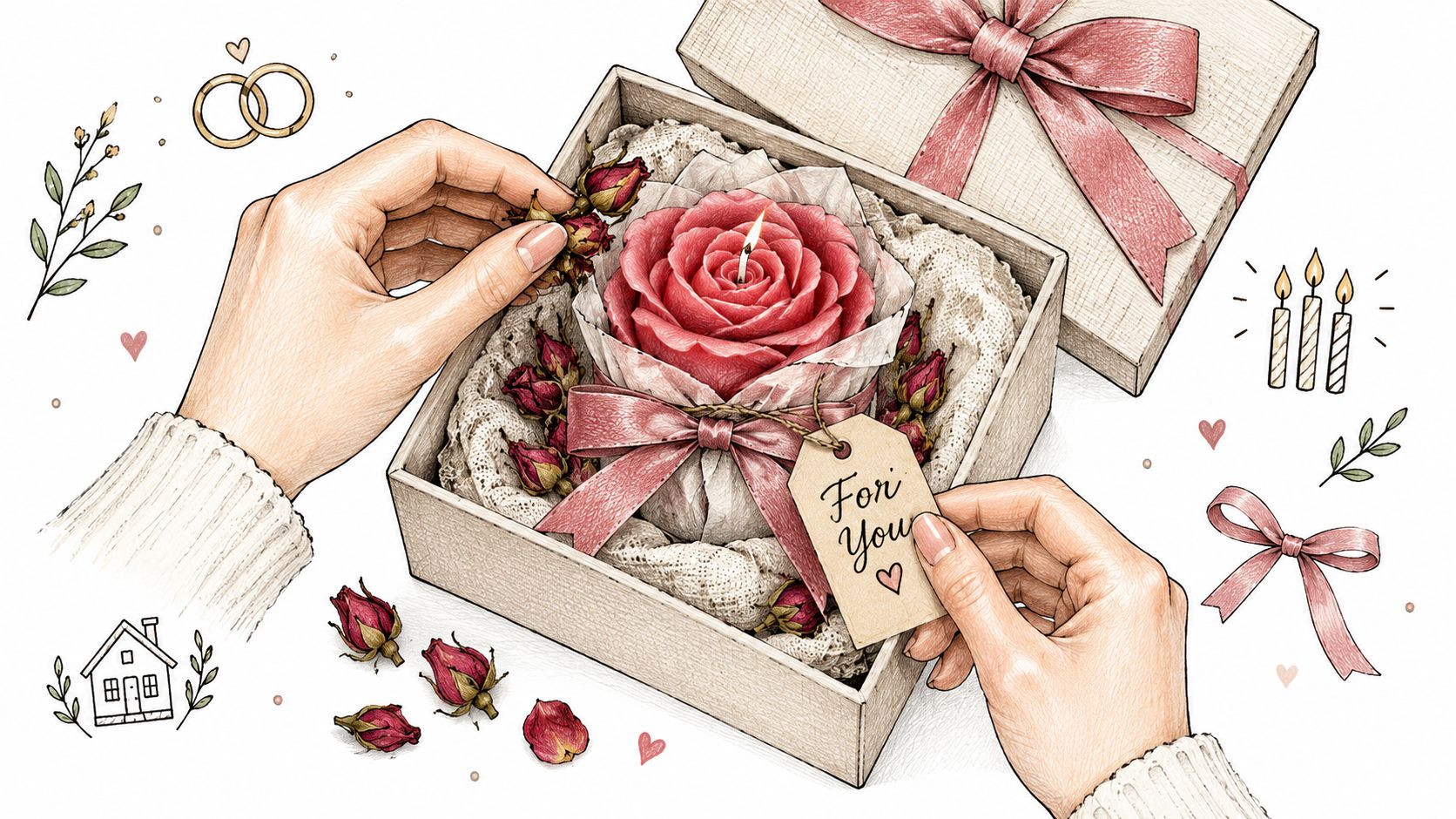
Thoughtful presentation matters. Cedar & Lily Clothier offers complimentary gift packaging over $100 and handwritten notes, details that give a candle and fashion pairing a personal finish. Readers looking for more presentation ideas can explore these luxury gift boxes for women.
The best keepsakes aren't necessarily the loudest gifts. A well-chosen rose candle can remain on a vanity or shelf long after the wrapping disappears, recalling the person, occasion, and feeling behind it.
Styling Rose Candles for Every Occasion
Rose fragrance works like an invisible styling detail. A fresh green rose supports a polished work outfit and transitions easily into weekend errands. A powdery rose complements bridal preparation, soft textures, and a calm dressing-room ritual. A jammy or vanilla rose gives a date night or evening gathering more warmth, while rosewood and oud suit a gala-ready mood with velvet, tailoring, or a statement accessory.
For relaxed weekends, a rose candle belongs beside a robe, a book, or a carefully chosen knit. In a guest room, a restrained profile creates welcome without dominating the space. For work-to-weekend living, the strongest choice is usually a rose with citrus, musk, or dry woods, because it feels composed during the day and more expressive after dark.
The candle is part of a complete lifestyle, not an isolated home accessory. Shoppers can experience the collection alongside dresses, handbags, jewelry, and contemporary designer pieces at Cedar & Lily Clothier's Utica Square location in Tulsa or downtown Jenks, where the team can help connect fragrance, outfit, and occasion. Online shoppers can browse the store's collection, while local visitors can see fit and fabric in person and receive styling help matched to the moment.
Cedar & Lily Clothier offers a curated mix of fashion, accessories, fragrances, and candles for women building polished work-to-weekend wardrobes and memorable gifts. Visit Cedar & Lily Clothier online, stop by Utica Square in Tulsa or downtown Jenks, or reach out to the team for personal styling help with the right rose candle and the look to accompany it.