

A mini dress is office-appropriate in most business-casual and creative workplaces when it's structured, opaque and thoughtfully layered; it's usually the wrong choice in conservative client-facing roles, where a midi is the safer default. The deciding factor isn't the mini label alone, but how the finished outfit works for the actual working day.
The familiar dilemma starts in front of the mirror: the dress looks polished standing up, dinner is already on the calendar, and changing between appointments would be inconvenient. Choosing a mini dress for work means checking the less photogenic details too, including the meeting-room chair, the commute and whether the jacket will stay on.
Table of Contents
- The Short Answer on Mini Dresses at Work
- How to Read Your Workplace Dress Policy
- Mini Dress Rules by Dress Code and Setting
- How to Build a Work-Ready Mini Look
- Hosiery, Footwear and Fabric by Season
- From Desk to Dinner in the Same Mini
- Shop Your Work Mini at Cedar & Lily
The Short Answer on Mini Dresses at Work
A work-ready mini needs enough coverage to function without constant adjustment. A dress that requires repeated tugging at the hem isn't a practical office purchase, however appealing its neckline or color.
Appearance still matters in flexible workplaces. In The Fold's global workwear survey, 99% of respondents said first impressions count, according to FashionNetwork's coverage of the 2025 survey. Separately, 87% of women surveyed globally in 2025 said dressing appropriately remained important in a flexible working environment, according to The Fold's workwear report.
The details that decide whether it works
- Seated coverage: The hem needs to stay comfortable when sitting, crossing an office or reaching for a bag. Standing length alone doesn't settle the question.
- Opacity: Fabric and lining should provide coverage in daylight and under office lighting. A jacket can't correct a transparent skirt.
- Formality: A defined shoulder, restrained neckline and considered shoes make a shorter dress look intentional rather than improvised.
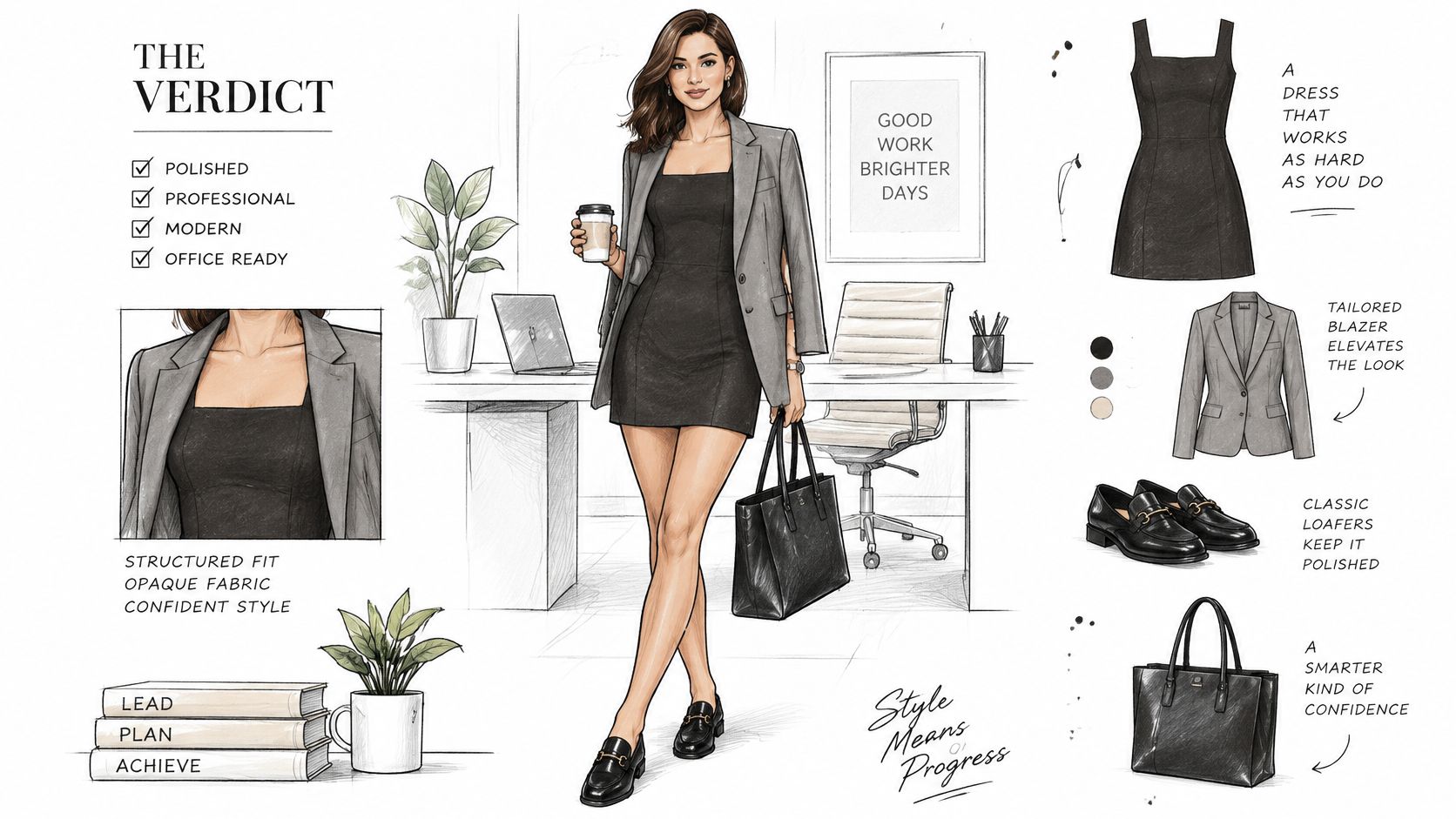
Conservative law, finance and banking environments call for greater caution, especially when clients are involved. A midi is the safer default there, even when a mini would be perfectly comfortable in a creative studio.
There's also a difference between looking dressed up and looking ready for work. A fitted party dress with an office jacket remains a party dress if its neckline, movement or coverage doesn't suit the setting.
Before buying: Would this dress look right in the meeting room where the most senior person sits, after an extended period seated?
How to Read Your Workplace Dress Policy
The first checkpoint is the employer's written policy, not a supposed nationwide hemline rule. The U.S. Equal Employment Opportunity Commission's prohibited employment practices guidance allows employers to establish dress codes, including standards for particular job categories, provided those rules don't unlawfully discriminate.
A business-casual label isn't permission to wear every casual dress. Some employers define it through specific exclusions, while others leave staff to interpret examples and workplace habits.
Check the wording before choosing the outfit
- Identify the relevant standard. Look for separate definitions of business professional, business casual and casual-day clothing. A shorter dress might suit an internal working day but fall outside the standard required for an external presentation.
- Read the named exclusions. Georgia's state human-resources dress-code guidance lists short or tight skirts, miniskirts, sundresses, beach dresses and spaghetti-strap dresses among inappropriate business-casual examples. If an employer expressly excludes minis, adding tights and a blazer doesn't remove that restriction.
- Observe the right reference group. Senior colleagues in comparable roles are more useful guides than someone working under a different department's expectations. Check ordinary office days and client events separately, since those occasions may require different wardrobes.
The distinction between policy and enforcement matters too. The EEOC's grooming-standards guidance explains that sex-specific requirements must be suitable, consistently applied and equivalent in burden; selectively policing women's clothing raises a different issue from maintaining a clear workplace standard.
Religious accommodation can also require exceptions to ordinary appearance rules. The EEOC's religious garb guidance explains that employers must accommodate sincerely held religious practices unless doing so would create an undue hardship.
For help distinguishing formality levels, Cedar & Lily Clothier's professional dress-code guide provides a useful wardrobe reference. It doesn't replace an employer's actual requirements.
The final shopping checklist is straightforward: written policy, named examples, comparable senior colleagues and client exposure. An unclear policy deserves clarification before a dress is purchased specifically for work.
Mini Dress Rules by Dress Code and Setting
A mini reads differently in a bank branch than in a design studio, and the gap is wider than most dress-code advice admits. The table below sets out what each setting expects, from conservative offices where the mini stays in the closet to after-work drinks where it earns its keep.
| Setting | Mini length guidance | Layers | Footwear |
|---|---|---|---|
| Conservative offices, including law, finance and banking | Not recommended; choose knee length or a midi | Structured blazer, opaque tights, buttoned neckline | Closed-toe pumps |
| Business-casual office | Just above the knee, hem stable when seated | Structured blazer or cardigan; opaque tights in cool months | Pumps, loafers or block heels |
| Creative or tech office | Mini with a confident, non-clingy fit | Cropped jacket or fine-knit layer | Ankle boots or sleek sneakers |
| Hybrid role with video calls | Appearance is primarily waist-up on camera; check the seated hem | Blazer on camera, set-in jacket neckline | Comfortable closed-toe shoes out of frame |
| Client meetings and presentations | Only where permitted, in lined, opaque fabric | Fitted blazer and opaque tights | Pumps |
| After-work drinks or events | Mini works well | Lightweight jacket or structured topper | Heeled boots or strappy heels |
Start with the row that matches the workplace and move across to the layer and footwear. When a single day spans two settings, build for the more formal one. A blazer that comes off at 6 p.m. costs nothing; a bare-shoulder mini at a 9 a.m. client meeting cannot be undone.
In law, finance and banking the mini is a weekend piece. Knee length or midi holds the line there, and no layer turns a shorter hem into a match for the room. I would also place a client-facing day in the client-meetings row even when the rest of the week sits comfortably in business casual.
What each layer changes
A structured blazer builds a defined shoulder and a cleaner businesswear line. It reads best when the dress still shows below the jacket hem; a jacket that swallows the whole hem looks like a coat worn indoors.
A cardigan softens the presentation. Fine-gauge knit passes in business casual, while a slouchy version drops the outfit toward weekend. A cropped jacket shifts proportion more than authority, which suits a creative floor better than a finance one.
Opaque tights cut the contrast between a short hem and bare legs, and they add warmth in cool months. They buy coverage. They do not convert a length your employer prohibits into an acceptable one.
A layer shifts formality. It does not override the dress code.
Read the appointment, not just the industry
A designer who spends the morning at a desk and the afternoon presenting to a traditional client needs a different outfit from a colleague staying in the studio all day. A technology employer's relaxed office does not set the dress standard for a customer visit.
Hybrid schedules get the same treatment. Camera framing covers the waist up, yet standing to answer a door, collecting a delivery or walking into an in-person meeting still requires a complete, functional outfit. Check the hem seated before you rely on it.
Workplace judgments also run past conventional formality. Virginia Commonwealth University's coverage of workplace-clothing research separates formality, provocativeness and fashionability, and ties skin-revealing or strongly body-contouring clothing to lower perceived competence.
A dress that skims the body keeps its shape without that penalty, which is why fit does more office work than length alone.
Cedar & Lily Clothier's business-casual outfit ideas for women show additional combinations for workplaces that allow a less formal approach.
How to Build a Work-Ready Mini Look
Start with the dress itself, then add the pieces that support the setting. Buying an unsuitable base and hoping accessories will solve it usually creates more compromise than choosing a better fit.
A fitting-room routine that catches the problems
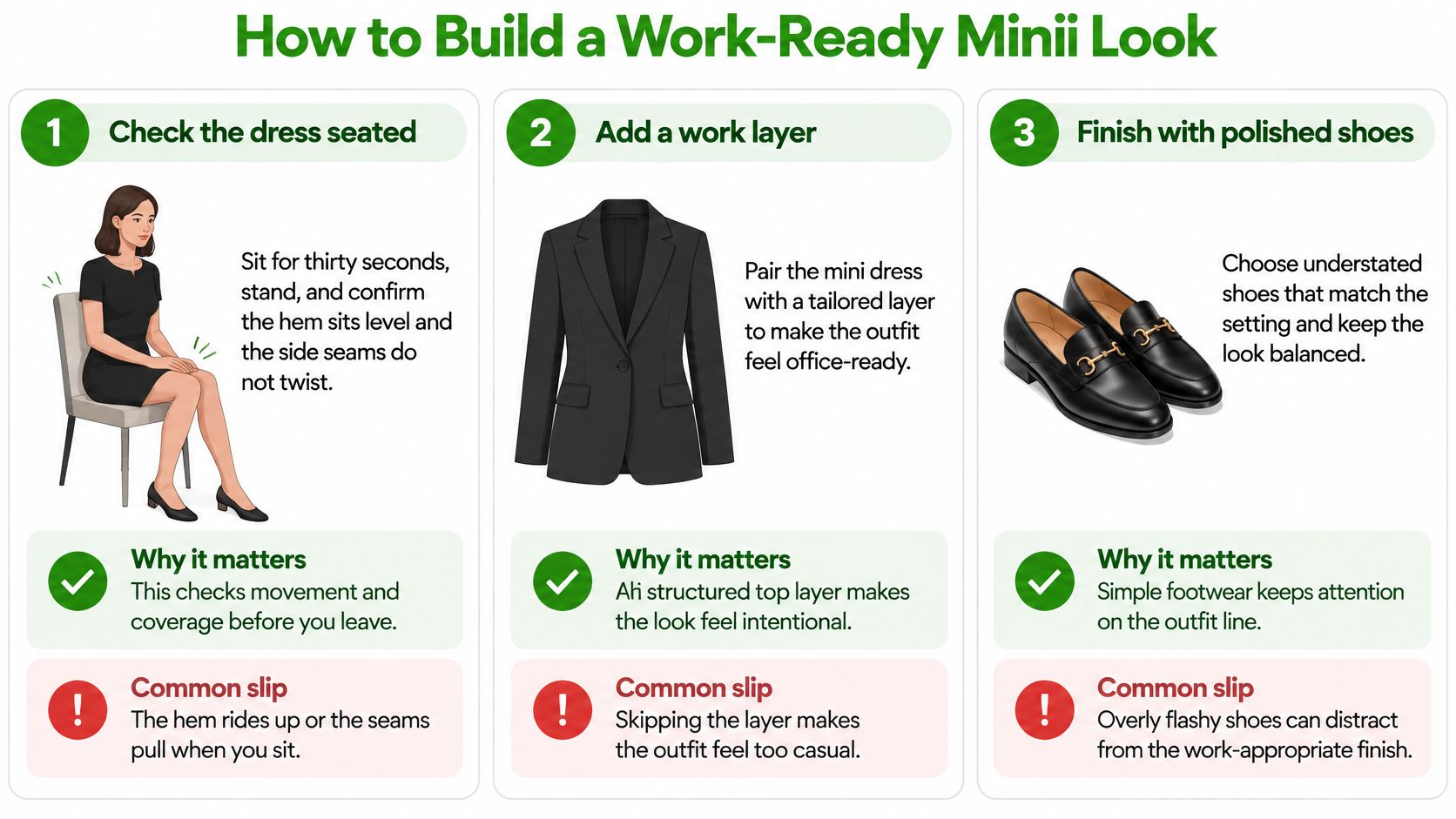
- Check the dress seated. Sit, stand and walk, then confirm that the hem settles level and the side seams remain straight. The common slip is approving a dress while standing still, only to discover that it climbs with every movement.
- Confirm opacity and lining. Examine the skirt against light, then check it worn over the intended undergarments. If the leg outline or underwear shows through, choose a better-lined style rather than assuming a jacket will provide coverage; opaque tights can help only when the overall fabric remains suitable.
- Resolve fit before altering length. On a conventionally set-in sleeve, the shoulder seam should sit near the shoulder bone, with enough room through the hips to sit comfortably. A hem that rides high needs more usable length or a different cut, not shortening; a tailor can assess whether a hem allowance or fit adjustment offers a sensible solution.
- Add the structured layer. The Julia Scoop Neck Mini Dress has a scoop neckline, relaxed fit and mini silhouette that works with jackets or cardigans. The Bari Jacket is described by Cedar & Lily Clothier as polished and suited to the office or a casual evening; the guide to choosing blazers for work helps refine the pairing. The common mistake is choosing a jacket so bulky that it overwhelms the dress.
- Apply the setting's hosiery and footwear. Use the workplace table rather than selecting shoes solely because they coordinate with the dress. A technically matching shoe can still be wrong for the appointment.
- Keep accessories controlled. A structured bag and simple jewelry let the dress and jacket establish the outfit. Competing prints, prominent hardware and elaborate shoes can make the combination feel event-focused rather than work-ready.
Check the complete outfit in motion
The finishing check should include the jacket buttoned and open, the bag on the shoulder, and the shoes intended for the day. A dress shouldn't need a special posture to look right.
The visual routine below reinforces the main sequence.
Hosiery, Footwear and Fabric by Season
Season changes the fabric, the layer and the hosiery. The workplace still sets the limits, so read the table below with your dress code in hand rather than as a weather forecast.
| Season | Fabric | Layer | Hosiery | Footwear |
|---|---|---|---|---|
| Spring | Lightweight ponte or crepe, lined | Light blazer or trench | Sheer tights or bare legs where allowed | Loafers or block heels |
| Summer | Cotton blend or linen-look, lined | Lightweight cardigan for air conditioning | Bare legs or sheer hosiery where allowed | Sandals only in casual offices; otherwise flats or heels |
| Autumn | Ponte, fine knit or wool crepe | Structured blazer or long cardigan | Opaque tights | Pumps or knee boots |
| Winter | Wool blend or thicker knit, lined | Coat worn over a blazer | Opaque, lined tights | Ankle or knee boots |
The seasonal adjustment that matters most happens across the whole outfit. A breathable summer fabric under a heavy, coated lining still runs hot by mid-afternoon, and a thick winter knit can need a smooth slip layer to stop it catching on tights. Fix the combination, not just the dress.
Recovery matters as much as stretch
Stretch describes how readily fabric extends. Recovery describes how well it returns to its original shape, a distinction explained in TextileTuts' guide to ASTM D2594 stretch-and-recovery testing.
For workwear, easy stretch without good recovery leaves the seat bagged and the hem distorted by lunchtime. A rigid woven makes the opposite trade: crisp structure and dependable coverage, with less give during a long seated day.
Test it in the fitting room. Sit, stand, walk a lap, then look at the hem, the hip and the waistband for ripples or fabric that no longer lies flat. A mini has less spare length to absorb that movement, so shape retention carries more weight in a short skirt than in a midi.
Fabric check: Softness is a reason to touch a dress. Shape retention is a reason to consider it for work.
Warm-weather details need a separate judgment
Lining alone does not make a dress office-ready. A lined mini can still fall short of a conservative code on neckline or back coverage, and the For Love & Lemons Eileen Mini Dress is the kind of piece to assess under daylight, with the jacket you plan to wear over it, before you commit to it for a weekday.
Cedar & Lily Clothier's summer dress fabric guide helps separate how a fabric feels from how much it covers. Cleaning routine counts too: a dress you plan to rotate twice a week should survive the way you launder, whether that is machine wash cold or a weekly trip to the dry cleaner.
A seasonal layer changes how formal the outfit looks; the dress beneath it still has to meet the setting. A winter coat comes off indoors, so what remains at your desk is the outfit that has to hold up.
From Desk to Dinner in the Same Mini
Start with a versatile base. A mini works as a desk-to-dinner purchase when the dress itself clears the office bar first, then each change for the evening is deliberate: jacket shape, shoes, jewelry, hosiery. The dress does the day's real work; the styling shifts the emphasis.
That flexibility has a clear audience. In 2025, 92% of the 1,000 U.S. hybrid workers surveyed for IWG's Workwear Reimagined report wanted clothing that worked for both work and leisure, according to IWG's report announcement.
A business-casual morning and dinner afterward
Consider a relaxed scoop-neck mini that meets the coverage and fit requirements. For a business-casual morning, a fitted blazer, opaque tights, and pumps give it a composed finish. The morning routine stays simple because the jacket and shoes carry the formality, not a lot of decorative extras.
Before dinner, a sleek evening jacket replaces the blazer and heeled boots replace the pumps. Tights remain practical in cooler weather; in warm weather, bare legs can work for the evening setting. Switching the jacket's shape and the shoes' character often does enough. The base dress stays the same.
A relaxed working day and an evening event
The Arca Mini Dress is described as a day-to-night design with a flattering silhouette and a cut intended for comfort. For a business-casual day, a structured jacket and closed-toe flats offer a sensible styling direction, provided the dress's actual fit and coverage suit the office.
A longer statement necklace and strappy heels shift the emphasis toward the event. The necklace should sit cleanly against the neckline rather than catching, bunching or competing with it.
- Keep the base dependable: The dress must work before the evening accessories are added.
- Change the emphasis: Jacket shape, footwear and jewelry do different jobs, so every item doesn't need replacing.
- Allow a different length: A conservative workday may require a separate evening dress rather than a styling workaround.
Cedar & Lily Clothier carries dresses in mini, midi and maxi lengths, allowing a midi to remain the conservative work choice and a mini to serve evening plans. Its day-to-night outfit guide offers further ways to organize that transition. If the workday leans conservative, let the midi stay the base and use the mini for the evening half; the boutique team can help build that switch around pieces already in a wardrobe.
Shop Your Work Mini at Cedar & Lily
Buy for the calendar you keep. A shopper splitting the week between internal meetings, client visits and a Thursday dinner needs a different mini from someone whose office never sees an outsider. Decide the strictest room on the schedule first, then choose the dress that clears it.
Cedar & Lily Clothier carries curated designer labels, including LoveShackFancy, Elliatt, Favorite Daughter and Lace the Label, with dresses offered in mini, midi and maxi lengths. That spread helps: the mini handles the flexible days, while a midi or maxi covers the rooms where coverage carries more weight. Comparing two or three cuts across those labels is the practical way to find the one that keeps its shape from morning through the commute home.
Make the visit specific
- Bring the work layer: Trying a dress with the jacket you will wear reveals more than trying it on its own.
- Describe the setting: Business casual, conservative client meetings and creative-studio days pull recommendations in different directions.
- Check the full outfit: Shoes, hosiery and undergarments change both comfort and how smoothly a dress hangs.
Then settle the layer. The Bari Jacket has a clean fit and is described as suited to the office or a casual evening, which makes it the piece to pull over a mini in the fitting room before you commit. A long cardigan softens the same dress for a looser floor. A structured jacket does the opposite, and that shift in perceived formality is usually the difference between a mini that reads as workwear and one that reads as weekend.
At Utica Square in Tulsa and downtown Jenks, shoppers can examine fabric, compare proportions and get personal styling help before deciding. If an evening event is also on the calendar, the Story Dress is available for pickup at the Jenks store and is usually ready in 24 hours.
Cedar & Lily Clothier offers curated dresses, refined layers and personal styling guidance for building a work-to-evening wardrobe. Visit Cedar & Lily Clothier to browse online, or bring your office dress requirements to the Tulsa or Jenks boutique for help choosing a suitable length, fit and finishing layer.