


You're probably standing in front of a mirror with the same question I hear in the fitting room all the time. The necklace is gorgeous on its own, but once it's on your body, something feels off. Maybe it's too much with the blouse. Maybe it disappears into the dress. Maybe it suddenly makes the whole outfit feel more “trying” than chic.
That's why knowing how to wear statement necklace styles well has less to do with being bold and more to do with building a look that feels settled. A strong necklace needs the right setting, the right scale, and the right supporting cast. When those pieces line up, the effect is polished, not busy.
I think of it as total look cohesion. The necklace matters, of course, but so do the neckline, fabric, haircut, button placement, and the event on your calendar. A crystal collar for a gala doesn't behave the same way as a brushed metal piece over a crisp shirt before a client lunch. If you style both the same way, one of them will fail.
Choosing Your Statement Piece Wisely
The easiest way to wear a statement necklace well is to choose the right one before you even get dressed. Most styling problems start at the selection stage, not in front of the mirror.
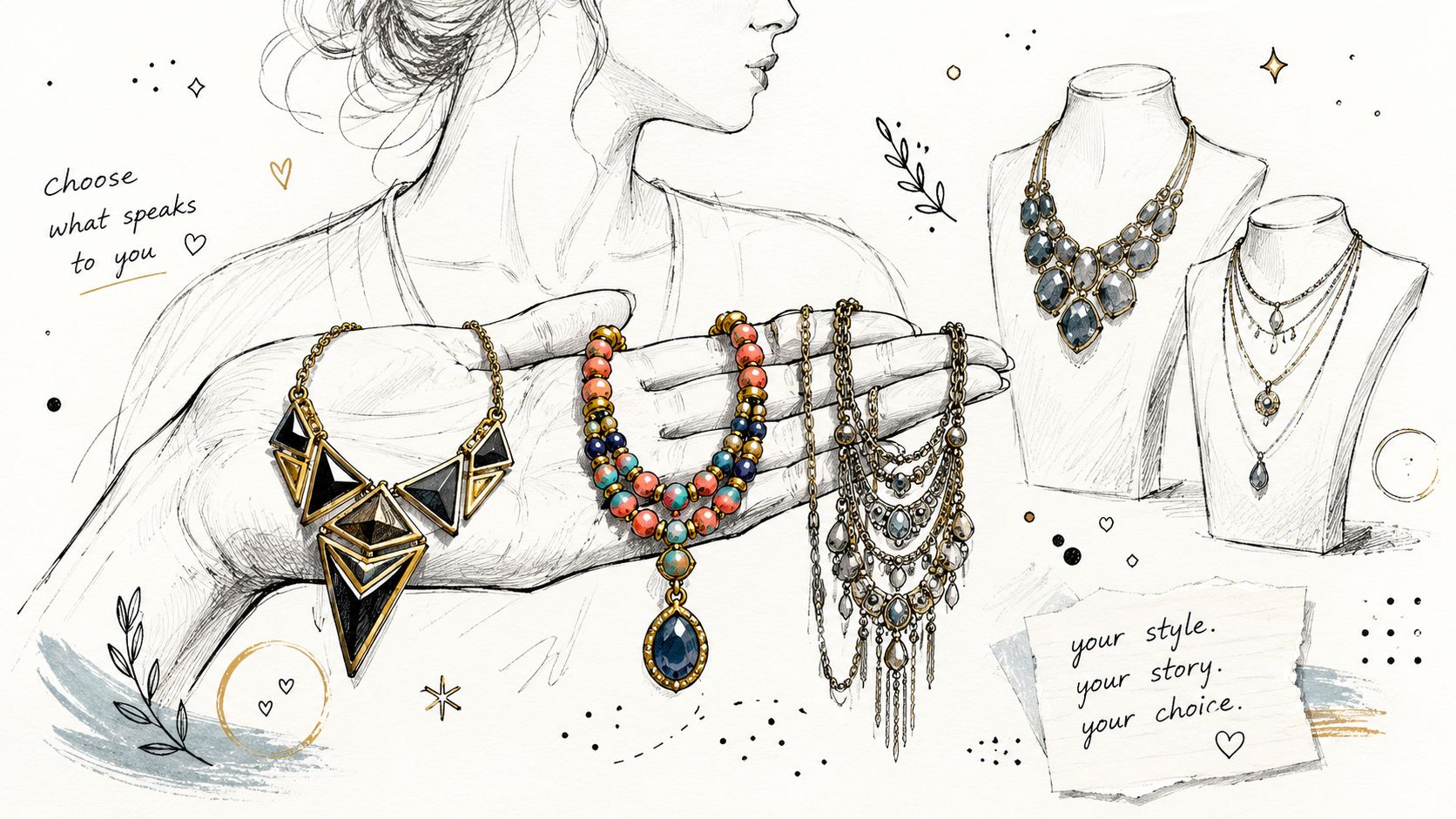
Start with the occasion
A necklace that feels magical at night can look overdressed in daylight. Professional styling guidance notes that statement necklaces are most appropriate for formal evening events, and pieces spanning 6 to 8 inches across the collarbone are considered acceptable for maximum drama, especially with strapless or collarless dresses for galas, prom nights, and upscale events (professional styling guidance).
That gives you a useful filter. If you're dressing for a black-tie wedding or a charity gala, a broad collar necklace can absolutely work. If you're dressing for an office, a client dinner, or a smart brunch, that same width can feel too theatrical unless the outfit is extremely restrained.
Practical rule: The more formal the event, the more visual space your necklace can claim.
For day, I usually look for structure rather than sparkle. Geometric links, brushed metals, sculptural chains, and beadwork with a cleaner line tend to read intentional in daylight. A piece like a curated ball chain necklace is a good example of statement through presence rather than ornament. It adds edge and weight without forcing the rest of the outfit into evening mode.
Judge proportion on your frame
Not every statement piece needs to be oversized. The right scale depends on your shoulders, neck length, and the visual weight of your clothing.
A petite frame can still wear a bold necklace beautifully, but the piece usually needs more negative space inside the design, or a cleaner silhouette, so it doesn't swallow the neckline. On a taller frame or broader shoulder line, a denser bib or chunkier collar often looks balanced.
Use this quick fitting-room test:
- Check shoulder width: If the necklace extends visually beyond your natural shoulder rhythm, it starts wearing you.
- Look at neck length: Shorter necks usually benefit from pieces with open shape and visible skin around them.
- Match garment weight: A whisper-thin camisole and a very heavy industrial necklace can clash. A structured blazer or substantial knit can support more heft.
If you're still figuring out where your style lives, Cedar & Lily's guide on how to find your personal style is useful because it helps you choose jewelry that aligns with the rest of your wardrobe, not just a single outfit.
Let your taste lead the mood
The smartest necklace in the room still won't work if it isn't you. Modern dressers often do better with architectural shapes, polished chainwork, or monochrome stones. Romantic dressers tend to come alive in floral motifs, softer curves, and pieces with movement.
Here's the distinction I use with clients:
| Style mood | Necklace direction | Best setting |
|---|---|---|
| Modern | Geometric, metal-forward, clean lines | Office, dinners, minimal dressing |
| Romantic | Floral, crystal, curved shapes | Weddings, showers, evening events |
| Classic | Pearl-accented, symmetrical, refined shine | Work events, luncheons, formal daywear |
| Artistic | Mixed texture, unusual materials, asymmetry | Creative workplaces, gallery nights |
When a necklace matches your personal language, you don't have to “pull it off.” It already belongs to you.
The Art of the Neckline
You button a crisp white shirt for a client meeting, add a bold necklace, look in the mirror, and something feels off. The necklace is beautiful. The shirt is polished. Together, they compete. Neckline styling solves that problem, but the broader goal is larger. The necklace should belong to the whole outfit, not just the space at the collar.
Pair the necklace with the neckline and the setting
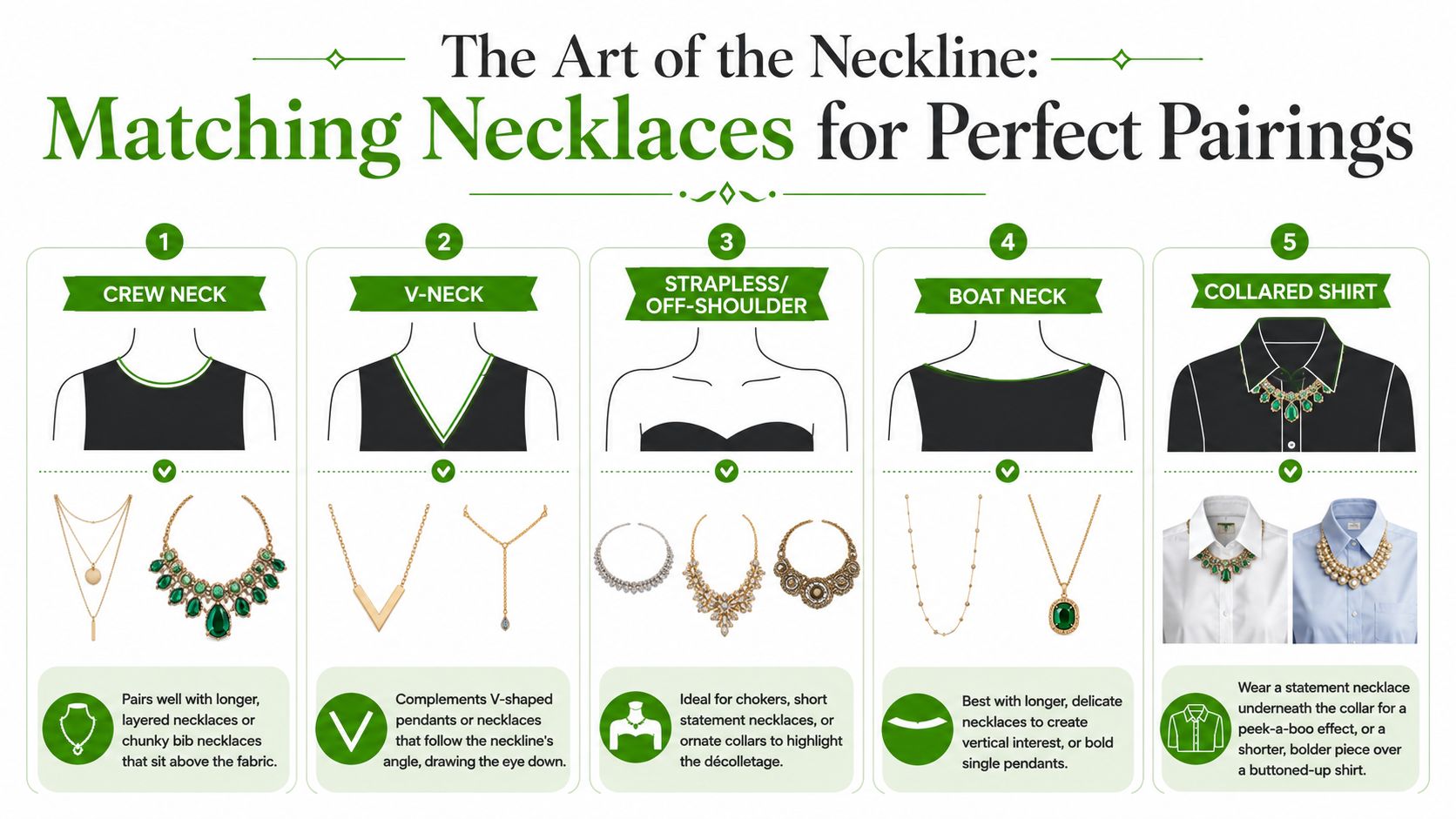
A neckline gives your necklace its placement, but the occasion decides how bold that placement should feel. In a professional setting, I usually treat a statement necklace as a finishing line inside the outfit. With an open collared shirt, a shorter architectural piece that sits just above the first button opening looks intentional and clean. With a crew-neck knit, a rounded bib or polished collar necklace reads sharper because the fabric creates a solid backdrop.
For evening, you can show more skin and use that openness. A sweetheart neckline welcomes a curved piece that mirrors the top edge of the dress. Off-shoulder gowns usually look strongest with a shorter necklace that frames the collarbone rather than dropping into the center of the chest. If you are dressing for a strapless event look, Cedar & Lily's guide on what jewelry to wear with a strapless dress gives useful examples by occasion.
The best pairings feel connected at first glance.
- Crew neck: Rounded statement styles, collar necklaces, and shorter bibs usually sit best.
- Deep V: Pendants or angular shapes that follow the opening keep the line clean.
- Sweetheart: Soft curves and medium-width pieces tend to echo the bodice well.
- Off-shoulder: Choker-length or collarbone-skimming designs keep attention lifted.
- Open collared shirt: Structured, compact necklaces work better than sprawling, ornate bibs.
A visual cheat sheet helps if you're more of a mirror learner than a rules learner:
Where outfits usually go wrong
The common mistake is reading the neckline in isolation. A necklace that suits the cut of the top can still look wrong if the fabric, silhouette, or mood of the outfit sends a different message.
For example, a heavily beaded necklace on a soft ruffled blouse often feels too busy because both pieces bring movement and detail near the face. The same necklace on a matte column dress can look refined because the dress gives it room. At Cedar & Lily, I see this often with textured pieces. Boucle jackets, chunky knits, satin lapels, and crisp poplin each change how a necklace registers. Texture either supports the jewelry or competes with it.
Boat necks need extra care for exactly that reason. They already create width across the upper body, so a wide collar necklace can make the shoulder line feel heavier. A pendant with some length or a single sculptural piece placed lower usually keeps the proportions calmer.
Use neckline strategy to keep the total look cohesive
A strong necklace should connect with the lines of the garment, the surface of the fabric, and the formality of the event. That is what makes it look effortless.
If your outfit includes a high collar, swept-up hair often gives the necklace more breathing room. For occasions where both hairstyle and neckline matter, Conde Professional's updo guide is a practical reference.
A quick decision table
| Neckline | What tends to work | What often fails |
|---|---|---|
| Crew neck | Rounded bib, collar, layered chain with clear placement | Long piece that disappears into fabric |
| Deep V | Pendant or angular shape that follows the V | Wide flat bib that cuts across the line |
| Strapless | Collar, crystal bib, shorter dramatic piece | Necklace that hangs too low and interrupts the open space |
| Off-shoulder | Choker length, sculptural short piece | Busy layering near bare shoulders |
| Boat neck | Vertical pendant, simpler bold element | Very wide collar that repeats the horizontal line |
A good neckline pairing makes the necklace feel built into the outfit from the start.
Create Harmony in Your Outfit
A statement necklace looks polished when the rest of the outfit gives it a clear role. The goal is total look cohesion. Every other choice, from fabric to bag to hairstyle, should support the necklace instead of competing with it.
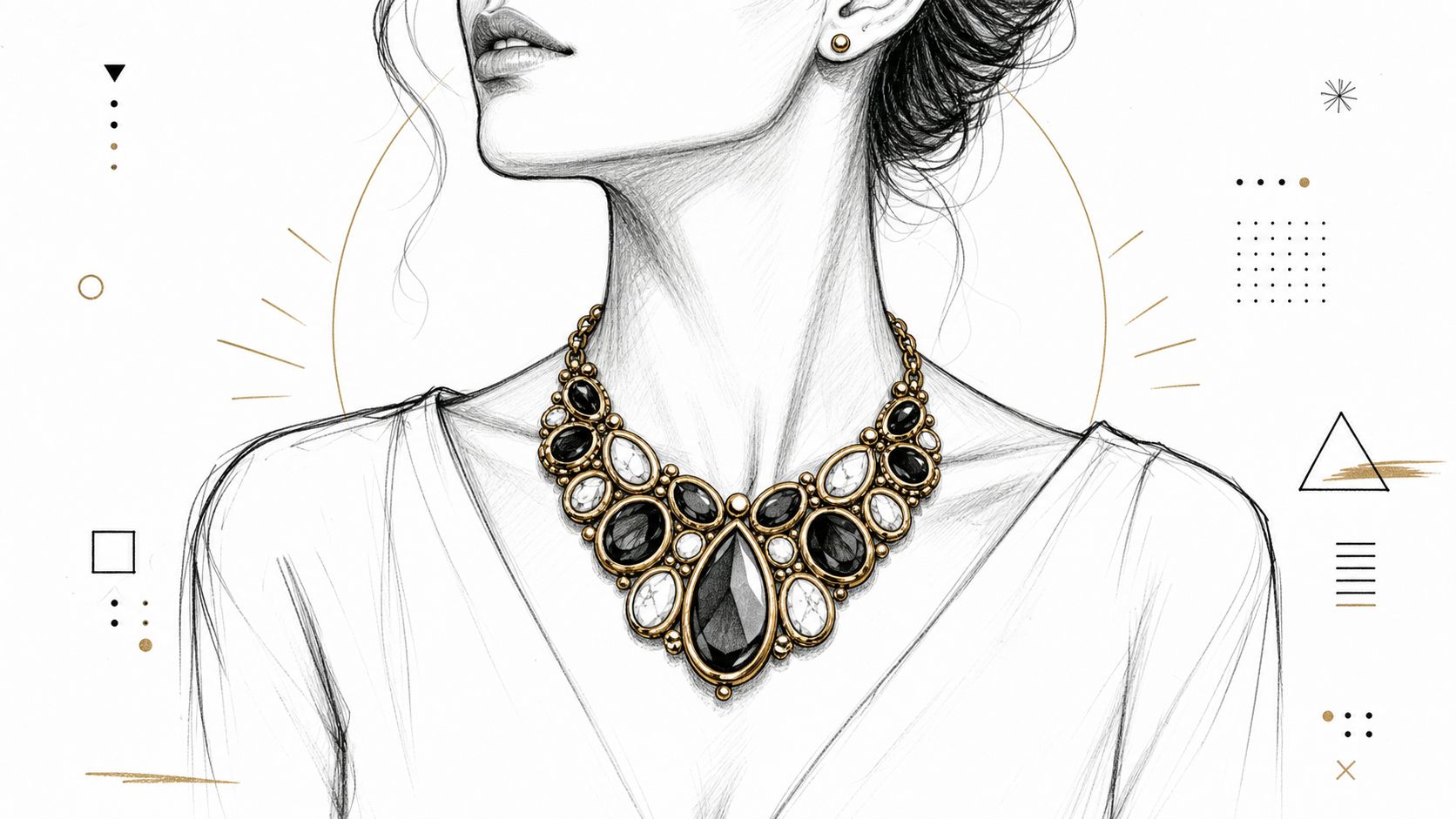
Let one area lead
In the fitting room, this is usually the fix that changes everything. A client puts on a strong necklace, then adds chandelier earrings, a stack of bangles, and a decorated bag. The outfit starts to feel busy, even if every individual piece is beautiful.
Keep the focal point near the face singular. Studs, slim hoops, or bare ears usually look cleaner with a large necklace. If you want more drama, place it somewhere else in the look. A sharp heel, a saturated clutch, or a strong cuff on one wrist adds personality without crowding the neckline.
A quick edit helps:
- Earrings: Studs, tiny hoops, or none
- Bracelets: One cuff or one slim bracelet
- Rings: Fewer, simpler shapes if the necklace is ornate
- Bags: Structured and quiet rather than beaded or heavily embellished
This matters even more in professional settings. If the necklace is doing the work, the rest of the accessories should read polished, not festive.
Consider fabric, pattern, and silhouette together
Necklaces do not sit in isolation. They react to surface, weight, and shape.
At Cedar and Lily, I often see the same necklace behave very differently depending on the garment. On crisp poplin, metal and geometric stones feel sharp and intentional. On brushed knits, that same piece can look too hard unless the shape is smoother. On matte crepe, crystals and mixed materials usually read refined because the fabric absorbs light instead of fighting it.
Use this as a working guide:
| Clothing texture | Necklace that usually works |
|---|---|
| Crisp poplin | Polished metal, clean beads, structured shapes |
| Soft knit | Rounded forms, smoother finishes, medium visual weight |
| Matte crepe | Crystal, stones, mixed materials |
| Heavy pattern | One clear shape or one dominant tone |
| Satin or shine | Cleaner silhouette, less surface detail |
Silhouette matters too. A strong necklace pairs best with clothing that has one clear line. A column dress, a clean blouse, or a structured jacket gives the eye a place to rest. If your top already has ruffles, contrast trim, puffed sleeves, or dense embellishment, choose a simpler statement necklace or skip it altogether.
One good question to ask is, "What is the first thing I want people to notice?" If the answer is the necklace, reduce noise around it.
Dress for the setting, not just the mirror
A necklace that looks perfect with a slip dress at night can feel overworked at 9 a.m. with a structured tote and laptop in hand. Context changes scale.
For the office, I prefer pieces with presence but clean edges. Resin links, brushed gold, sculptural metal, and tonal stones usually look more convincing than high-sparkle bibs in daylight. For weddings, galas, and evening dinners, shine can go further because the lighting, fabric, and mood support it.
Hair plays into that balance. A high necklace can disappear under loose waves or compete with a busy collar. For event dressing, Conde Professional's updo guide is a useful reference if you want the neck and collarbone to stay visible.
If you are refining the whole outfit around one bold accessory, this guide on how to accessorize an outfit with balance gives a broader framework.
Layering without clutter
Layering works best when each necklace has a job. One piece should lead. The others should support it with length, texture, or a small flash of contrast.
Filigree Jewelers' layering guide recommends spacing layered lengths by 2 to 3 inches so each piece stays visually distinct. That spacing is what keeps the stack readable instead of tangled.
There is a trade-off. Layering adds richness, but a single bold necklace usually feels stronger and more controlled. For work, one sculptural piece is often enough. For evening, a statement necklace with one finer chain below it can look beautiful if the lengths stay clearly separated.
When an outfit feels slightly off, remove one competing element before you blame the necklace. That small edit usually restores the balance.
Master Advanced Statement Necklace Styling
The hardest styling questions aren't about gala dressing. They're about the in-between outfits. The shirt you wear to work. The blazer you need to keep polished. The necklace you want to wear at noon and still like at dinner.
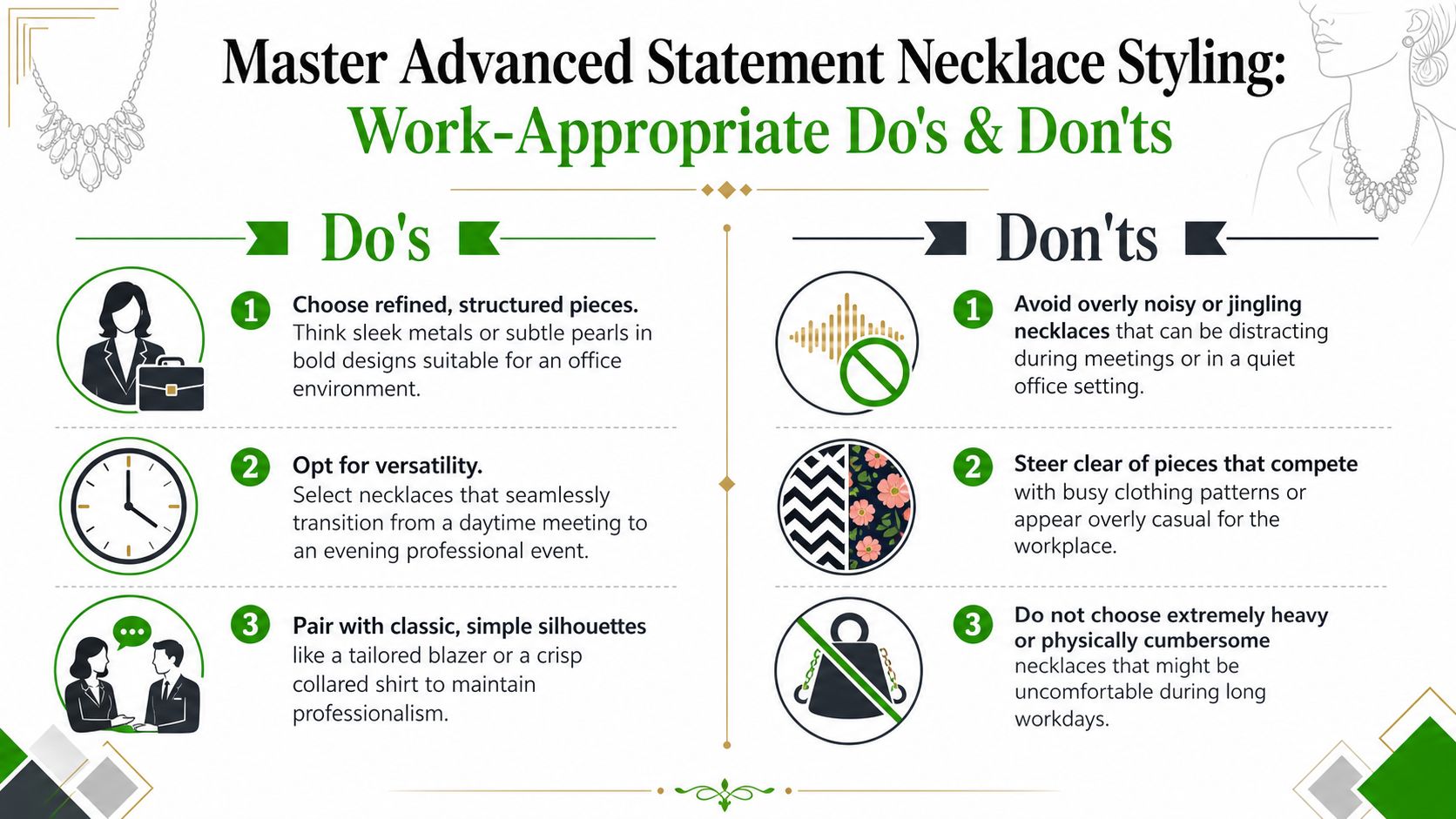
The collared shirt question
This is one of the most frequently asked styling problems, and it's still underserved. Existing advice often tells women to wear the necklace with the collar, but there isn't data-backed guidance on the ideal gap or on how collar stiffness affects hang for polished desk-to-dinner dressing (discussion of that gap in guidance).
So here's the practical version I use.
Method one is the peek-out approach. Leave the shirt open enough that the necklace sits just inside the collar line, with only part of it visible. This works best with smoother necklaces and shirts that drape softly.
Method two is the fully-over-collar approach. Button the shirt higher and place a shorter, structured necklace on top. This looks sharper and more intentional, especially with crisp shirting.
What changes the result
Not all shirts behave the same way. A softer poplin collar usually allows a necklace to settle more naturally underneath. A stiffer oxford collar can push against the necklace and create awkward lift, especially if the piece is chunky.
Here's the trade-off to watch:
- Soft collar plus fluid necklace: More relaxed, easier for desk-to-dinner.
- Stiff collar plus structured necklace: Cleaner and more editorial.
- Bulky necklace plus thick placket: Often too much volume at center front.
A blazer adds another layer of complexity. Under a structured blazer, the necklace should either sit clearly inside the lapel opening or clearly above the inner top edge of the blouse. The in-between zone often looks accidental.
A strong work look should feel composed from the shoulder line down. If the necklace catches on the collar, fights the lapel, or makes the shirt buckle, it isn't polished enough for professional wear.
Keep work styling refined
For work, choose necklaces that have shape and presence without excess motion. Pieces that jingle, swing heavily, or require constant adjustment become distracting fast. A refined statement reads much more polished than a loud one in professional settings.
This is also the one place where a boutique assortment can help because you can compare necklace weight, closure placement, and scale against real garments in the same wardrobe. Cedar & Lily Clothier carries dresses, blazers, tops, and accessories in one edit, which makes it easier to build a work-to-event look around a single jewelry decision.
Final Touches and Long-Term Care
The final polish usually comes from details that aren't the necklace itself. Hair, makeup, and maintenance all change whether the piece feels elegant or chaotic.
Finish the styling around your face
If the necklace is broad or ornate, pull the visual noise away from it. A low bun, sleek ponytail, tucked-behind-the-ear wave, or half-up style keeps the collarbone area visible. When hair spills over both shoulders, even a beautiful necklace can disappear.
Makeup should support the mood, not compete with it. A bold lip can work with a statement necklace, but only if the rest of the look is disciplined. If the necklace has sparkle, texture, and color, a cleaner complexion and softer eye often look more expensive than a full drama-on-drama approach.
Try this simple finishing checklist:
- Hair off the necklace: Especially for shorter, wider pieces.
- Neckline lint-free and pressed: Statement jewelry highlights every wrinkle.
- Lip and necklace in balance: If one is vivid, let the other carry less visual heat.
- Perfume applied before jewelry: This helps reduce direct contact with the piece.
Protect the piece so it keeps its shape
Statement necklaces need more care than delicate chains because they're heavier, more structured, and often made with mixed materials. If you toss them into a drawer, they can tangle, scratch, or lose alignment.
Store each necklace separately. Lay flat when possible, especially if the piece has a shaped front panel or embellishment that can bend under pressure. If it hangs, make sure the clasp can support the weight without distorting the chain over time.
For cleaning, stay gentle. A soft dry cloth is usually enough after wear. If the necklace includes stones, beads, crystals, or fabric elements, avoid aggressive scrubbing and skip harsh cleaners unless the maker specifically recommends them.
Know when a necklace needs editing, not cleaning
Sometimes a necklace looks wrong not because it's worn out, but because one small part of the styling has shifted. The blouse is too textured. The collar is too stiff. The earrings are too assertive. Before you retire a piece, test it with a cleaner neckline and quieter companions.
That's often the difference between “I never wear this” and “This suddenly works.”
If you're building outfits for work, weddings, dinners, or event season, Cedar & Lily Clothier offers a curated mix of dresses, blazers, tops, and accessories that makes statement styling easier to get right. The advantage isn't just having more pieces to choose from. It's being able to create a complete look with proportion, texture, and occasion in mind so the necklace feels integrated from the start.