


You're standing in front of your wardrobe with three plans on the calendar: a Monday meeting, Saturday lunch, and dinner reservations. The oversized blazer looks like the obvious answer, yet one wrong layer can make it appear borrowed, bulky, or far too formal.
The solution isn't more clothing. It's controlled proportion. Keep the shoulder line intentional, then balance the blazer's volume with a defined waist or a shorter, slimmer hem underneath. That single decision makes the same jacket work with trousers, a slip dress, or jeans.
Why the Oversized Blazer Works Right Now
The oversized blazer has moved beyond trend-piece status. Its fashion lineage stretches back more than a century, while its modern breakthrough arrived in the 1970s and 1980s, when women adopted sharp, wide-shouldered tailoring as power dressing in corporate spaces. By the 1990s, the shape had developed into a more explicitly androgynous silhouette, establishing the familiar contrast between a roomy jacket and fitted bottoms. The documented history of the oversized blazer explains why that proportion still feels current.
In 2026, the most useful version of the look sits within a softer approach to authority. The shoulders remain defined, but the waist doesn't need to be rigidly nipped. A blazer can look polished over a ribbed knit in the office, relaxed over a T-shirt at lunch, or elegant over satin at night. You're wearing the same visual language, but changing the texture and the level of finish.
Stylist's rule: Let the blazer be generous in one area only. If the jacket is roomy, keep the layer beneath sleek, the hem purposeful, or the waist visible.
That's why I treat the oversized blazer as a wardrobe anchor, not an occasional statement. It multiplies the clothes you already own. A fitted dress gains structure, denim gains polish, and a simple knit-and-trouser combination acquires authority without looking stiff.
The category's commercial scale reflects that shift toward repeat wear. One industry forecast values oversized apparel at USD 130.18 billion in 2025 and projects it to reach USD 221.22 billion by 2034, with a 6.20% CAGR. Another report places the broader oversized fashion market at USD 121.6 billion in 2024, projecting USD 199.08 billion by 2033. These are market forecasts, not a reason to buy indiscriminately, but they show that relaxed volume has become a mainstream wardrobe language. The oversized-apparel market forecast offers useful context for that change.
If your personal style leans more expressive, use the blazer as the composed foundation for unusual color, jewelry, or print. A useful companion is this eccentric-chic fashion guide, especially if you want the jacket to anchor a more individual outfit rather than a conventional neutral uniform.
Fit Foundations Before You Style Anything
Styling can't rescue the wrong blazer. Before choosing shoes or jewelry, check whether the jacket is oversized or too large.
Start at the shoulder
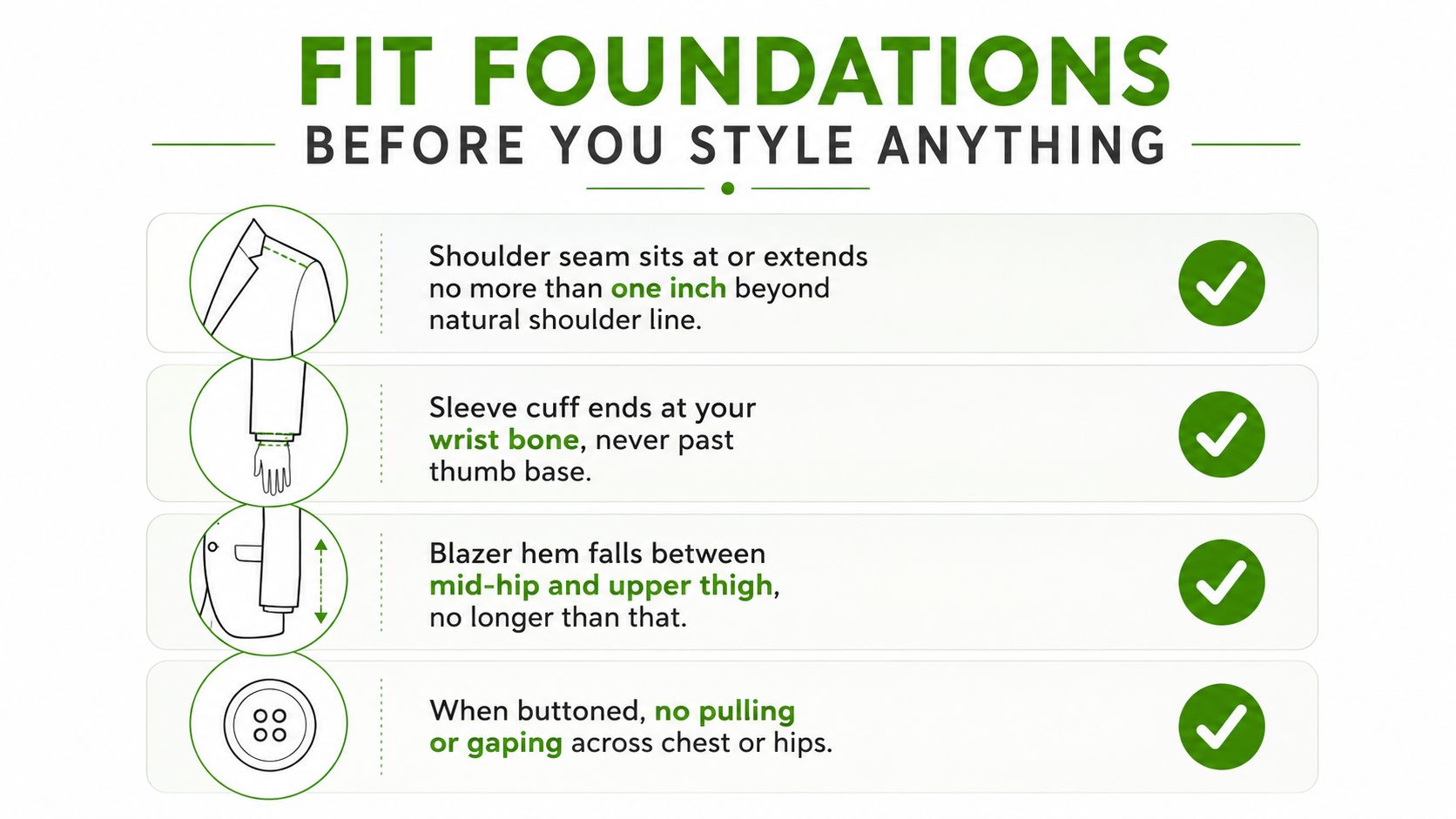
The shoulder seam should sit on the natural shoulder or extend only slightly beyond it. Expert guidance recommends a controlled line rather than an extreme drop, with the seam landing at or only slightly past the shoulder. Petite styling guidance for oversized blazers also emphasizes this balance, because excessive width makes the entire frame look compressed.
The sleeve should finish at the wrist bone, not at the fingertips. You need enough room to move, but the cuff shouldn't cover the hand. If the sleeve is perfect everywhere else and runs long, shorten it. That alteration preserves the blazer's shape far better than trying to push or fold the sleeve throughout the day.
Check the body and hem
For most frames, look for a hem from mid-hip through the upper thigh. A longer line can work on a taller body, but it needs enough visible shape beneath it. The blazer should skim rather than collapse around you, and the buttons shouldn't pull or gape across the chest or hips.
Don't automatically size up to create the look. The oversized effect should come from deliberate shoulder width and blazer length, not random excess throughout the body. Recent fit guidance suggests a shoulder drop of roughly one to two inches and a hemline that still reveals the body's shape. This oversized blazer formula is particularly useful when comparing true oversized tailoring with a standard jacket bought too large.
Use this fitting-room test:
- Button it once. If the chest or hips pull, move on. A relaxed blazer should still close cleanly.
- Raise both arms. The jacket can shift, but it shouldn't drag sharply across the back.
- Let your arms hang. If the sleeve swallows your hand, budget for shortening or choose another size.
- Walk and sit. Watch the hem. It should drape, not twist around your body.
- Look at the shoulder from behind. A clean seam reads intentional. A collapsed shoulder reads borrowed.
Tailor the sleeve, protect the drape
Sleeve shortening is usually the most worthwhile adjustment. Taking in the body can destroy the relaxed fall that makes an oversized blazer attractive, particularly in wool blends, linen, and double-knit crepe. Those fabrics have different memories: linen relaxes and creases, wool blends recover more readily, and crepe can cling if the fit is too close.
Spend alteration money where the eye notices it first. A clean sleeve and functional button closure matter more than forcing the waist into a shape the pattern wasn't designed to create. For additional workwear selection guidance, browse this guide to blazers for work.
Office Event and Casual Outfit Formulas
Choose the occasion first, then build around the same blazer. The difference between polished and misplaced usually comes from the under-layer, shoe, and bag, not the jacket itself.
| Occasion | Under-Layer | Bottom | Footwear | Accessory | Trade-Off |
|---|---|---|---|---|---|
| Office | Fitted ribbed knit or silk shell | High-rise tailored trousers | Low block heel or loafer | Structured tote | Polished and reliable, but it can read corporate |
| Event | Liquid satin slip or column dress | Dress replaces separate bottom | Heeled sandal | One statement earring | Elegant and fluid, but fabric contrast prevents a costume-like result |
| Casual | White T-shirt or ribbed tank | Straight-leg or barrel jeans | Loafer, sneaker, or ballet flat | Soft shoulder bag | Approachable and easy, but petites need a defined hem to keep shape |
For the office, tuck a fitted ribbed knit or silk shell into high-rise trousers. Keep the jacket open or fasten one button, then choose a low block heel or refined loafer. A structured tote gives the relaxed tailoring enough authority for meetings without making the outfit feel overly formal.
The event formula works because the blazer's firmness contrasts with the dress's movement. Wear it open over a liquid satin slip or column dress, add a heeled sandal, and stop at one statement earring. Don't pile on a necklace, belt, cocktail ring, and ornate shoe. The blazer already provides visual architecture.
Casual dressing needs one deliberate element to prevent the outfit from looking accidental. Pair the jacket with a white tee or fitted ribbed tank, straight-leg or barrel jeans, and either a loafer, clean sneaker, or ballet flat. A soft shoulder bag keeps the mood relaxed, but a petite frame may need a shorter visible hem or a half-tuck beneath the blazer.
Fabric rule: Match the blazer's weight to the base layer's weight. A heavy jacket over a thick sweatshirt creates bulk, while a lightweight blazer over a substantial knit can lose its shape.
For more combinations to adapt to your own wardrobe, use these blazer outfit ideas for women. The most effective outfits don't require a complete new wardrobe. They require a clear swap between the base layer, bottom, and shoe.
Seasonal Layering Through the Year
An oversized blazer earns its place when it works beyond one weather window. Change the fabric and under-layer first, then adjust the bottom and shoe.
| Season | Under-Layer | Bottoms | Footwear |
|---|---|---|---|
| Spring | Fine cotton T-shirt or silk shell in a tonal hue | Straight-leg trousers or slip skirt | Loafer, ballet flat, or low heel |
| Summer | Fitted ribbed tank under breathable linen | High-rise shorts | Flat sandal, loafer, or sleek sneaker |
| Fall | Thin merino turtleneck or fine-gauge knit | Cropped trousers | Ankle boots |
| Winter | Cashmere turtleneck or thin crewneck | Wool trousers | Knee-high boots |
Spring keeps the line light
Use a fine cotton tee or silk shell in a color close to the blazer. That tonal relationship makes the roomy outer layer look considered, especially with straight-leg trousers or a slip skirt. A loafer or ballet flat keeps the transition-season outfit practical, while a low heel adds polish for the office.
Summer needs breathable structure
Choose linen or another breathable blazer fabric over a fitted ribbed tank. High-rise shorts expose enough leg to balance the jacket's length, and pushing the sleeves once creates ease without turning the whole outfit sloppy. Keep the shorts fitted rather than oversized unless the blazer is notably short and lightweight.
Fall benefits from a narrow under-layer
A thin merino turtleneck or fine-gauge knit adds warmth without competing with the jacket. Cropped trousers reveal the ankle and create a clean break above ankle boots, which stops the outfit from becoming one continuous block of fabric.
Winter requires careful stacking
Use a cashmere turtleneck or thin crewneck beneath the blazer, then add wool trousers and knee-high boots. If you need another coat, choose one with enough room through the shoulders and drape it over the shoulders rather than forcing it over a rigid jacket. This guide to coats worn over blazers can help you assess the outer layer before you leave home.
Store the blazer on a substantial hanger, follow its care label, and avoid compressing the shoulders under a crowded coat rack. Good layering starts with a jacket that still holds its intended shape.
Accessories and Shoe Pairings That Finish the Look
Accessories tell people whether you threw on a blazer or styled an outfit. Use them to sharpen the occasion, not to compete with the jacket.
Work needs clean edges
Point-toe pumps and block-heel loafers extend the polished message without demanding a high heel. Add a structured leather tote and small gold or silver studs. A slim belt can define the waist if the blazer is worn open, but keep it close in color to the jacket or base outfit.
For evening, replace practical polish with controlled shine. Strappy heeled sandals or pointed kitten-heel boots work with a satin dress, while a minaudière or soft clutch keeps the hand free of daytime bulk. Add a delicate pendant or layered chain, then consider a thin satin scarf at the neck if the neckline needs interest.
Weekend accessories should create contrast. Chunky loafers, white court sneakers, or western boots make a blazer feel less precious. A slouchy hobo bag, tortoiseshell sunglasses, and one bold detail, such as oversized hoops or a silk bandana, are enough.
Proportion adjustment: A belt sharpens the waist, but a contrasting wide belt can shorten the torso. Petite frames should choose a tonal, thin belt instead.
Shoes change the visual center
A pointed shoe pulls the eye forward and lengthens the lower line. A chunky loafer grounds a longer blazer and works especially well with denim. A ballet flat softens the tailoring, while a boot creates a stronger vertical connection between the leg and the jacket.
Petite frames should avoid accessories that create several abrupt horizontal breaks. Curvy frames can use a belt or a clear neckline to make the waist legible. Broad-shouldered frames benefit from a longer pendant or open neckline that draws attention downward, while taller frames can handle a larger bag or wider shoe without losing balance.
Use a maximum of three noticeable accessories. For example, choose a belt, tote, and earrings for work, or a clutch, pendant, and sandal for an event. That editing makes the oversized silhouette look deliberate.
Watch the accessory pairings in motion before deciding. This visual styling guide can help you compare the effect of different shoes and finishing pieces.
Adjusting the Silhouette for Your Body Frame
The right oversized blazer doesn't disguise your frame. It gives the frame a clear outline, then places volume where you want it.
Petite frames
Choose a blazer that ends around mid-thigh rather than extending well beyond it. Sleeves should finish just past the wrist bone while leaving the hand visible, and a single button or open-front styling preserves a long vertical line.
A high-rise bottom keeps the legs visually clear. Avoid extreme dropped shoulders, especially with heavy fabric. For petite proportions, expert guidance recommends a 33/66 vertical ratio, roughly one-third top and two-thirds bottom, along with a minimalist monochrome base to reduce visual compression. This petite proportion guidance is a useful fitting reference.
Curvy frames
Select an open, longer blazer that skims rather than grips. The under-layer should be defined, not oversized, and a half-tuck can mark the waist without forcing the jacket closed.
Single-breasted tailoring usually keeps the front cleaner. If you belt the jacket, use a medium or slim belt and let the fabric fall naturally above and below it. The aim is a visible shape, not a tight hourglass effect.
Broad-shouldered frames
Choose softer construction, a V-neck under-layer, and a lower button stance. These details shift attention away from the upper shoulder area and create a longer center line.
Avoid aggressive shoulder padding or very high, rigid lapels if your goal is balance. A darker blazer with a lighter or more open neckline beneath it can also draw the eye downward without hiding your shoulders.
Taller frames
You can carry longer hemlines, wider lapels, and a belted closure with ease. Straight-leg or wide-leg trousers can match the blazer's volume, provided the waist or top layer remains visually clear.
A curated shopping approach starts with these design details before color or label. At Cedar & Lily Clothier, shoppers can use fit guidance across blazers, trousers, dresses, accessories, and outerwear through online shopping or in-person associates at its Oklahoma storefronts. That kind of wardrobe review is more useful than buying a jacket because the shoulder looks dramatic on a hanger.
The best blazer for you is the one that creates a clean relationship between shoulder, waist, hem, and shoe. Body shape is only the starting point. Fabric behavior, posture, and the outfit underneath decide whether the volume looks elegant.
Quick Styling Checklist and Common Questions
Run this audit before leaving the house. It should take less than a minute.
- Shoulder seam: It sits at, or only slightly beyond, your natural shoulder.
- Sleeve cuff: It ends at the wrist bone and leaves the hand visible.
- Hemline: It falls from mid-hip through the upper thigh, with longer lengths reserved for frames that can support them.
- Base layer: It's lightweight and close to the body, such as silk, thin cotton, or a fine knit.
- Lower silhouette: The bottom has a clear shape, whether it's a trouser, straight jean, short hem, or column dress.
- Shoes: The category matches the occasion, from pumps and loafers to sneakers and boots.
- Accessories: You've edited the finish to a few purposeful pieces rather than decorating every surface.
Common questions
Can petite women wear oversized blazers? Yes, provided the jacket doesn't overwhelm the vertical line. Choose a controlled shoulder, a mid-thigh hem, a visible wrist, and high-rise bottoms.
How do you keep an oversized blazer office-appropriate? Pair it with a fitted knit or silk shell, high-rise trousers, polished shoes, and a structured tote. Keep the colors restrained if your workplace is formal.
Which pants balance an oversized blazer? Straight-leg and trousers are the safest choices, while wide-leg pants work best on taller frames or when the waist is clearly defined.
Should you button the blazer or leave it open? Button one point when you want authority, and leave it open when you want a longer, easier line. Don't button it if the chest or hips pull.
How do you avoid looking swallowed by fabric? Show one deliberate area of shape, such as the waist, ankle, wrist, neckline, or shorter hem. A monochrome base also reduces visual interruption.
Final fitting verdict: If the jacket looks large everywhere, it's too large. If it looks roomy through the body but precise at the shoulder, cuff, and hem, you've found the right proportion.
Visit Cedar & Lily Clothier to explore curated blazers, separates, dresses, denim, and accessories for work-to-weekend dressing. Use the boutique's online or in-store fit guidance to choose an oversized blazer that works with your frame, schedule, and existing wardrobe.