

The most popular advice about denim is that comfort requires compromise. For women dressing around a morning meeting, a client lunch, or an evening reservation, that advice is outdated. Black relaxed jeans can offer room through the seat and thigh while retaining the visual discipline of dark denim, provided the wash, proportions, and finishing pieces are chosen with care.
A polished pair should work harder than a weekend-only jean. A deep black finish can stand in for fitted trousers with a blazer and refined shoes, while a softer charcoal or faded wash can loosen the same silhouette for travel, errands, and casual dinners. The difference isn't the denim alone. It's the complete outfit.
Cedar & Lily Clothier's approach to a versatile wardrobe follows the same practical principle outlined in its capsule wardrobe guide: buy pieces that connect naturally to what already hangs in the closet. The right relaxed jean should pair with existing knitwear, blouses, jackets, and accessories rather than demand an entirely new wardrobe.
Table of Contents
- Defining the Black Relaxed Fit
- Black vs. Other Denim Washes
- Styling for Work and Weekend
- Finding Your Perfect Size
- Caring for Your Black Denim
- Shop Refined Relaxed Fits
Defining the Black Relaxed Fit
A relaxed fit is defined by ease, not only by a wide leg. The cut generally gives the wearer more room through the seat, thighs, and leg, then continues in a straight or gently relaxed line toward the hem. That creates movement without the exaggerated volume of an oversized jean.
Skinny denim stays close to the body from waist to ankle. A conventional straight jean usually keeps a more consistent width through the leg, but it may offer less room at the hip and thigh. Relaxed jeans sit between those categories. They allow the upper leg to breathe while maintaining enough structure to look intentional.
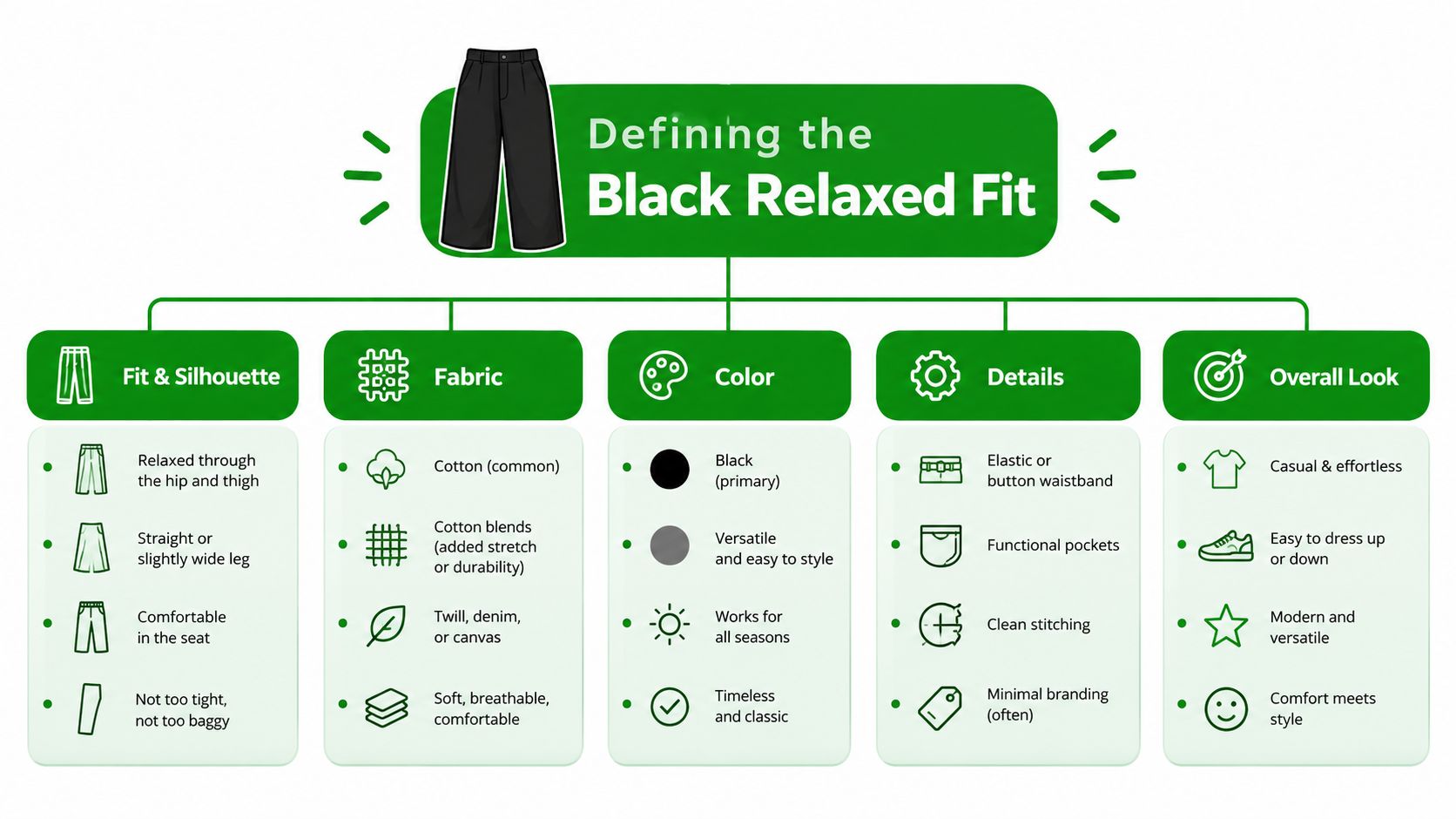
Product descriptions for relaxed denim commonly identify rigid cotton or non-stretch fabric, often with extra ease from the hip through the ankle. A retailer's relaxed-fit construction describes the shape as roomier through the seat and thigh with a straight leg to the hem, while another listing pairs a regular waist with rigid cotton denim. These details matter because cotton denim tends to hold a cleaner line at the start, then soften as it breaks in rather than immediately losing its shape. The guide to relaxed fit clothing offers useful background for shoppers still comparing roomier silhouettes.
The measurements behind the shape
Fit language becomes easier to understand when translated into garment dimensions. One listing for a black relaxed jean gives a 12-inch front rise, 15.5-inch back rise, 19-inch leg opening, and 32-inch inseam for size 32. Those measurements help explain why the jean feels easier through the hip and upper leg than a narrow cut.
A separate product listing specifies a 31-inch inner leg length for size 33/32 and a 36-inch waist circumference for that same size. Measurements vary by brand and style, so a familiar numerical size isn't enough on its own. Rise, leg opening, and inseam determine whether the volume looks balanced on a particular frame.
For shoppers comparing proportions, the advice in this mid-rise denim guide can also help clarify how the waistband position changes the overall line. The most flattering relaxed fit usually has visible ease, but no collapse at the waist or excessive pooling at the hem.
Black vs. Other Denim Washes
"Black denim" covers several distinct finishes, and each one sends a different style message. A deep, uniform black has the cleanest appearance. It creates the closest visual relationship to fitted trousers and works particularly well with blazers, silky tops, polished flats, and evening shoes.
Faded black is softer and more casual. It often has a slightly gray cast at areas of friction, which gives the jeans a lived-in quality. This wash works with chunky sweaters, relaxed jackets, simple tees, and casual footwear, but it needs more support if the outfit has to meet a conservative office dress code.
Charcoal sits between the two. It preserves the depth associated with dark denim while reducing the starkness of solid black. That makes it an appealing option for women who want versatility but prefer a gentler contrast against ivory, camel, soft pink, or muted blue.
Stone-washed black introduces visible variation across the fabric. The finish can feel vintage and deliberately relaxed, so it suits weekend dressing and casual social plans more naturally than formal work settings. It can still look refined, but the surrounding pieces need to be crisp.
Choosing the right finish
| Wash | Overall impression | Works especially well with |
|---|---|---|
| Deep black | Sleek and tailored | Blazers, blouses, pointed shoes |
| Charcoal | Soft and versatile | Neutrals, knitwear, understated accessories |
| Faded black | Casual and lived-in | Sweaters, jackets, everyday footwear |
| Stone-washed black | Textured and vintage-inspired | Weekend layers, relaxed tops, casual outings |
The practical choice depends on the wardrobe role. A woman buying one pair for work-to-weekend use will usually get the most mileage from deep black or charcoal. A second pair can bring in the character of faded or stone-washed denim without asking a casual finish to perform a structured role.
Current denim coverage distinguishes deep black, charcoal, and stone-washed finishes rather than treating them as interchangeable, while broader fashion reporting identifies lighter blue washes as the fresher novelty direction for 2026. That makes black relaxed jeans a stable wardrobe foundation, not necessarily the most fashion-forward choice in every setting. Their strength is reliable versatility.
Styling for Work and Weekend
The quickest answer is simple: for work, choose a clean dark wash, a structured top layer, and shoes with a deliberate shape. A relaxed leg looks office-appropriate when the rest of the outfit supplies polish. The same jeans become weekend-ready when the jacket softens, the top becomes simpler, and the footwear loses some formality.

Three formulas that hold up
For business casual, pair deep black relaxed jeans with a tucked blouse, a shaped blazer, and a loafer or pointed flat. Keep the waistband clean and avoid a heavily distressed hem. A compact handbag and restrained jewelry complete the look without making the denim feel disguised.
For a creative office, use the same silhouette with a fine-gauge sweater, a shorter jacket, and an ankle boot or refined sneaker. The proportions should remain balanced. If the leg is generous, the top should either be tucked or cropped near the high hip so the outfit doesn't become visually heavy.
For a client lunch followed by dinner, start with a fluid blouse, a longline blazer, and a low heel. After work, remove the jacket, add a more expressive earring, and switch to a dressier shoe. The outfit changes character without requiring a complete change of clothes. More ideas for that transition appear in Cedar & Lily's guide to day-to-night outfits.
Proportion is the polish
A relaxed jean doesn't need a tight top to look flattering. It does need a clear point of balance. A tucked shirt, a defined shoulder, a cropped outer layer, or a visible waistline prevents the extra ease from reading as accidental.
Practical rule: If the denim is roomy through the leg, give the outfit one crisp element. That can be a blazer, a structured bag, a pointed toe, or a clean collar.
For weekends, trade the blazer for a softly textured cardigan or an easy jacket. A fitted tank under an open shirt can work for warm weather, while a simple knit and ankle boot create a composed cold-weather combination. The jeans remain the anchor, but the supporting pieces decide whether the outfit feels professional, social, or purely practical.
Finding Your Perfect Size
Relaxed jeans should feel easy, not shapeless. The waistband needs to sit securely without digging, the seat should have room without sagging, and the thigh should allow movement without producing excessive folds. Shoppers accustomed to stretch denim often misread rigid cotton at first because the fabric feels firmer before it softens.
Start with four measurements
- Waist: Measure where the waistband will sit, then compare that number with the garment's measurement chart. Don't assume the same labeled size will fit identically across different cuts.
- Rise: Check the front and back rise. A longer rise can provide more coverage and change where the waist appears to sit, while a shorter rise creates a different relationship between the waistband, top, and hip.
- Inseam: Measure from the crotch to the preferred hem point. A longer inseam can create a full break over shoes, while a shorter length may show more of the ankle and make the relaxed leg feel lighter.
- Leg opening: Look at the hem width, especially if the jeans will be worn with boots, loafers, or slim sneakers. A wider opening can balance a fuller thigh, but it can also overwhelm a smaller shoe.
Specific listings illustrate why these figures matter. One black relaxed style gives a 31-inch inner leg length for size 33/32 and a 36-inch waist circumference for that same size. Another lists a 12-inch front rise, 15.5-inch back rise, 19-inch leg opening, and 32-inch inseam for size 32. Those are garment details, not universal standards, but they show what shoppers should look for when comparing options.
Use the fitting room as a movement test
Sit, walk, and bend slightly. The waistband should stay in place, and the fabric shouldn't pull sharply across the front hip or strain at the pockets. Rigid or non-stretch denim may relax with wear, but it won't correct a waistband that is too small.
A good relaxed fit looks roomy in the silhouette and precise at the points that keep the garment in place.
If the waist fits but the leg feels too voluminous, a different cut may solve the problem better than sizing down. If the thighs feel tight, sizing down will usually sacrifice comfort and distort the intended line. Cedar & Lily's guide to choosing the perfect jeans provides a useful reference before an online purchase, while in-person fitting lets shoppers assess the actual fabric and proportions.
Caring for Your Black Denim
Black denim shows care mistakes quickly. Friction, heat, and repeated washing can remove dark dye from the surface, leaving the fabric with a gray cast and making high-wear areas look uneven. A considered routine preserves both the color and the structure of the jeans.
Turn the jeans inside out before washing. Use cold water and a detergent formulated for dark fabrics, then choose a gentle cycle when the care label allows it. Washing inside out reduces direct surface abrasion, while cold water helps limit the combination of heat and agitation that accelerates fading. Levi's denim-care guidance also recommends these dark-denim habits, including avoiding high heat and drying in shade, as detailed in its denim care instructions.
A simple care routine
- Wash only when needed: Airing the jeans between wears can reduce unnecessary laundering.
- Protect the surface: Keep the garment inside out so the outer face experiences less rubbing in the machine.
- Skip high heat: A hot dryer can accelerate fading and alter the fabric's feel.
- Air-dry in shade: Hang or lay the jeans away from direct sun to slow color loss and reduce the risk of dye transfer.
- Follow the label: The care instructions for the actual garment take priority over general denim habits.
Don't use high heat to force a quick finish. Air-drying takes more planning, but it's the most reliable way to help a deep black pair retain its original appearance. If the jeans feel stiff after drying, gentle wear will help the cotton soften without sacrificing the shape.
Shop Refined Relaxed Fits
The best pair of black relaxed jeans earns its place by solving several wardrobe problems at once. It should feel comfortable through the seat and thigh, hold a convincing line through the leg, and look polished enough to support a blazer or event-ready top. A dramatic wash or exaggerated proportion may be exciting, but a refined cut usually delivers more frequent wear.
Cedar & Lily Clothier carries curated contemporary and designer clothing for women, including denim, tops, blazers, outerwear, dresses, jumpsuits, and accessories. The boutique doesn't manufacture its own line. Instead, the assortment includes selected labels such as Vanessa Mooney and Lace the Label, allowing shoppers to build an outfit around the denim rather than treating jeans as an isolated purchase.
The Frame relaxed straight raw fray jean illustrates the kind of proportion worth examining closely. A raw or deep finish can give a relaxed straight shape more presence, while the surrounding styling determines whether it leans toward office polish, dinner dressing, or everyday ease.
Why an in-person fitting helps
Online measurements are useful, but denim communicates through fabric weight, stiffness, rise, and the way the leg falls over a shoe. At Cedar & Lily's Utica Square location in Tulsa and downtown Jenks storefront, shoppers can see those details directly, compare fits, and ask the team for styling help. That matters particularly with rigid denim, where the difference between intentional ease and unwanted bagginess is easiest to judge on the body.
For shoppers outside Oklahoma, the online store at cedarandlilyclothier.com offers another way to explore the collection. The practical goal remains the same: choose a pair that can move from a polished work outfit to a relaxed weekend combination, then support it with pieces already suited to the wearer's schedule and style.
Cedar & Lily Clothier offers curated denim and contemporary wardrobe pieces online and at its Utica Square Tulsa and downtown Jenks boutiques. Visit Cedar & Lily Clothier to shop refined relaxed fits, see the fabric in person, or reach out to the team for personalized styling help.